Hiking Poles Height Calculator
Size trekking poles from hiker height, preferred elbow angle, terrain, uphill and downhill grades, pack load, pole style, wrist strap preference, and marking increments.
📌Trail Presets
Presets load practical pole-fit cases, including compact hikers, tall hikers, fast folding poles, heavy packs, snow baskets, and slope-heavy routes.
⚙Calculator
Recommended hiking pole settings
Calculate to see neutral, uphill, downhill, marking, symmetry, and terrain fit details.
📊Fit Metrics
📋Reference Tables
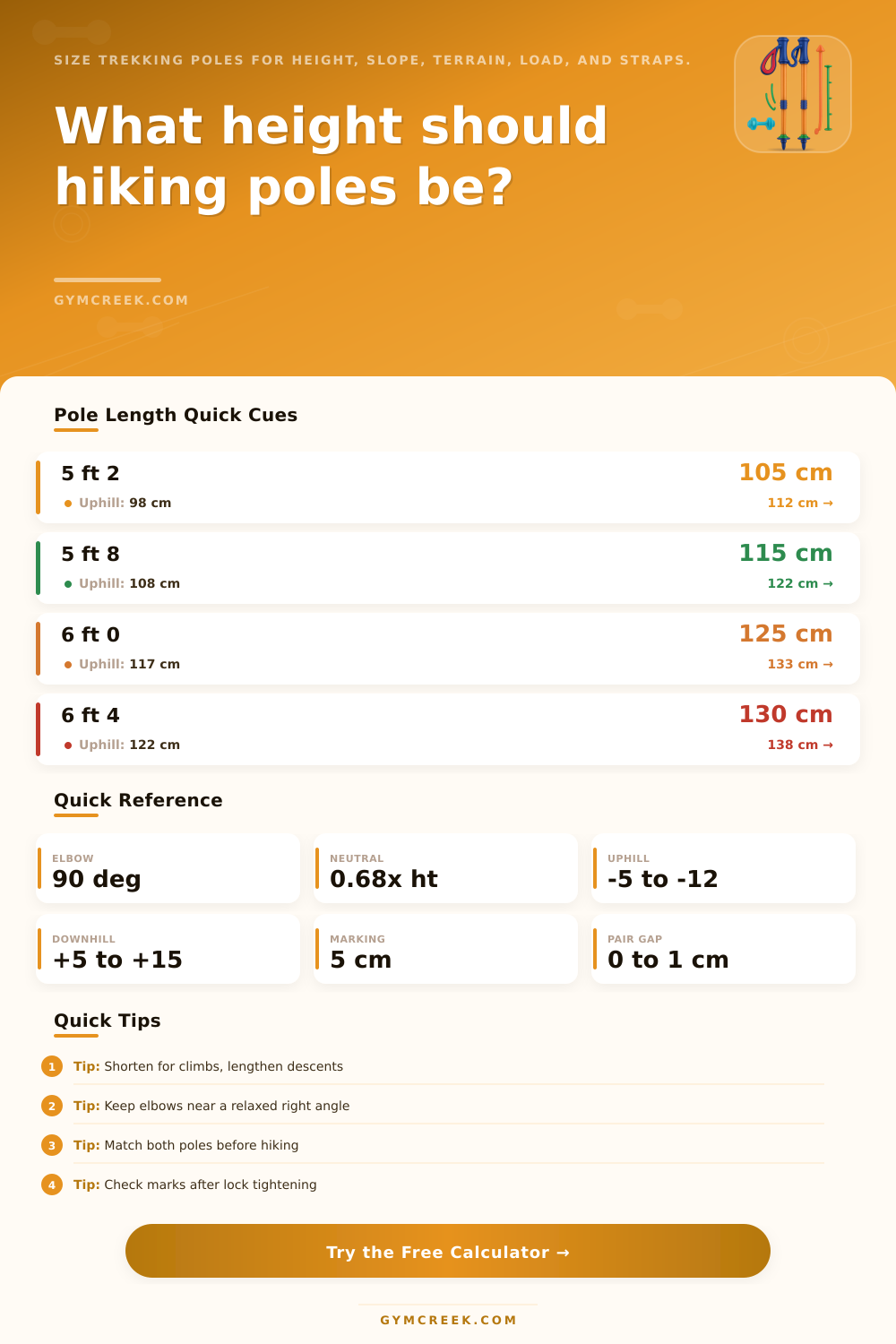
| Hiker height | Neutral pole | Best use |
|---|---|---|
| Under 5 ft 1 in / 155 cm | 100 cm | Compact fixed or adjustable poles |
| 5 ft 1 in-5 ft 7 in / 155-170 cm | 105-115 cm | Most day hikes and light packs |
| 5 ft 8 in-6 ft 0 in / 173-183 cm | 115-125 cm | Standard adjustable range |
| Over 6 ft 0 in / 183 cm | 125-135 cm | Longer shafts or tall-size poles |
| Grade | Uphill change | Downhill change |
|---|---|---|
| 0-5% | 0-2 cm shorter | 0-3 cm longer |
| 6-12% | 3-6 cm shorter | 4-8 cm longer |
| 13-22% | 7-10 cm shorter | 9-12 cm longer |
| 23%+ | 10-14 cm shorter | 12-16 cm longer |
| Terrain | Length bias | Fit priority |
|---|---|---|
| Smooth dirt path | Neutral | Comfortable elbow angle |
| Rocky uneven trail | 1-2 cm shorter | Quick plants and balance |
| Snow or loose scree | 2-3 cm longer | Basket reach and support |
| Technical boulders | 2-4 cm shorter | Hand clearance and agility |
| Pole style | Useful range | Check before hiking |
|---|---|---|
| Telescoping adjustable | Broadest range | Both clamps seated at same mark |
| Folding fixed length | Small or no range | Size close to neutral length |
| Hybrid folding adjustable | Moderate range | Extension not past safe mark |
| Fixed-length pole | No adjustment | Choose for most common terrain |
💡Fit Tips
Trekking pole length are another important factor to consider by a person who is purchasing trekking poles. The length of trekking poles will impact the way in which the poles provides support for a persons body when trekking on different type of terrain. If a persons trekking poles are of an incorrect length for the terrain that they are traveling on, the person may experience discomfort in there shoulders or wrists.
Therefore, a person must be able to adjust the length of their trekking poles according to the slope of the ground that they are traveling on, the weight of the pack that they are carrying, and the type of terrain that they are trekking on. The height of the person determines the length of trekking poles that should be used as a baseline for a persons trekking poles. When standing on flat ground, a person should adjust their trekking poles so that their elbows are at a relaxed right angle.
How to set the right length for your trekking poles
For most individuals, the length of the trekking poles should be approximately sixty-eight percent of the height of the individual. This length will help to keep the body and upper limbs of the trekking pole in a stable, comfortable position. However, a person’s trekking poles will have to be adjusted in length based off the slope of the ground that they are traveling on.
When climbing steep slope, a person should use trekking poles of a shorter length so that their trekking poles can drive downward into the step. When walking downhill on steep slopes, a person should use trekking poles of a longer length so as to help to preserve their center of gravity. In addition to adjusting the trekking poles according to the slope of the ground, a person will have to adjust the length of the trekking poles according to the terrain.
On smooth dirt terrain, trekking poles can remain in the neutral position of the persons trekking poles. However, on rocky or rooty terrain, the trekking poles may need to be slightly shorter in length. Shorter trekking poles allow the tip of the pole to plant quick on rocky terrain.
On snow or scree terrain, a person should adjust trekking poles to a longer length so that the basket of the trekking pole will be able to find purchase in the terrain. In either case, the goal is to adjust trekking poles so that the tip of each pole is beneath the center of mass of the trekking pole. The weight of the persons pack will also have an impact upon the length of the trekking poles that they should use.
When a person is carrying a heavy pack, the persons shoulders will sag downward, and the person will experience change in the support that their trekking poles need to provide. If a person is carrying a heavy pack, they may have to adjust the length of their trekking poles by a few centimeters to allow for the trekking poles to have more grip near the individuals center of mass. A person that use firm trekking pole straps will have more strength through their wrists when trekking downhill, allowing trekking poles to be longer.
When using more loose straps or no straps at all, trekking poles will have to be shorter to allow for the trekking poles to have more leverage in trekking downhill. Finally, the style of trekking poles that a person uses will impact the ability of that person to adjust the length of their trekking poles. For example, trekking poles that have telescoping sections will have markings along those poles that allow a person to adjust the poles for length.
For folding trekking poles, there are fewer settings for the trekking poles, so they must be set to the apropriate length for trekking on the terrain that they will encounter. Additionally, each pair of trekking poles should be inspected to ensure they are the same length. If they are not of the same length, the individual may feel a mismatch between the trekking poles after trekking on them for many hours.
The suggested length for trekking poles is merely a starting point. During the first mile of trekking, a person can adjust the length of their trekking poles if their elbows feel like they are above or below a relaxed right angle with their arms. A person should be aware that the length of trekking poles will not be a single length, but rather a range of lengths for different terrain types and slope.
You should of checked the length before you go hiking. Its important to recieve the right size so you dont have problems.