Hiking Pace Calculator
Estimate moving time, stop time, adjusted trail pace, and finish time from distance, elevation, pack weight, terrain, fitness, and Naismith/Tobler-style models.
📌Trail Presets
Presets fill realistic trail combinations. Adjust the inputs for your actual route, pack, weather, and group speed.
⚙Calculator
Trail pace snapshot
Enter route details and calculate the hike estimate.
📊Route Metrics
📑Reference Tables
| Model | Base idea | Climb handling | Best use |
|---|---|---|---|
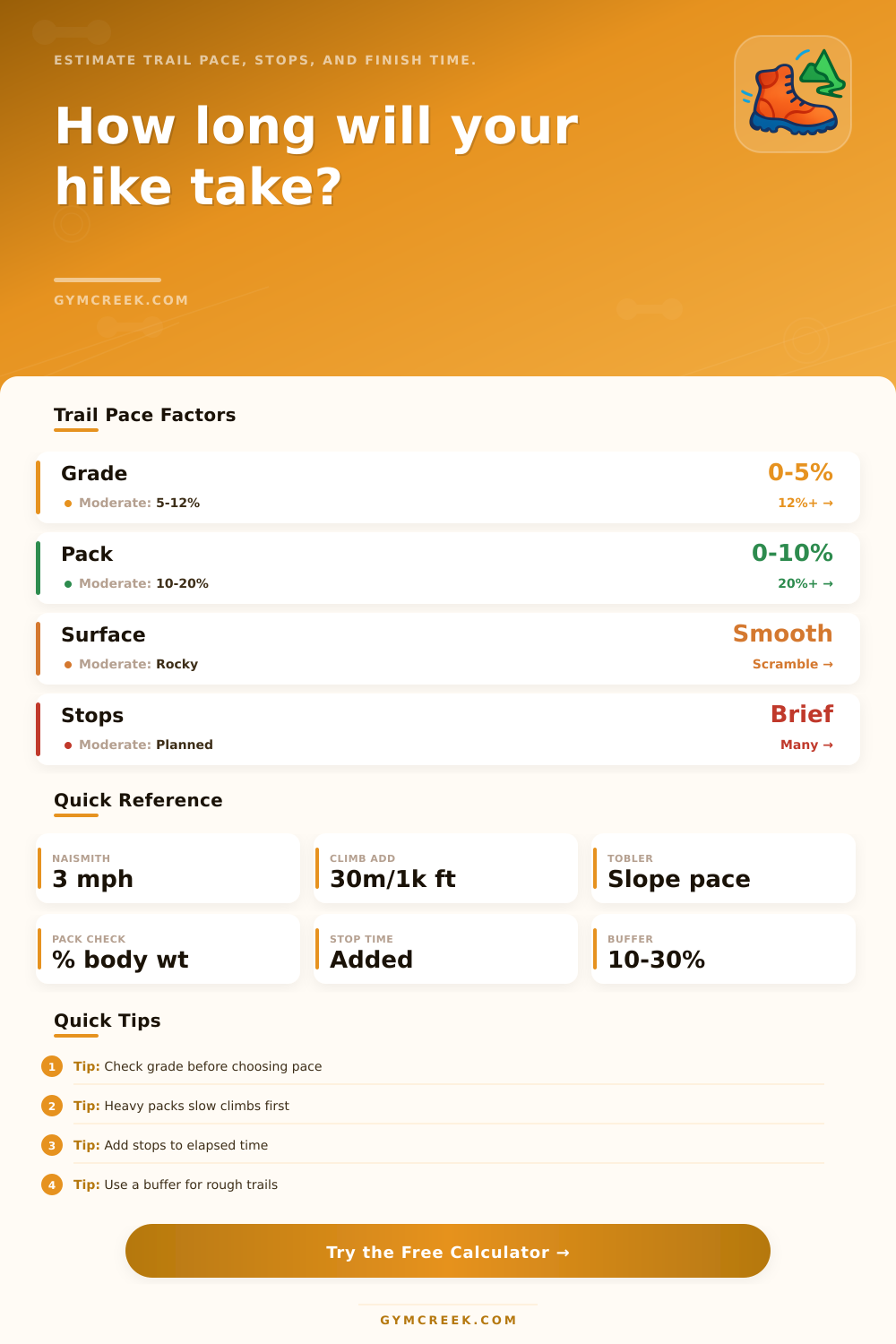
| Naismith | 3 mph flat | 30 min per 1000 ft | Simple planning |
| Tobler-style | Slope speed curve | Grade changes speed | Steep terrain |
| Adjusted blend | Average of models | Terrain and pack factors | Trip estimate |
| Elapsed plan | Moving time plus stops | Stop schedule added | Finish clock |
| Terrain | Factor | Use when | Pace effect |
|---|---|---|---|
| Smooth path | 0.96x | Wide graded trail | Slightly faster |
| Dirt trail | 1.00x | Normal maintained trail | Baseline |
| Rocky roots | 1.08x | Frequent foot placement | Slower |
| Scramble | 1.32x | Hands, talus, snow | Much slower |
| Pack load | Range | Common trip | Planning cue |
|---|---|---|---|
| Light | 0-10% | Short day hike | Small penalty |
| Moderate | 10-18% | Long day hike | Watch climbs |
| Heavy | 18-25% | Overnight pack | Add buffer |
| Very heavy | 25%+ | Expedition load | Plan slower |
| Grade | Meaning | Pace cue | Check |
|---|---|---|---|
| 0-5% | Gentle | Base pace works | Distance led |
| 5-10% | Climbing | Use Naismith add | Gain matters |
| 10-18% | Steep | Use more buffer | Footing matters |
| 18%+ | Very steep | Expect slow travel | Route choice |
💡Tips
A pace estimate is a tool that people can use to plan there hike. A pace estimate will help you to understand how long a hike will take. A pace estimate is a more useful measure of a hike than measuring the distance of the hike.
This is because the distance of the hike dont take into account the elevation or the weight that you will have to carry on the hike. A pace estimate will help you to understand when you will finish your hike. Elevation gain is a factor that many people does not think of when planning a hike, but the gain in elevation will significantly affect the length of your hike.
Plan Your Hike with a Pace Estimate
A thousand feet of elevation gain will take more time then flat miles. The hike up mountains will slow your hikely pace, and the legs will find it difficult to move up those elevations. A pace estimate calculator will take into account the elevation gain and the elevation loss of the hike.
The weight that you are carrying on your hike will also impact your hiking pace. If you are carrying a light daypack, it will have little effect on your hiking pace on even more gentler terrain. However, if you are carrying a heavy pack, your heart rate will increase, and you will need to take more breaks while climbing.
The pace estimate calculator will account for the effect that your pack weight will have on your hiking pace. The terrain that you are hiking on will also have an effect on your hiking pace. Different terrains requires different hiking speeds.
For example, even maintained dirt trails will have a more different hiking pace to mud or talus. The pace estimate calculator will take into account the different terrain on the hike. Finally, your fitness levels and the hiking group will have an impact on the time it will take to complete the hike.
If you are a solo hiker, you will have a better hiking pace than a group of people on the hike. This is simply because a group of people will take more time for certain actions during a hike. The pace estimate calculator allow you to adjust for group dynamics.
By adjusting for group dynamics, the pace estimate will not assume that the group move at the same rate as a single person. Environmental conditions, such as heat and humidity, can also impact an individual’s hiking journey. While the route remains the same when hiking in hot weather or high humidity, the time required to hike the route may increase.
Stops are different from the pace that an individual take when hiking. Stops must be considered in the total time spent on the hiking journey. While short breaks throughout the day may seem minimal when considered individually, the total time spent on breaks can have an impact on the total time spent on the hike.
The pace estimate calculator will separate moving time from stops so that individuals can consider each of these variables in there journey. The reference tables on the page allow individuals to more specifically understand the way that each of the variables impact the hike. Each of the tables include factors like terrain, pack weight, and grade so that individuals does not have to memorize each of the values.
By understanding the factors that impact the estimated time for the hike, individuals will understand the numbers that is presented within the calculator. The hike calculated by the pace estimate tool cannot account for all variables. The pace estimate isnt a guarantee for the individual hiker.
Factors like weather during the hike, navigation errors, and physical feelings during the hike could all impact the time required to complete the hike. However, since the pace estimate includes a range of possible times for the hike, hikers can include a buffer into their schedule to account for the unknown variables. There are a variety of ways to use the pace estimate calculator.
For instance, you can use the calculator to test different starting times for the hike. Additionally, you can use the calculator to adjust for a heavy pack or to compare two different hiking routes. While the goal of the calculator is not to provide precision to the minute, the calculator can help individuals make certain that they will be able to finish their hike without rushing into the low light hours.