HIIT Workout Calculator
Estimate HIIT calories, total work time, work-to-rest ratio, session training load, weekly strain, and recovery need from body weight, interval format, rounds, exercise type, intensity, fitness level, warmup, cooldown, and frequency.
📌HIIT Presets
⚙Calculator Inputs
HIIT workout snapshot
Enter your interval setup to estimate calories, work time, work-to-rest ratio, training load, and recovery need.
📊Metrics Grid
📑MET And Interval Tables
| Exercise type | Base MET | Best fit | Model note |
|---|---|---|---|
| Bodyweight circuit | 8.0 | Squats, push-ups, lunges, mountain climbers | Moderate equipment-free conditioning |
| Burpee intervals | 10.5 | High-effort full-body intervals | Higher strain from repeated floor-to-stand work |
| Bike sprints | 11.0 | Low-impact sprint repeats | Strong calorie output with less landing stress |
| Run sprint repeats | 12.5 | Short hard running intervals | Highest impact option in this model |
| Rowing machine | 9.8 | Power strokes or conditioning rows | Full-body output with controllable pacing |
| Battle ropes | 10.0 | Upper-body conditioning intervals | High local shoulder and grip fatigue |
| Kettlebell swings | 9.5 | Hip-hinge power intervals | Technique quality changes load quickly |
| Jump rope HIIT | 12.0 | Fast singles or double-under blocks | High cadence and lower rest increase burn |
| Format | Work/rest | Density | Typical use |
|---|---|---|---|
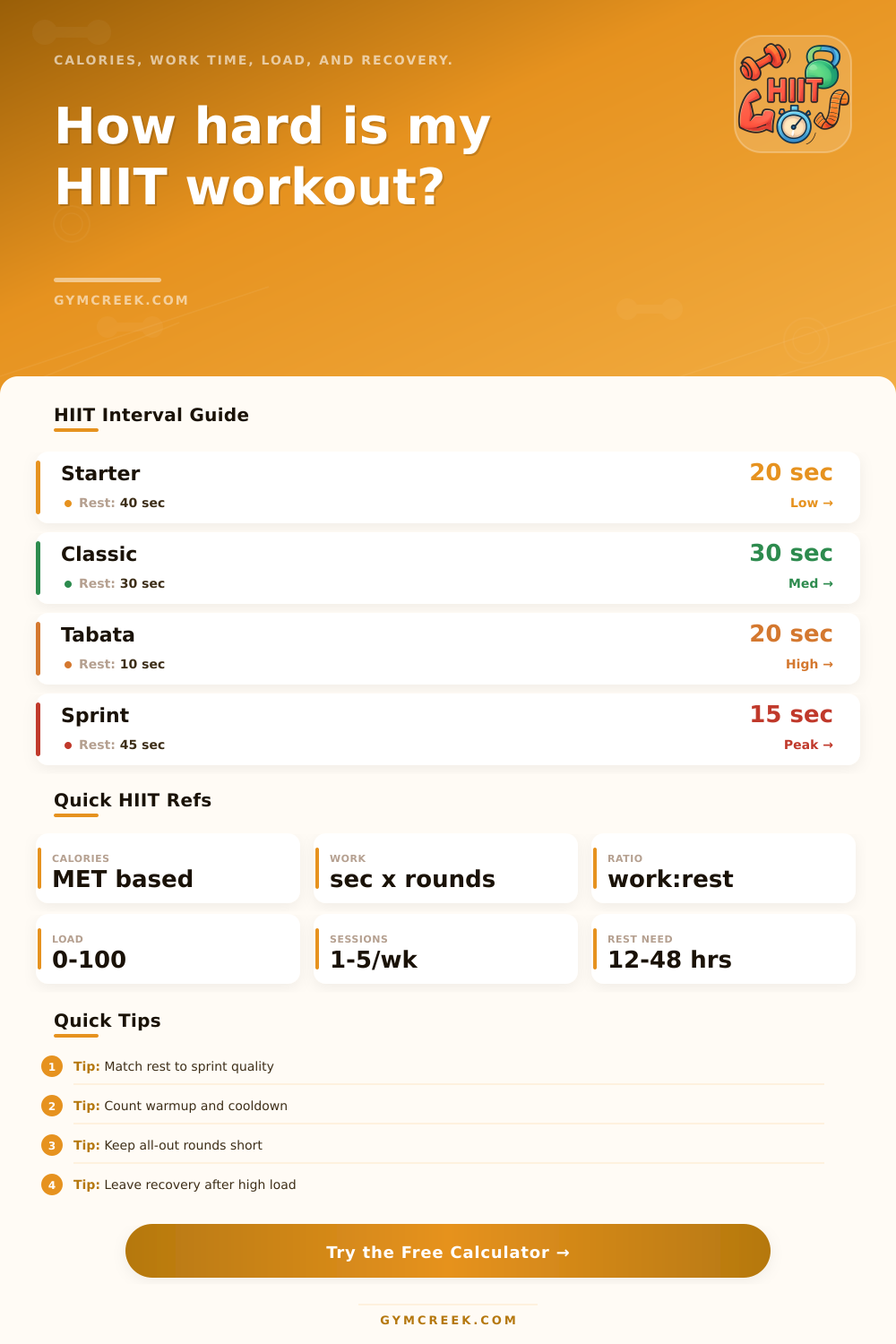
| Beginner intervals | 20 sec / 40 sec | 33% work | Skill practice, return-to-training, or first HIIT block |
| Classic equal intervals | 30 sec / 30 sec | 50% work | Balanced conditioning with repeatable form |
| Tabata style | 20 sec / 10 sec | 67% work | Short, intense blocks when exercise choice is safe |
| Power repeats | 15 sec / 45 sec | 25% work | Sprint quality, speed, and high-output repeats |
| Advanced density | 40 sec / 20 sec | 67% work | Conditioned athletes with controlled technique |
| Load score | Band | Recovery need | Frequency cue |
|---|---|---|---|
| 0-34 | Light HIIT | About 12 to 18 hours | May fit 3 to 5 times weekly if joints feel good |
| 35-59 | Moderate HIIT | About 18 to 30 hours | Often fits 2 to 4 times weekly with easy days between |
| 60-79 | Hard HIIT | About 30 to 42 hours | Usually cap at 2 to 3 times weekly |
| 80-100 | Very high HIIT | About 42 to 60 hours | Use sparingly and protect sleep, soreness, and technique |
| Step | Formula | Output | Why it matters |
|---|---|---|---|
| Work time | Work seconds x rounds / 60 | Minutes | Separates true hard effort from total clock time |
| Work:rest ratio | Work seconds / rest seconds | Ratio | Shows whether the session favors density or sprint quality |
| Calories | MET x 3.5 x kg / 200 x minutes | kcal | Standard exercise energy estimate using body weight |
| Training load | Density, MET, intensity, rounds, and fitness adjustment | 0-100 | Rates session strain relative to a practical HIIT ceiling |
| Recovery need | Load band plus weekly frequency and intensity | Hours | Estimates how much spacing the next HIIT day may need |
💡Tips
High intensity interval training is an form of exercise that involve performing intervals of high-intensity exercise with intervals of rest. Although high intensity interval training can lead to fitness gains in shorter periods of time then steady state cardio exercise, the benefits of high intensity interval training depend upon the way in which the training session are structured. The specific structure of high intensity interval training sessions can provide various benefit to the participant, such as the ability to increase their speed, burn calorie, or even develop soreness and fatigue after the session is complete.
The use of a calculator can be beneficial to those who wish to participate in such interval training, as the calculator can mathematically calculate the required calculation for the interval training session, and allow the individual to view the demands that will be placed upon their body prior to beginning the interval training session. Those interval training session calculator require the individual to provide several different input to the calculator to determine their training requirements. One primary input that the calculator can use is the body weight of the individual that will be performing the interval training session.
How to Use an Interval Training Calculator
The calculator utilizes the body weight as individuals with higher body weights has to expend more energy to perform the interval training sessions, and thus will burn more calorie during those sessions. Another of the inputs that is required is the type of exercise that will be performed during the interval training session. Exercises like burpees and running sprints will have higher requirements for the body than exercises like cycling or rowing.
The individual can also enter the intensity settings that will be utilized during the session into the calculator; higher intensity setting will indicate that the individual will either be performing controlled hard interval training or will be performing high intensity interval training at all out level of effort. Additionally, the individual can enter the fitness level into the calculator; beginners will be able to experience more strain during their training sessions than those seasoned interval training athlete, who will be able to recover more quickly after each round of exercise. The durations of the work interval and the rest periods between those work intervals can also be entered into the calculator.
Sessions that include longer work intervals with shorter rest period will have higher levels of overall stress placed upon the individual performing the intervals. Sessions that include long period of rest between intervals of exercise will allow for protection of the quality of the sprints performed, but will reduce the stress placed upon the body during the interval training session. The ratio of work intervals to rest periods will allow the individual to understand whether the session is designed to allow for the individual to perform repeated bout of power exercise or sustained exercise.
Both warm up and cooldown period can be included in the calculation of the time requirements for the interval training session. Finally, the frequency with which these sessions can be performed each week can be entered into the calculator; performing high intensity interval training sessions every day will create more stress upon the body than performing the intervals every other day, for instance. The calculator will output several different values from the interval training session that is entered into the calculator.
One of the main output is the number of calories that will be burned during that interval training session. The number of calories is calculated based off the work intervals, the rest periods, and the afterburn effect that will occur after the interval training session. The training load score for the session is another of the calculator’s outputs; this score scores the session from 1 to 5 (or light to very high intensity).
This score include factors like the intensity and fitness levels entered into the calculator. The recovery need for that session is another of the calculator’s outputs; this output will show how many hour the individual should rest before performing another session of high intensity interval training. Finally, the calculator will output the weekly load for those sessions; this number is calculated by multiplying the training load score by the frequency with which those sessions are performed each week.
One of the mistake that many individuals make with interval training is attempting to increase the density of their training sessions to the maximum level. While high densities of interval training may enable individuals to perform intense intervals for short periods of time, increased densities will decrease the quality of the movement that the individual can perform. Instead, the individual should select the work to rest ratio for those intervals according to the goal that the individual has for that training session.
If the goal is to incorporate sprints into the training session, longer periods of rest should be allowed between those sprints. If, however, the goal is to condition the body, shorter ratio of work to rest can be performed. The calculator allows individuals to understand the load that will result from these different work to rest ratios, preventing individuals from overexerting themself.
Another group of individuals who may fail to use the calculator to its full advantage are those who neglect to include warm up and cooldown periods in their training sessions. Skipping the warm up may result in injury to the individual, and skipping the cooldown will leave the body in a stressed state after the exercise session. Therefore, it is beneficial to include the warm up and cooldown period in the total time calculations for those sessions.
Additionally, another way in which the calculator can be utilized is as a planning tool. For instance, by altering only one variable within the parameter of the interval training session, individuals can view the impact that such alteration will have upon other variables within the session. By altering the rest periods, for example, the load score that is output by the calculator will change; reducing the rest periods will increase the load score for the individual.
Other variable that can be altered include the type of exercise that is to be performed, and the frequency with which the sessions are to be performed each week. Overall, the calculator enables individuals to understand which types of interval training sessions will lead to high load score. Additionally, it can inform the individual of the length of time that they will need to rest before performing another interval training session.
These benefits of the calculator make it possible for individuals to adjust their training program to include periods of high load and low load exercise sessions, ensuring that individuals can train hard without injuring themself or becoming to tired to be effective in their training endeavours.