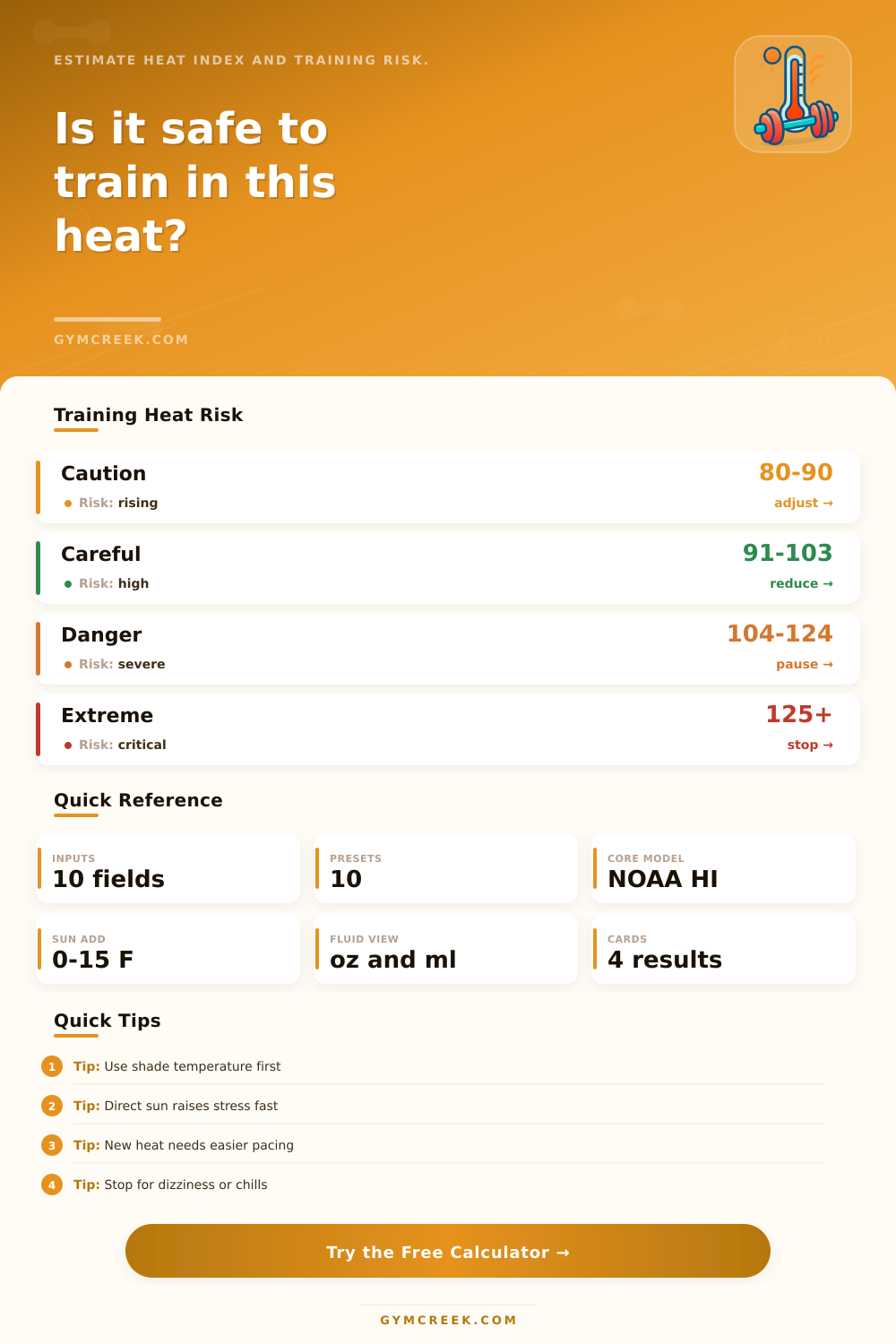
Heat Index Training Calculator
Estimate the NOAA heat index, then translate the weather into a training stress score using sun exposure, intensity, duration, hydration, acclimation, clothing, and air movement.
📌Heat Training Presets
Presets load distinct training environments so you can compare how the same heat index changes when sun, effort, hydration, acclimation, and clothing change.
⚙Calculator Inputs
Heat training snapshot
Enter weather, effort, and athlete context to estimate training heat risk.
📊Heat Metrics Grid
📑Reference Tables
| Category | Heat index | Main concern | Training implication |
|---|---|---|---|
| Lower heat concern | Under 80°F / 27°C | Heat stress usually manageable | Normal plan if athlete status is good |
| Caution | 80 to 90°F / 27 to 32°C | Fatigue can rise with long exposure | Watch pace drift and fluid access |
| Extreme caution | 91 to 103°F / 33 to 39°C | Heat cramps or exhaustion possible | Reduce intensity or extend breaks |
| Danger | 104 to 124°F / 40 to 51°C | Heat illness risk is serious | Shorten, move, or replace the session |
| Extreme danger | 125°F+ / 52°C+ | Heat stroke risk can escalate quickly | Do not run hard training outdoors |
| Factor | Low adjustment | High adjustment | Why it changes risk |
|---|---|---|---|
| Sun exposure | Shade +0°F | Turf or track +15°F | Radiant heat warms skin and equipment beyond shade readings |
| Intensity | Easy +0°F | Max effort +18°F | Higher effort creates more internal heat per minute |
| Duration | Under 30 minutes +0°F | 120+ minutes +9°F | Long exposure adds dehydration and thermal strain |
| Acclimation | Full heat block -6°F | New to heat +8°F | Adapted athletes sweat earlier and tolerate heat better |
| Clothing and gear | Light kit +0°F | Pads or pack +12°F | Insulation slows evaporative and convective cooling |
| Adjusted stress | Risk band | Starting work-rest | Session choice |
|---|---|---|---|
| Under 85°F | Low | Continuous with normal breaks | Keep plan, monitor thirst and pace |
| 85 to 94°F | Moderate | 30:5 or easy continuous | Reduce hard surges if humidity is high |
| 95 to 103°F | High | 20:10 | Shorten quality work and move to shade |
| 104 to 114°F | Very high | 10:10 | Skills, walk breaks, or indoor alternative |
| 115°F+ | Stop level | No hard outdoor intervals | Postpone, cool indoors, or choose recovery work |
| Duration | Cooler heat | Hot humid heat | Practical check |
|---|---|---|---|
| Under 30 minutes | Drink to thirst | 6 to 12 oz / 180 to 350 ml | Start hydrated, especially before morning sessions |
| 30 to 60 minutes | 12 to 20 oz / 350 to 600 ml | 18 to 30 oz / 530 to 890 ml | Carry fluid if no fountain is reliable |
| 60 to 90 minutes | 20 to 32 oz / 600 to 950 ml | 30 to 48 oz / 890 to 1420 ml | Weigh-in data gives the best personal target |
| 90+ minutes | 32+ oz / 950+ ml | 48+ oz / 1420+ ml | Add electrolyte strategy with qualified guidance |
| Any duration | Stop if symptoms appear | Do not force excess water | Confusion, chills, or collapse are urgent signs |
💡Heat Training Notes
Going beyond the air temperature, there are many other factor relate to heat that can affect your performance in the gym or on the field. Factors like humidity, sun exposure, and more can all significently impact the way that your bodies reacts to the heat. For instance, humidity can play a significant role in how easy your body can cool itself.
Sun exposure can also significantly impact the stress that your body feels. Each of these factor, along with others related to training, can be accounted for in a heat index training calculator to provide you with a better understanding of the stress that will be placed upon your body during your training sessions. There are three main outputs from a heat index training calculator.
How Heat and Weather Affect Your Workout
The first will be the adjusted stress value for your workout. The adjusted stress value will help you to understand how intense the workout will feel in comparison than the weather reading. The second output will be the work-to-rest ratio for your workout.
This indicates how long you should rest between periods of work out. Finally, the fluid target will let you know how much fluid you should drink during your workout in order to maintain proper hydration. These outputs will not replace your own judgment regarding your training plan, but they can help to eliminate guesswork when the weather are uncertain.
Heat acclimation is another factor that will play a significant role in your bodys reaction to heat. Individuals who has trained in hot temperatures for as little as two weeks will find that their bodies can handle heat better than those who have not trained in heat recently. With heat acclimation, the body begin to sweat earlier, the plasma volume within the body increase, and the heart rate begins to decrease.
Both heat index training calculators takes these factors into account to provide you with a more accurate calculation of the stress that your body will take during your training session. Clothing is another factor that can impact your bodys ability to regulate it’s temperature. Wearing heavy clothing will trap more heat against your body.
The length of your training session will obviously have a major impact upon the stress that your body will take during that session. Twenty minutes of training will take less stress upon your body than ninety minutes of training. The heat index training calculators take this into account by calculating a duration penalty.
As the stress upon your body increases within the calculations, the work-to-rest ratio will become more restrictively. You should use this calculator before beginning your training, not while you are performing your workout. By inputting the weather, your intensity, your hydration levels, and your clothing into this calculator, you can create a plan for your training that accounts for the risks of too much heat upon your body.
Air movement is another environmental factor that will significently impact your bodys ability to cool itself. Air movement will allow your body to better cool itself through the process of evaporation. However, if your body is not experiencing air movement, like within the gym or the stadium, your body will be able to cool itself less.
Heat index training calculators include air movement in their calculations for you to understand the impact of this factor upon your workout. If you are performing your workout in a gym with no air movement, the stress upon your body will be greater than if you were performing your workout outdoors in the open air with air movement. Using this calculator will help you to make intelligent decisions about your training plan.