Heart Rate Reserve Calculator
Calculate heart rate reserve, Karvonen target heart rate zones, estimated max heart rate, aerobic training ranges, and session intensity from your resting pulse and training goal.
📌Presets
Each preset loads a realistic age, body size, resting pulse, max heart rate method, recovery pulse, and training goal so the HRR output changes in practical ways.
⚙Calculator
Heart rate reserve snapshot
Enter your resting pulse, age, and training goal to calculate Karvonen heart rate zones.
📊Fitness Metrics Comparison
📑Reference Tables
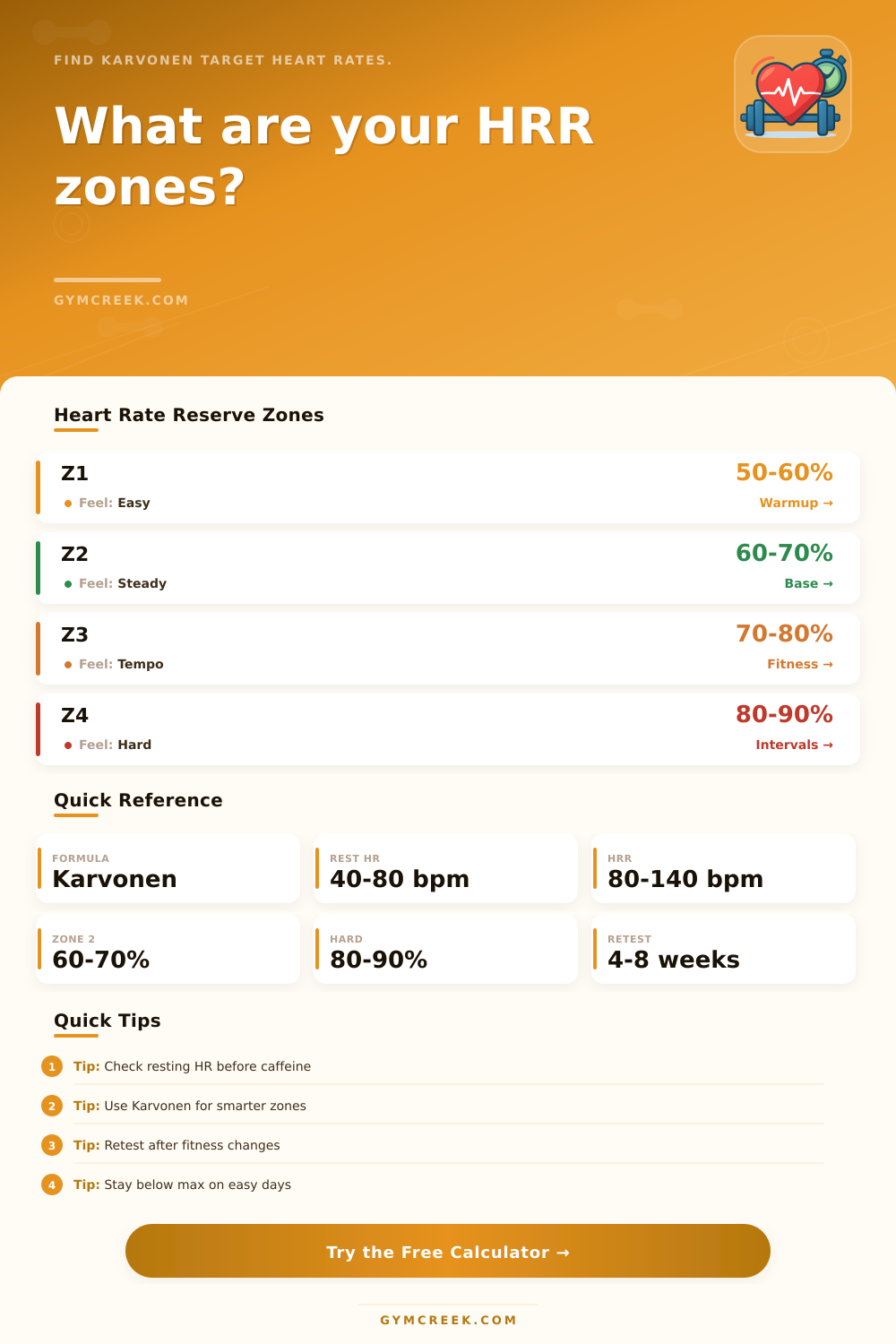
| Zone | HRR range | Training feel | Common use |
|---|---|---|---|
| Zone 1 | 50 to 60% | Very easy | Warm-up, recovery, cooldown |
| Zone 2 | 60 to 70% | Comfortable steady | Aerobic base and longer sessions |
| Zone 3 | 70 to 80% | Moderate to strong | Tempo endurance and fitness |
| Zone 4 | 80 to 90% | Hard controlled | Threshold intervals and race work |
| Zone 5 | 90 to 100% | Very hard | Short anaerobic repeats |
| Method | Formula | Best use | Notes |
|---|---|---|---|
| Tanaka | 208 - 0.7 x age | General adults | Balanced default estimate |
| Classic | 220 - age | Quick comparison | Simple but often less individual |
| Gellish | 207 - 0.7 x age | Adult fitness | Close to Tanaka |
| Nes | 211 - 0.64 x age | Broad adult estimate | Slightly higher for many adults |
| Known max | Tested max HR | Experienced athletes | Use only from a safe valid test |
| Resting HR | Typical label | Fitness signal | Calculator impact |
|---|---|---|---|
| Under 50 bpm | Very low | Often endurance trained | Larger HRR if max is normal |
| 50 to 59 bpm | Low | Common in fit adults | Broad aerobic zone spread |
| 60 to 79 bpm | Average | Typical adult range | Moderate HRR range |
| 80 to 99 bpm | Elevated | Check sleep, stress, heat | Raises all Karvonen targets |
| 100 plus bpm | High | Needs caution if persistent | May narrow training margin |
| Scenario | HRR focus | Session style | Useful check |
|---|---|---|---|
| New cardio habit | 50 to 65% | Walk or easy bike | Can talk in sentences |
| Aerobic base | 60 to 70% | Long steady work | Breathing stays controlled |
| Tempo fitness | 70 to 80% | Continuous moderate hard | Talk in short phrases |
| Threshold intervals | 80 to 90% | Repeats with recovery | Hard but repeatable |
| HIIT peaks | 90 to 95% | Short hard bursts | Use sparingly and recover |
💡Tips
Heart rate reserve are the difference between resting heart rate and maximum heart rate. Heart rate reserve show the amount of capacity that the heart has for physical work. Many peoples use a formula that calculate the percentage of an individuals maximum heart rate to find training zone.
However, using heart rate reserve to calculate training zones is more accurate because it take into consideration an individual’s resting heart rate. An individual with a lower resting heart rate will have a more higher heart rate reserve. Zone 1 is used for resting and active recovery, while Zone 2 is aerobic base training.
How Heart Rate Reserve Helps You Train
In Zone 2, an individual can hold a conversation. Individuals with a larger heart rate reserve can perform easy exercises in this zone. An individual with a higher resting heart rate will have a higher heart rate in Zone 2.
Recovery heart rate are used to show how quickly an individual’s resting heart rate return to normal after performing strenuous exercise. Thirty or more beat per minute in the first minute after exercise demonstrate that the body has recovered well from the strenuous exercise. A slow drop in resting heart rate after exercise indicate fatigue or the need for an easy day.
An individual can use they recovery heart rate to compare their resting heart rate to their calculated training zones. An individual can use this measurement of heart rate to better understand their body and training data instead of guess as to whether there heart rate measurements are good or average. An individual can use their calculated heart rate zones based off training goal.
For instance, an individual looking to lose fat may train in a wider heart rate band. However, an individual looking to perform threshold intervals will train closer to the top of their calculated heart rate zones. Each training goal will change the target heart rate zone.
For instance, the calculator may take into consideration the length of the training session. Forty-five minutes of threshold training will not use the same heart rate calculation then forty-five minutes of interval training. Body size and activity levels will impact the calculations of an individual’s training zones.
Body size will impact the amount of energy expend during exercise. Activity levels will also play a role in the calculation as individuals who are more active will have higher aerobic base zones. While these factors will not impact the calculation of heart rate zones, they will help to indicate how to use those zones in the creation of a training plan for the week.
A common mistake in calculating training zones will be to use the maximum heart rate calculation based on an individuals age. While formulas such as the Tanaka and Gellish formulas can help to calculate an individual’s maximum heart rate, an individual could also use their tested maximum heart rate to override the calculation provide by these formulas. Using an individual’s tested maximum heart rate will ensure that the training zones calculates to the appropriate effort level.
An individual’s resting heart rate will change depending on their sleep cycle, stress, caffeine intake, and illnesses. An individual should take the resting heart rate at the same time every morning before get out of bed. An individual’s resting heart rate may spike in the morning due to stress, so it is recommended to take the resting heart rate over several days to find the average.
As an individual become fitter, resting heart rate will decrease. An individual’s decreasing resting heart rate will allow for their percentage of heart rate reserve to decrease as well. An individual will be able to perform the same amount of exercise at a lower heart rate.
This lower resting heart rate will allow for an individual to have more headroom when performing strenuous exercise or to allow for better recovery after exercise. Heart rate reserve can be used as a training tool for an individual to make daily training decisions. The calculator will perform the calculations so an individual can focus on there body.
By monitoring the recovery of an individual’s heart rate to normal resting heart rate, an individual can monitor their training zone to ensure that it align with the effort that they are expending during exercise. If the heart rate zones match the physical effort that an individual is expending during exercise, then the training plan is precise. If the individuals heart rate zones do not match their physical effort, then their heart rate reserve indicates either the need for recovery or a retest of their maximum heart rate.
By using an individuals heart rate reserve, an individual can train using their own numbers and measurements as opposed to using a generic training chart.