Heart Rate Recovery Calculator
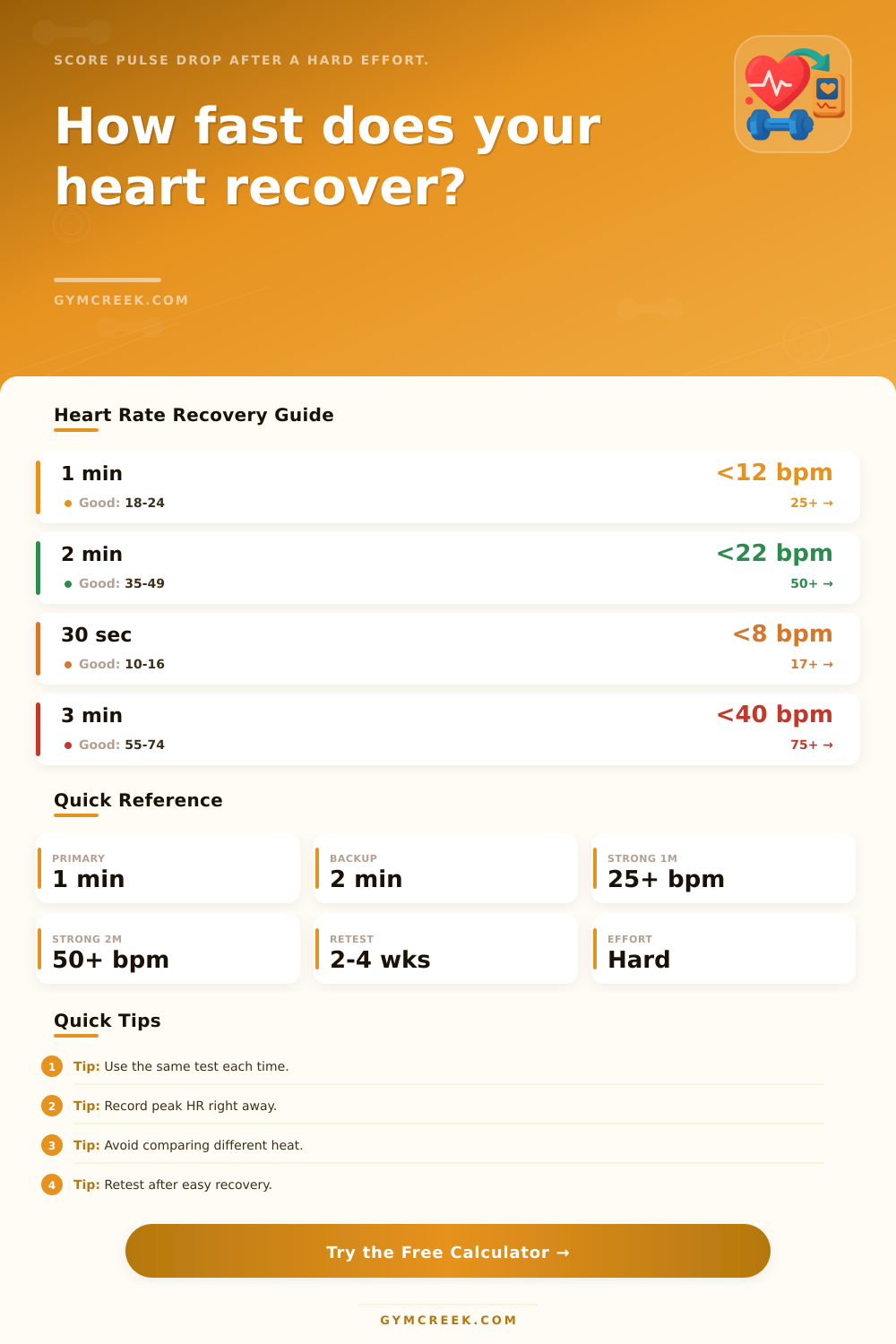
Score how quickly your pulse drops after a hard effort, compare 30-second, 1-minute, 2-minute, and 3-minute recovery markers, and keep repeat tests consistent.
📌Presets
Presets load realistic recovery profiles so you can compare how fitness level, stopping method, heat, and effort change the same heart-rate-recovery score.
⚙Calculator
Heart rate recovery snapshot
Enter peak and recovery pulse readings to score your recovery profile.
📊Recovery Metrics
📑Reference Tables
| Marker | Needs Attention | Typical Fitness | Strong Recovery |
|---|---|---|---|
| 30-second HRR | Under 8 bpm | 10-16 bpm | 17+ bpm |
| 1-minute HRR | Under 12 bpm | 18-24 bpm | 25+ bpm |
| 2-minute HRR | Under 22 bpm | 35-49 bpm | 50+ bpm |
| 3-minute HRR | Under 40 bpm | 55-74 bpm | 75+ bpm |
| Recovery Method | Expected Effect | Use Case | Compare With |
|---|---|---|---|
| Standing still | Strictest field score | Step tests and treadmill checks | Standing tests only |
| Walking cooldown | Slightly slower drop | Run workouts and intervals | Same cooldown pace |
| Seated recovery | Often faster drop | Clinical or gym checks | Seated tests only |
| Lying down | Fastest recovery posture | Controlled recovery check | Same posture only |
| Scenario | Likely Pattern | Watch | Retest |
|---|---|---|---|
| New runner | 1-minute drop improving first | Overreaching signs | Every 2-4 weeks |
| Endurance athlete | Large 2-minute and 3-minute drop | Heat and dehydration | After recovery week |
| Strength athlete | Moderate HRR, strong peak power | Conditioning gap | Every 4 weeks |
| Return from break | High peak and slower drop | Too much intensity | Every 2 weeks |
| Formula | Variables | Output | Purpose |
|---|---|---|---|
| Absolute HRR | Peak HR minus recovery HR | Bpm drop | Main score |
| Percent HRR | Bpm drop divided by peak HR | Percent drop | Size context |
| HR reserve | Max HR minus resting HR | Reserve range | Effort context |
| Tanaka max HR | 208 minus 0.7 times age | Estimated max HR | Fallback max |
| BMI | Weight and height | kg/m² | Body context |
💡Tips
Heart rate recovery is a measurement of how your body handle stress. Heart rate recovery provide information about how your autonomic nervous system is responding to the exertion of your body. If your heart rate drops quick after performing a period of hard exertion, your autonomic nervous system is responding well to the stress.
However, if your heart rate continues to drop slow after the exertion, it can mean that fatigue, heat or exertion harder than realized is to blame. The calculator will calculate the math for you after you enter your number. It will remove the guesswork of determining which heart rate value is the most important to use to describe your autonomic nervous systems response to exertion of your body.
What Is Heart Rate Recovery and How to Test It
Many people focus on the one minute heart rate recovery mark. This is the mark between sympathetic and parasympathetic nervous system response. Twenty beats dropped at one minute is the standard mark for trained athlete.
Trained athletes may see lower drops if the individual experienced poor sleep or exertion in hot weather. Two minutes into recovery is also important to consider. If the trained athlete drops another fifteen or twenty beat, the autonomic nervous system considers this a complete response.
However, if during the second minute, an athlete only drop five or six beats, their first minute heart rate drop may have been an optimistic reading. Your posture will change your heart rate recovery. When standing still, your heart has to work against the force of gravity.
Therefore, standing still will produce the strict score for heart rate recovery. Walking will keep the muscle in your legs pumped and active. This will slow the drop in recovery of heart rate by a few beat.
When you are sitting and resting, or lying down in a 躺 position, gravity will aid your heart in the pumping of blood. Therefore, sitting or lying down will speed up your heart rate recovery. The calculator will account for your posture.
Your posture should remain the same during your test for heart rate recovery. Age and fitness level will change the baseline of heart rate recovery. Younger athletes often experience a greater drop in heart rate.
This is because younger athletes has higher maximum rates and lower resting rates. The same is true of athletes of older age groups. The heart rate recovery difference is that older athletes have a smaller heart rate range.
The calculator will account for your age in the calculation of your heart rate recovery. This calculation will not penalize you for having a smaller heart rate range if you are of an older age. The level of effort you exert during your exertion will impact your heart rate recovery score.
The higher your level of exertion during your run or session, the lower your heart rate recovery will be. The score will always be lower after an easy session than after a hard session. The calculator will ask for your rate of perceived exertion to account for this.
Other factor such as heat or stimulants in your system like caffeine will also impact your heart rate recovery. The calculator will account for exertion in hot weather or after stimulants like caffeine. The calculator includes the reference tables for different reasons.
For instance, heart rate recovery calculations while standing will have different reference tables than those who are completing heart rate recovery while cycling. These tables provide a rough estimation of the heart rate recovery value that is normal for an individual. These estimation table will only be helpful if you use the same protocol to complete your tests for heart rate recovery as the one that you use for the table’s references.
Your test type, recovery posture and time of day should be the same for every test that you perform for heart rate recovery. Use heart rate recovery as one data point for your autonomic nervous system. Combine this with other data points regarding how your body feel during exertion, sleep and any change to your power or pace while running in the days after this test for heart rate recovery.
A single low score for heart rate recovery after a night of poor sleep is not a reason to change your training. However, three low score over time may indicate a change in your training. The calculator will assist in your observation of these value and trends without requiring any arithmetic calculation of your own.
The most important habit to develop in measuring your heart rate recovery is to ensure that your test for heart rate recovery are repeatable. To accomplish this, pick one type of test to perform every two to four week. Ensure that you use the same warm-up and exertion for your test of heart rate recovery each time.
Enter the same number into the calculator each time you perform this test. Using the same protocol will make the trend for your heart rate recovery score evident to you. The trend will help you to make decision regarding your training or if you should take a week off from more exertion.
The calculator can make the trend more easier for you to observe in comparison to performing the tests yourself.