Heart Rate Intensity Calculator
Classify a session by percent of max heart rate, heart-rate reserve, RPE, training goal, duration, and signal agreement.
📌Presets
Each preset loads age, max-HR method, resting HR, average HR, RPE, goal, duration, and context so the classifier can compare multiple intensity signals.
⚙Calculator
Heart rate intensity snapshot
Enter session HR, resting HR, RPE, goal, and duration to classify intensity.
📊Intensity Metrics
🎯Class Bands
📑Reference Tables
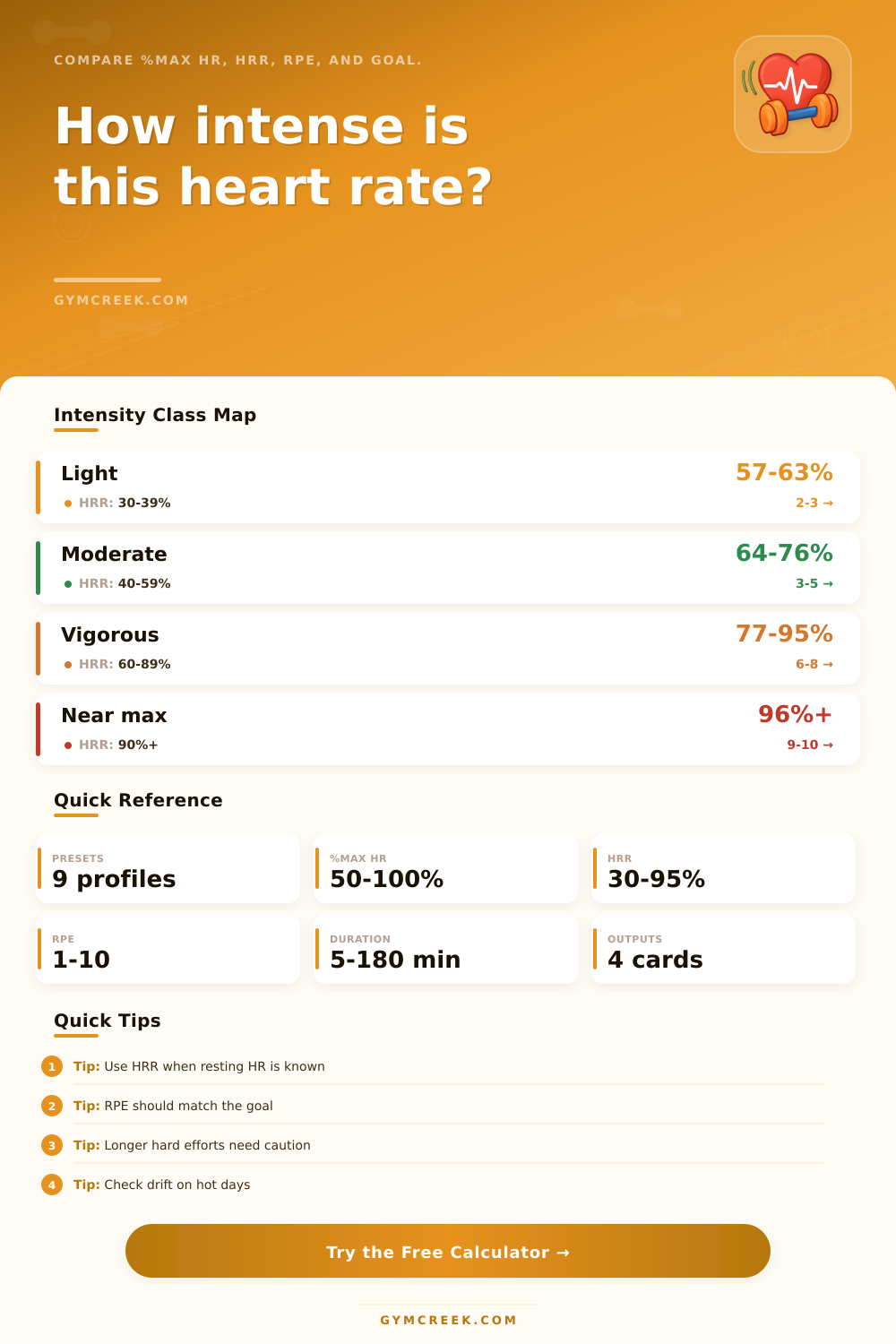
| Class | Percent max HR | HRR percent | RPE cue |
|---|---|---|---|
| Very light | Under 57% | Under 30% | RPE 1 to 2, very easy |
| Light | 57 to 63% | 30 to 39% | RPE 2 to 3, easy |
| Moderate | 64 to 76% | 40 to 59% | RPE 3 to 5, steady |
| Vigorous | 77 to 95% | 60 to 89% | RPE 6 to 8, hard |
| Near maximal | 96% plus | 90% plus | RPE 9 to 10, brief |
| Goal | %Max HR target | HRR target | Usual duration |
|---|---|---|---|
| Recovery | 50 to 60% | 30 to 40% | 10 to 45 min |
| Easy aerobic | 60 to 70% | 40 to 55% | 20 to 90 min |
| Aerobic base | 65 to 78% | 50 to 65% | 30 to 120 min |
| Tempo | 78 to 88% | 65 to 80% | 15 to 60 min |
| HIIT | 85 to 95% | 75 to 90% | 10 to 35 min |
| Input | Formula role | Why it matters | Quality check |
|---|---|---|---|
| Max HR | Session HR / max HR | Shows broad cardiovascular strain | Tested max beats formula max |
| Resting HR | (Session HR - rest) / HRR | Personalizes intensity by reserve | Use morning average |
| RPE | Effort signal from 1 to 10 | Catches heat, fatigue, and medication effects | Rate the whole session |
| Duration | Minutes x intensity score | Converts intensity into load | Include work time only |
| Goal | Target band comparison | Flags mismatch between plan and effort | Pick the main session purpose |
| Pattern | Likely meaning | Calculator flag | Best next check |
|---|---|---|---|
| High HR, low RPE | Heat, caffeine, drift, or bad max HR | Signal gap | Check resting pulse trend |
| Low HR, high RPE | Fatigue, medication, poor sleep, or illness | Signal gap | Use symptoms and recovery |
| Vigorous for easy goal | Session is harder than planned | Goal mismatch | Lower pace or resistance |
| Near max for long time | High strain or bad input data | Duration caution | Review HR source and effort |
| HRR much above %max | Low resting HR changes the reserve view | Method split | Use both bands, then RPE |
💡Tips
Heart rate intensities is the measurement of how hard your heart is working when you are perform physical activity. This measurement can be difficult to use corectly. Many individuals uses a heart rate monitor to assess their heart rate.
However, they do not understand whether this heart rate measurement reflect their training goal. Some individuals feel that every heart rate measurement are accurate. Others completely ignore their heart rate monitors.
Use Heart Rate and How Hard You Feel to Guide Your Training
Both of these choices can lead to an individual missing important informations from their monitor. To use heart rate intensity properly, an individual must understand the three different signal that will show physical effort. The first signal is the percentage of the maximum heart rate.
The second signal is the heart rate reserve, which takes into account the resting heart rate of the individual. The third signal is the rating of perceived exertion, or RPE. This signal measure the effort that an individual feels their body is exerting during exercise on that day.
When all three of these measurements are the same, the measurement system can be trusted to provide accurate information about the effort. However, if the measurements do not agree, there will be a mismatch of effort. There are several reason why there might be a mismatch between these three measurements.
Heat, dehydration, and high caffeine intake can all lead to a high heart rate with low effort. Fatigue and medication can lead to low heart rate with high effort. The differences between these three measurements provides more information about an individual than the heart rate measurement alone provide.
The goals that an individual is training for will also change how the individual should use the heart rate intensity. A moderate heart rate might be used for build an aerobic base for an individual. However, that same heart rate might be used for a recovery session.
Alternatively, that same effort can be used for a tempo workout as opposed to an interval workout. The effort for each goal will not necessarily be the same. If an individual does not match their effort with their training goal, they might find themselves making every training session more harder than they had planned.
If they make every training session too hard, they will prevent recovery and their long-term development of strength and endurance. The length of an individuals workout also matters. An effort that lasts for only a few minute at near-maximal effort is not the same as near-maximal effort that lasts for an hour.
Thus, some classification system will include a caution flag if an individual performs the same level of effort for a long period of time. The calculator will allow an individual to input information about their age, resting heart rate, session heart rate, RPE, training goal, and the length of their session. The calculator will provide an individual with information regarding whether or not their effort measurement system agree.
With this information, an individual can adjust their training. Most individuals will benefit from using this training calculator a few times each week. However, they dont need to use it for every training session.
A few training sessions will allow individuals to develop an awareness of their body that will last for many month. For example, individuals will become more aware of their rising heart rate when they exert themselves for long periods of time with the same pace. An individual might also notice that their RPE value is high after a period of poor sleep.
These observations will allow individuals to adjust their upcoming training session. For instance, if an individual has a high heart rate but low RPE score, this indicate that environmental factors might be affecting their training. If they have a low heart rate and high RPE scores, this might indicate that fatigue or medication is affecting their sessions.
The reference tables that are included with the calculator indicate the relationship between the different classification systems. These tables indicate the number of heart rate value for different levels of work, from very light work to near-maximal work. Additionally, the tables also provide information about the goals that an individual can have for their training and how long they should train for these goals.
These tables are not perfect, but using each table will give an individual a better understanding of their training efforts. Heart rate reserve will indicate the number of beat per minute for individuals with a resting heart rate and will provide a more personalized heart rate effort value than percentage of maximum heart rate. For individuals who have not found their maximum heart rate through testing, the heart rate reserve will still be more accurate than the percentage of maximum heart rate calculation.
Additionally, the RPE value will provide individual with an understanding of whether their heart rate and effort values match. A known value of an individuals maximum heart rate will be helpful in training calculations. These tools will allow individuals to become more aware of their body and develop an understanding of their training efforts.