Heart Rate Calculator
Estimate max heart rate, compare formula methods, calculate resting-HR-adjusted target zones, and choose practical activity targets with clear caution notes.
📌Presets
Each preset fills age, sex, resting heart rate, fitness level, max HR method, activity goal, caution setting, and session duration.
⚙Calculator
Heart rate snapshot
Enter your profile to estimate max heart rate and target training zones.
📊Fitness Metrics
📑Reference Tables
| Zone | Percent range | Effort cue | Common activity goal |
|---|---|---|---|
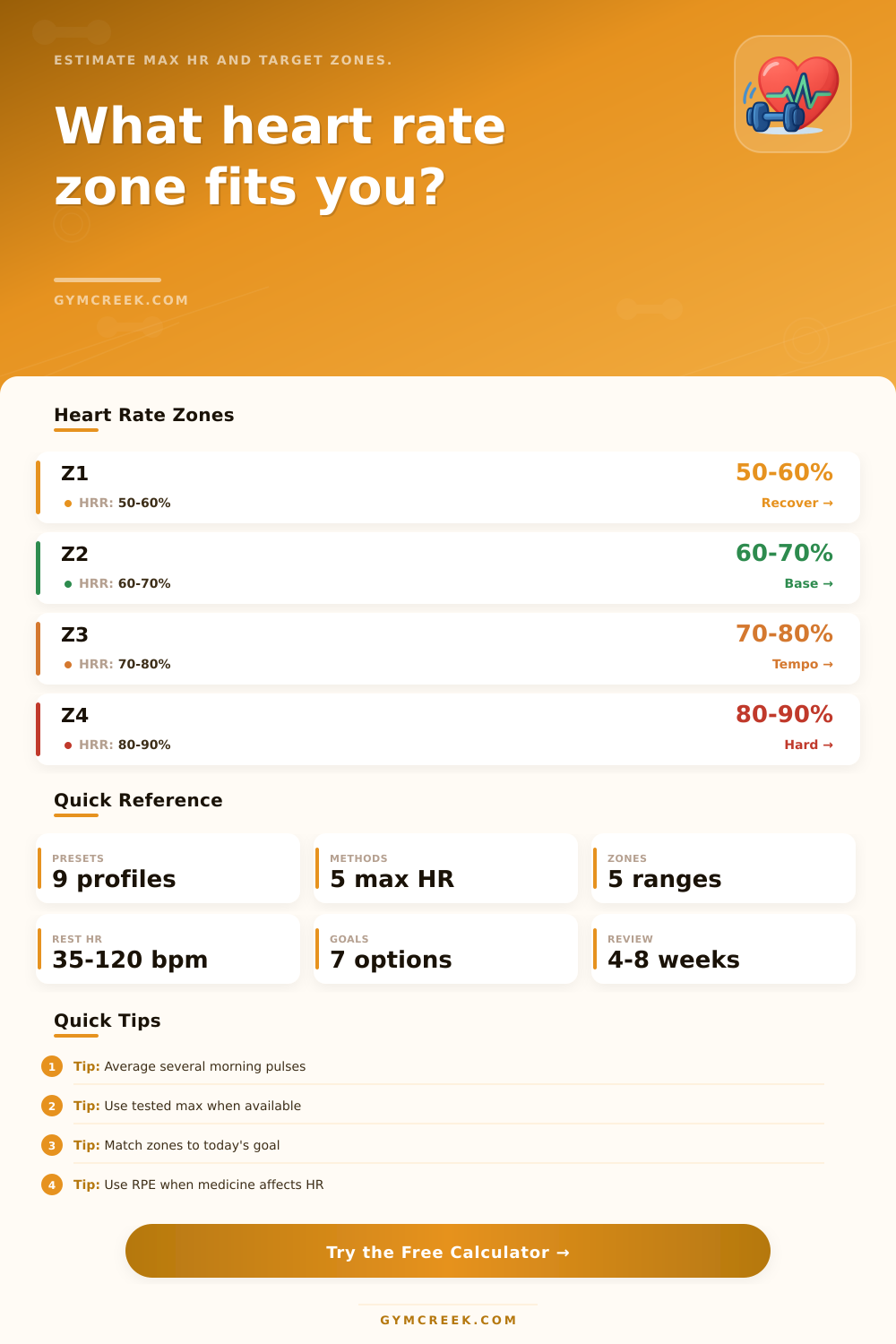
| Zone 1 | 50 to 60% | Very easy, full sentences | Warm-up, cooldown, recovery |
| Zone 2 | 60 to 70% | Comfortable, steady breathing | General health and aerobic base |
| Zone 3 | 70 to 80% | Moderate to strong | Fitness conditioning and tempo work |
| Zone 4 | 80 to 90% | Hard but controlled | Intervals and higher intensity practice |
| Zone 5 | 90 to 100% | Very hard, brief efforts | Short peak efforts only |
| Method | Formula | Best use | Important note |
|---|---|---|---|
| Tanaka | 208 - 0.7 x age | General adult estimate | Balanced default |
| Classic | 220 - age | Quick familiar estimate | Often less individual |
| Gellish | 207 - 0.7 x age | Adult fitness comparison | Close to Tanaka |
| Nes | 211 - 0.64 x age | Broad adult estimate | Slightly higher for many people |
| Known max | Tested max HR | Experienced exercisers | Use a safe valid test only |
| Resting HR | Typical label | Training meaning | Calculator impact |
|---|---|---|---|
| Under 50 bpm | Very low | Often highly trained | Wider HR reserve |
| 50 to 59 bpm | Low | Common in fit adults | Broad target range |
| 60 to 79 bpm | Typical | Common adult range | Moderate reserve |
| 80 to 99 bpm | Elevated | Check stress, heat, sleep | Raises HRR target BPM |
| 100 plus bpm | High | Use caution if persistent | Narrows margin |
| Selector | What it changes | Best effort check | Use this note |
|---|---|---|---|
| No caution | No target adjustment | Heart rate plus RPE | Use normal zones |
| Beta-blocker | Lowers displayed target | RPE and symptoms | Ask clinician for limits |
| Stimulant | Adds caution flag | Resting pulse trend | Avoid chasing high zones |
| Heat or poor sleep | Softens goal intensity | Talk test and hydration | Expect heart rate drift |
| Symptoms | Conservative warning | Stop if concerning | Seek professional guidance |
💡Tips
Heart rate is a way to measure the physical effort you are putting into your workout. Your heart rate will provide information to you that your watch may not provide. When you pay attention to your heart rate, you can better determine the logic of your workouts.
People who work out use heart rate calculators to determine the number of beats per minute that they should have while performing various workouts. Calculators will take your age, your resting heart rate, and other information to calculate the number of beats per minute that you should have during your workouts to improve your fitness. A heart rate calculator will use the information you input into the calculator to determine the number of beats per minute that you should have while exercising.
How to Use a Heart Rate Calculator
One of the inputs for the calculator is your age. As you get farther from 18 years of age, your maximum heart rate will drop. However, not everyone will have the same decline in there resting heart rate as they reach these ages.
A person who has trained there entire life may have a higher maximum resting heart rate than what the calculator calculates. A person who has not exercised in some time may have a lower resting heart rate. To combat this, individuals can enter their tested resting heart rate into the calculator, which will use that measured data for their calculations instead of the estimated data that the calculator could calculate.
Another input for a heart rate calculator is your resting heart rate. Individuals who have a lower resting heart rate have less strain placed upon their cardiovascular system. Furthermore, individuals with a lower resting heart rate will have a higher gap between their resting and maximum heart rate.
This gap in heart rate is known as heart rate reserve. Heart rate reserve is one of the variables use in the Karvonen method for calculating target heart rate. With this information, your heart rate calculator can determine your target heart rate.
A fit individual who can easily exercise compared with a newcomer to exercise may have different heart rate reserve numbers. To ensure that the target heart rate is adjusted for both individuals, your heart rate calculator uses your resting heart rate as one of the variables to determine your target heart rate. Your fitness level and your goals for your fitness level can change the number of beats per minute that you calculate for yourself with a heart rate calculator.
If you enter a fitness level of beginner in your heart rate calculator, the number of beats per minute will be lower for yourself than an individual who calculates their target heart rate as a fit individual. Your goals will also impact the number of beats per minute that your heart rate calculator determines for you. Your goal can range from recovery as a fit individual to fat loss for those who want to lose weight.
By entering your goal into the calculator, the calculator will adjust the number of beats per minute that you should have while exercising according to your goal for your fitness. A target heart rate calculator will help you to determine your goal for your fitness and ensure that you do not change your target heart rate with time. Individual factors can affect your resting and working heart rate.
Medications, stimulants, the amount of heat you are exposed to, and the quality of your sleep will all affect your resting heart rate. A heart rate calculator will apply a conservative offset to these variables to ensure that your calculated heart rate for your workouts will not place you in an unsafe range. The formulas will only provide estimates for your resting and working heart rates.
Your health and how you feel is more important than the numbers that a heart rate calculator calculates. The reference tables will provide information on the five zone map for your resting and working heart rate. There are different formulas for calculating your maximum resting heart rate, such as the Tanaka formula and the 220-minus-age formula.
Resting heart rate will also have an impact on your target working heart rate. While you do not have to memorize these tables, they can provide a way for you to verify the information that your calculator provides for you. Many individuals use a heart rate calculator but treat the number that is calculated as a permanent number for themselves.
Individuals may use the formula to calculate their maximum resting heart rate but never retest that maximum resting heart rate. Other individuals may use a resting heart rate that was taken while they were stressed and resting due to poor sleep. For resting heart rate, individuals should use the average of a few morning measurements of their resting heart rate.
Additionally, their resting heart rate and target heart rate zones should be rechecked every few weeks with their fitness level may have changed. The heart rate calculator will make it easy for individuals to adjust their resting and working heart rate and calculate a new target for themselves. The goal that you enter into the calculator should match the workouts that you are performing.
While the heart rate zones for fat loss and performance intervals may be the same, the feeling that an individual experiences during these two forms of exercise may not be the same. To determine your resting heart rate while performing these types of workouts, use the talk test and rate of perceived exertion. This will help you to determine your resting heart rate without the variables of heat, caffeine, and fatigue affecting your resting heart rate.
If your resting heart rate and the way that you breathe while performing the workouts do not match, you should listen to your breathing. After using the heart rate calculator for a few weeks, you will be able to see patterns in your resting and working heart rate. If you have been performing many aerobic workouts, your resting heart rate will drop.
Additionally, your ability to hold a steady working heart rate will improve with time. These changes to your working and resting heart rate are markers of your fitness and the changes in your body. By regularly using the heart rate calculator, you can determine when you should push your body to exercise more or hold back from exercising as much as possible.