Harris Benedict BMR Calculator
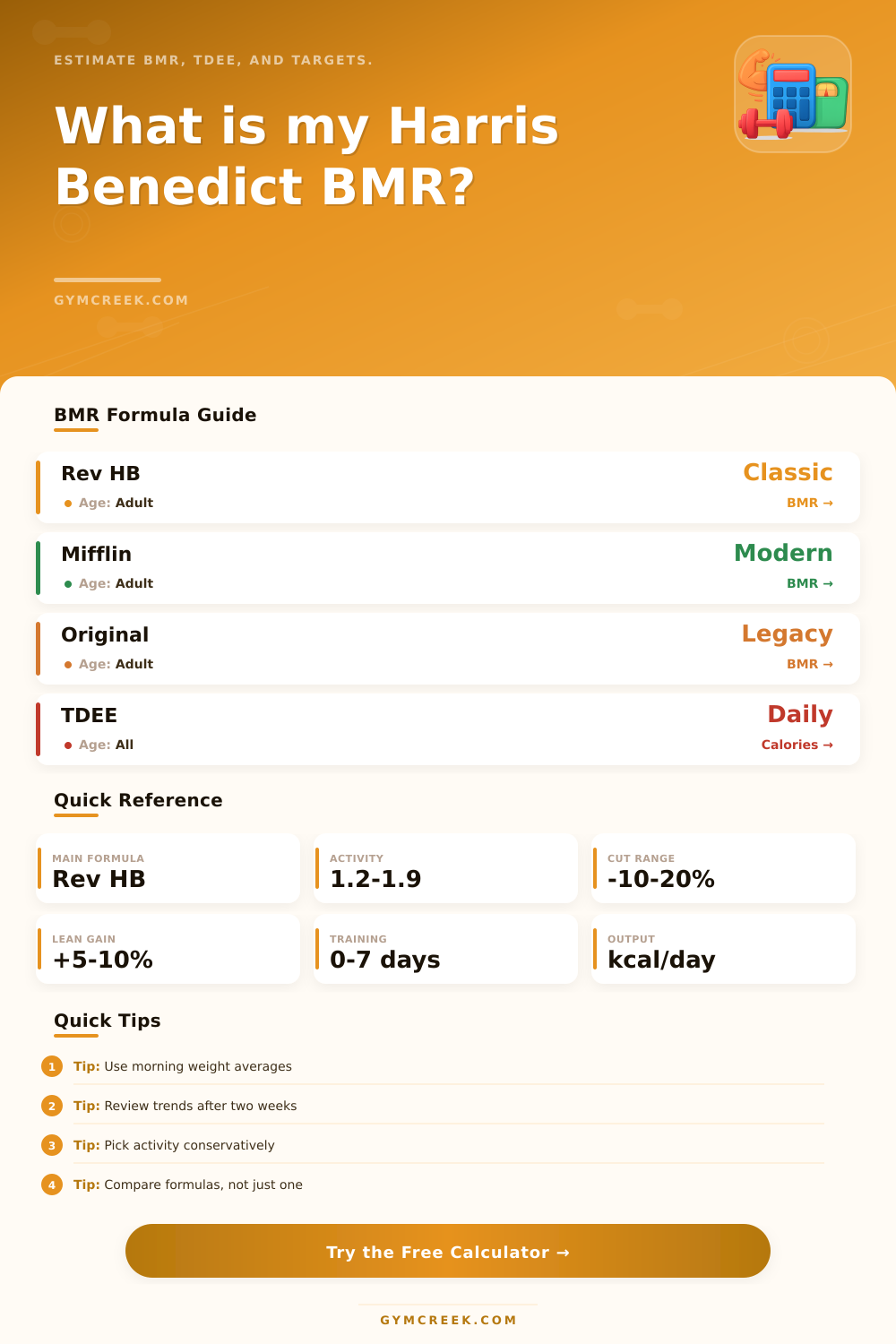
Estimate revised Harris-Benedict BMR, activity-based TDEE, training-day calories, goal targets, and side-by-side formula differences.
📌Presets
Each preset fills sex, age, height, weight, activity, training days, goal, and training calorie spread for a realistic BMR scenario.
⚙Calculator
Harris-Benedict BMR snapshot
Enter your stats to compare BMR, TDEE, and calorie targets.
📊Metrics Grid
📑Reference Tables
| Formula | Male equation | Female equation | Best use |
|---|---|---|---|
| Revised Harris-Benedict | 88.362 + 13.397W + 4.799H - 5.677A | 447.593 + 9.247W + 3.098H - 4.330A | Classic BMR estimate revised with modern coefficients |
| Mifflin-St Jeor | 10W + 6.25H - 5A + 5 | 10W + 6.25H - 5A - 161 | Often used as a modern comparison baseline |
| Original Harris-Benedict | 66.473 + 13.752W + 5.003H - 6.755A | 655.096 + 9.563W + 1.850H - 4.676A | Legacy reference, often slightly higher for some people |
| Activity level | Multiplier | Typical week | Selection cue |
|---|---|---|---|
| Sedentary | 1.20 | Desk work, little exercise | Low steps and no hard training |
| Lightly active | 1.375 | 1-3 training days | Some walking or easy sessions |
| Moderately active | 1.55 | 3-5 training days | Most consistent gym routines |
| Very active | 1.725 | 6-7 training days | Hard training or active job |
| Extra active | 1.90 | Daily hard training | Athlete volume plus physical work |
| Goal | Adjustment | Expected pace | Notes |
|---|---|---|---|
| Aggressive fat loss | -20% | Faster loss | Higher recovery demand |
| Steady fat loss | -15% | Moderate loss | Common starting deficit |
| Recomposition | -5% | Slow change | Useful with strength training |
| Maintenance | 0% | Stable trend | Best for baseline testing |
| Lean muscle gain | +8% | Slow gain | Small surplus for lifting |
| Performance gain | +12% | Fuel focus | Useful for high training blocks |
| Comparison note | What changes | Why it matters | How to use |
|---|---|---|---|
| Revised HB vs Mifflin | Different weight, height, age constants | Same person can see a meaningful BMR gap | Use the spread as an uncertainty range |
| BMR vs TDEE | TDEE multiplies BMR by activity | Daily movement can outweigh formula differences | Pick activity level conservatively |
| Goal target vs TDEE | Deficit or surplus is applied after activity | Targets should be tied to total expenditure | Review body-weight trend in 2 weeks |
| Training split | Calories shift across the week | Training days can be fueled without changing the weekly target | Keep the weekly average consistent |
💡Tips
Understanding how many calories an individual need requires an understanding of the individuals basal metabolic rate. The basal metabolic rate is the number of calories that an individual burn to perform basic bodily function, and this rate is calculated before any movement or exercise are accounted for. The Harris-Benedict equation is one method of calculating the basal metabolic rate, and the revised Harris-Benedict equation is another that produces more accuracy then the original Harris-Benedict equation.
In each of these method, the calculated basal metabolic rate allow an individual to set the number of calories that they will consume. Each of the different equations result in a different calculation of the number of calories that an individual need. These difference in calories can impact the results of an individual nutrition plan.
How to Use a Calorie Calculator
For instance, the revised Harris-Benedict equation utilizes different coefficient than the Mifflin-St Jeor equation or the original Harris-Benedict equation. Each of these methods may produce different result for the same individual of 100 or even 200 calories. Such a difference in calories can lead to an individual gain weight instead of losing weight, or vice versa.
The calculator present each of these different estimate after an individual enters their sex, age, height, and weight. An individual activity level is one factor that can lead to inaccuracy in the estimated calories for an individual. An individual’s activity level is used to change the basal metabolic rate to the total daily energy expenditure for that individual.
The individual chooses an individual’s activity level, but often chooses it to be too high for how active that individual actualy is. For instance, an individual who sit at a desk for the majority of the day, but who trains three times per week, will likely have a total daily energy expenditure that the calculator computes with the medium activity level rather than the very active activity level. The ability to test each activity level with the calculator allow for an individual to choose an appropriate activity level, or to adjust the activity level to ensure that the individual is making progress toward their goal.
An individual’s training days will change the amount of fuel for the body. An individual can change how many calories are consume on training days as compared to non-training days. For instance, rather than consuming a set amount of calories each day for a period of time, an individual can shift the calories for that individual toward their training days.
The ability to change the number of training days allow for an individual to redistribute their calories more appropriate toward training days. Additionally, the calorie calculator also allow for an individual to adjust how many calories they wish to shift from training days to rest days (or vice versa). An individual must choose their goal, which will determine how many calories they eat in comparison to their basal metabolic rate.
For instance, an individual who wishes to lose weight may choose a 20% calorie deficit, but such a deficit can lead to increased demand on the bodys recovery process. A smaller deficit or calorie surplus will lead to slower fat or weight loss, but may allow the body to better feel during training. Each of the goal are presented within the calculator to allow for an individual to choose which goal they wish to pursue in relationship to how they wish to feel during the process.
Body weight after two week will reveal more information about the effectiveness of the calculator than the number of calories alone. If the individual’s body weight change in the direction that they predicted, the calculator’s calculation of the number of calories is accurate. If the body weight does not change in the predicted direction, an individual may make an adjustment to the number of calories via the adjustment field for the goal.
This adjustment based off real data about the body is more beneficial than making guess about the number of calories an individual should of consume. Overall, then, the basal metabolic rate calculator is beneficial in that it turns a feeling into a number, and it allow an individual to test the different setting until they reach their goal.