Harness Size Calculator
Estimate a climbing harness size from waist, hips, upper thigh, rise, bodyweight, layering, and activity style so fit checks start with useful numbers.
📌Presets
Each preset fills a complete harness profile with body measurements, clothing allowance, activity style, and fit preference.
⚙Calculator
Harness fit snapshot
Enter waist, hip, thigh, rise, and clothing allowance to estimate a starting size.
📊Fitness Metrics Grid
📑Reference Tables
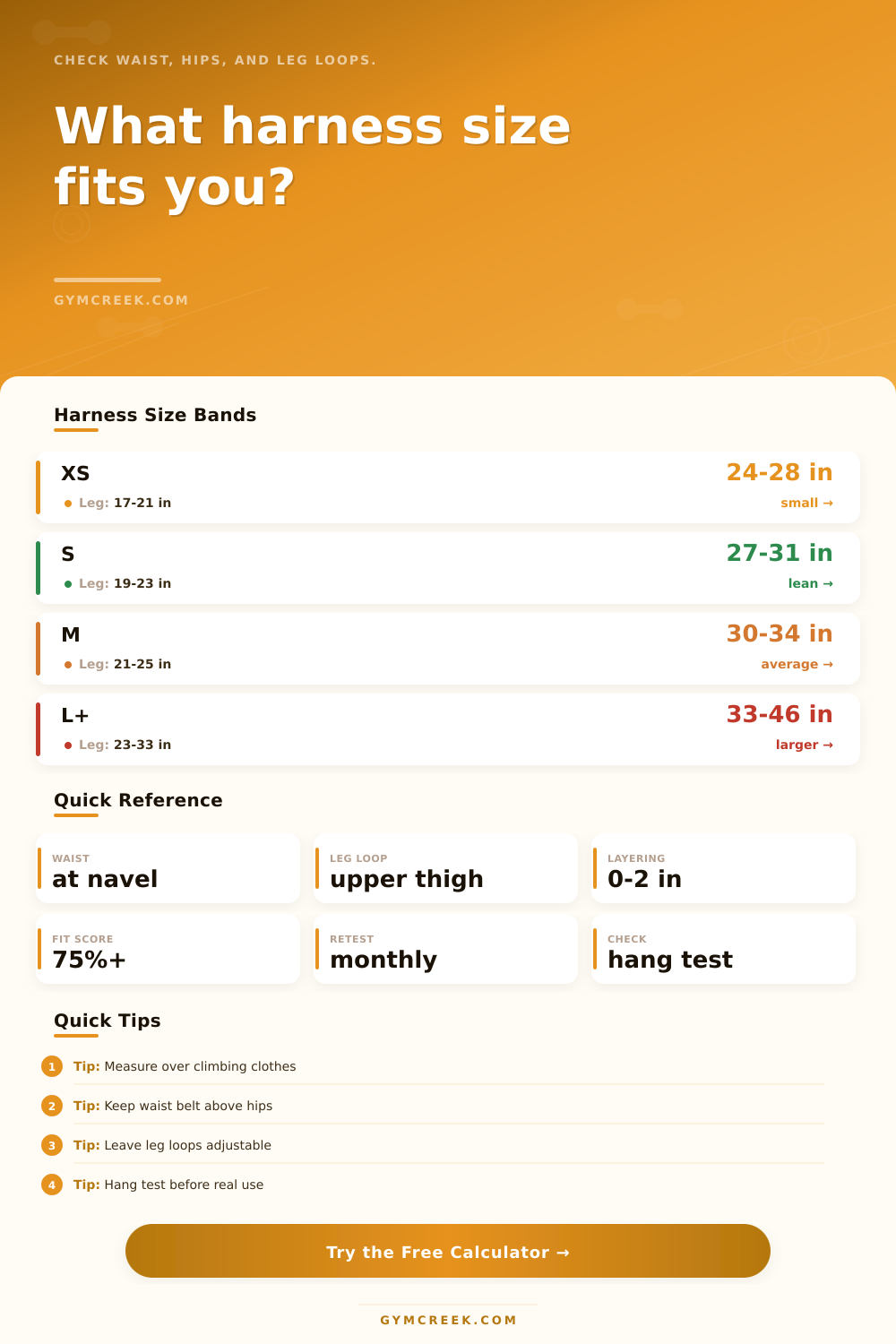
| Harness band | Waist range | Leg loop range | Common fit note |
|---|---|---|---|
| XS | 24-28 in / 61-71 cm | 17-21 in / 43-53 cm | Small adult or youth transition |
| S | 27-31 in / 69-79 cm | 19-23 in / 48-58 cm | Lean adult frames |
| M | 30-34 in / 76-86 cm | 21-25 in / 53-64 cm | Average adult starting point |
| L | 33-37 in / 84-94 cm | 23-27 in / 58-69 cm | Larger waist or thighs |
| XL | 36-42 in / 91-107 cm | 25-30 in / 64-76 cm | Broader adult frames |
| XXL | 40-46 in / 102-117 cm | 28-33 in / 71-84 cm | Extended adjustment range |
| Activity style | Waist ease | Leg ease | Fit priority |
|---|---|---|---|
| Indoor gym | 0.25 in / 0.6 cm | 0.75 in / 1.9 cm | Simple comfort and mobility |
| Sport climbing | 0.35 in / 0.9 cm | 1.00 in / 2.5 cm | Movement without sag |
| Trad or multi-pitch | 0.50 in / 1.3 cm | 1.25 in / 3.2 cm | Gear loops and stance comfort |
| Alpine or ice | 0.85 in / 2.2 cm | 1.75 in / 4.4 cm | Layers and high steps |
| Big wall | 0.75 in / 1.9 cm | 1.50 in / 3.8 cm | Long hanging comfort |
| Competition | 0.10 in / 0.3 cm | 0.50 in / 1.3 cm | Snug and low bulk |
| Measurement | Where to measure | Good check | Common error |
|---|---|---|---|
| Waist belt | At navel, above hip bones | Belt cannot slide down | Measuring jeans waist |
| Hip | Widest point over hip bones | Hip is larger than belt line | Tape angled upward |
| Upper thigh | High thigh under seat | Can squat and high-step | Measuring mid-thigh |
| Rise | Waist line to loop line | Tie-in sits centered | Ignoring torso length |
| Formula | Inputs | Output | Use |
|---|---|---|---|
| Adjusted waist | Waist + layers + activity ease | Belt target | Main size match |
| Adjusted thigh | Thigh + layer factor + leg ease | Loop target | Leg loop match |
| Fit score | Band center and edge room | 0-100% | Compare size bands |
| Hip clearance | Hip - waist | Size context | Belt security check |
💡Tips
It’s tempting to think that correct harness size is just the one corresponding to whatever number tag is on the jean leg. More often than not, this approach are wrong. Technical climbing clothing fits different than denim. And flat measurements is less effective at predicting how things will hang off your body once you have them hung off a wall.
If you’re getting chafed with high steps or the belt won’t stay in place if you lean back, there’s a good chance your harness doesn’t fit correcty. Our harness finder calculator (above) take some of the math out of it for you. It asks about your waist, hip and thigh circumferences, what kind of activity you do, and then suggests a starting point based off that information. Knowing why these numbers matter allow you to keep yourself comfy and safe on the route.
How to Measure for a Climbing Harness
First step, measure at the right place. This is where most folks get it wrong, measuring where their jeans waist line falls. When climbing, the belt of a climbing harness need to be just above your hip bones (typically around the belly button). If you measure below this, the belt will ride up on your hips during a dyno or while hanging by your arms. This will make you feel insecurely.
The tool asks for hip and waist circumference measurements to calculate distance between them, ensuring there’s enough space under the belt to hold it in place. If your hips are much larger than your waist, you’ll want a harness that can spans that distance so it doesn’t pinch.
There are other tradeoffs with leg loops too: Lots of current harnesses feature foam padding on the legs that looks nice but lack any adjustment. It is great if your thighs never change year-to-year, but it is not so great if you pack on a few pounds during winter or want to layer up and wear fat pants when climbing outside.
For this reason, the calculator allows you to select from either adjustable or fixed loops, as well as add an allowance for extra clothes underneath. If you’re going to rock up to the gym in short-shorts all summer, you’ll want zero bulk and a snug fit. Same harness, same shorts, except now you’re headed out on trad routes carrying gear and wearing pants. This is where the activity style settings makes things easier and help you account for those differences in the way you measure yourself.
As you can see, there’s a fit score on the output. That’s not a pass/fail score, but simply a measure of how close you are to the middle of each size band’s adjustable range. If your score is high, then you’re smack dab in the middle and can tighten or loosen the buckle accordingly. If it’s low, you’re towards the limits of the harness’s adjustability range.
If you’re on the far end of a size’s range, you may find that the next size up is more comfortable, though it has a little wider waist belt. Nobody wants their harness to feel like it’s going to fly off, but nobody wants it to cut off their circulation either. It’s a balance between comfort and security.
Remember: just because they fit the size range doesn’t mean you’re getting a good harness. Within a single size range, many different brands will have very distinct differences in how they are cut. And although I’ve included some reference tables to give you an idea of what legs and waists will look like in each harness size, there’s no way around it; everyone’s body shape is unique. Every harness needs to be tried on prior to purchase.
Hang off a solid anchor with nothing more than your weight, sit in a bouldering pad, whatever. See if the leg loops isn’t binding when you high-step. Make sure you can get at the belay loop comfortabley without having to twist into position.
As your body changes, your fit will change with it. If you put on some muscle mass or change your training intensity, reassess your harness once a year or so. What felt nice today may feel like torture tomorrow.
Take the calculator as a starting point to help you narrow down what to try on, but rely on your body to tell you what fits best. A comfy harness is a harness you should of thought about, which means one that keeps you safe. Focus on movement, not the gear, and let your fit enhance the climb instead of distract from it.