Hang Board Load Calculator
Estimate total hanging load, edge stress, grip-adjusted intensity, and the added weight or assistance needed for your target hangboard session.
📌Presets
Presets load common hangboard sessions and recalculate the active load, target range, and finger-stress score.
⚙Calculator
Hangboard load snapshot
Enter a hang setup and calculate your load.
📊Hang Metrics Grid
📑Reference Tables
| Goal | Intensity | Typical Hang | Primary Use |
|---|---|---|---|
| Rebuild | 30-45% | 10-20 sec | Easy tissue prep |
| Warmup | 45-60% | 7-12 sec | Activation |
| Repeaters | 60-75% | 6-10 sec | Work capacity |
| Strength | 75-90% | 7-10 sec | Heavy practice |
| Max hang | 90-105% | 5-10 sec | Peak force |
| Density | 50-70% | 20-45 sec | Longer holds |
| Edge Size | Stress | Common Use | Load Note |
|---|---|---|---|
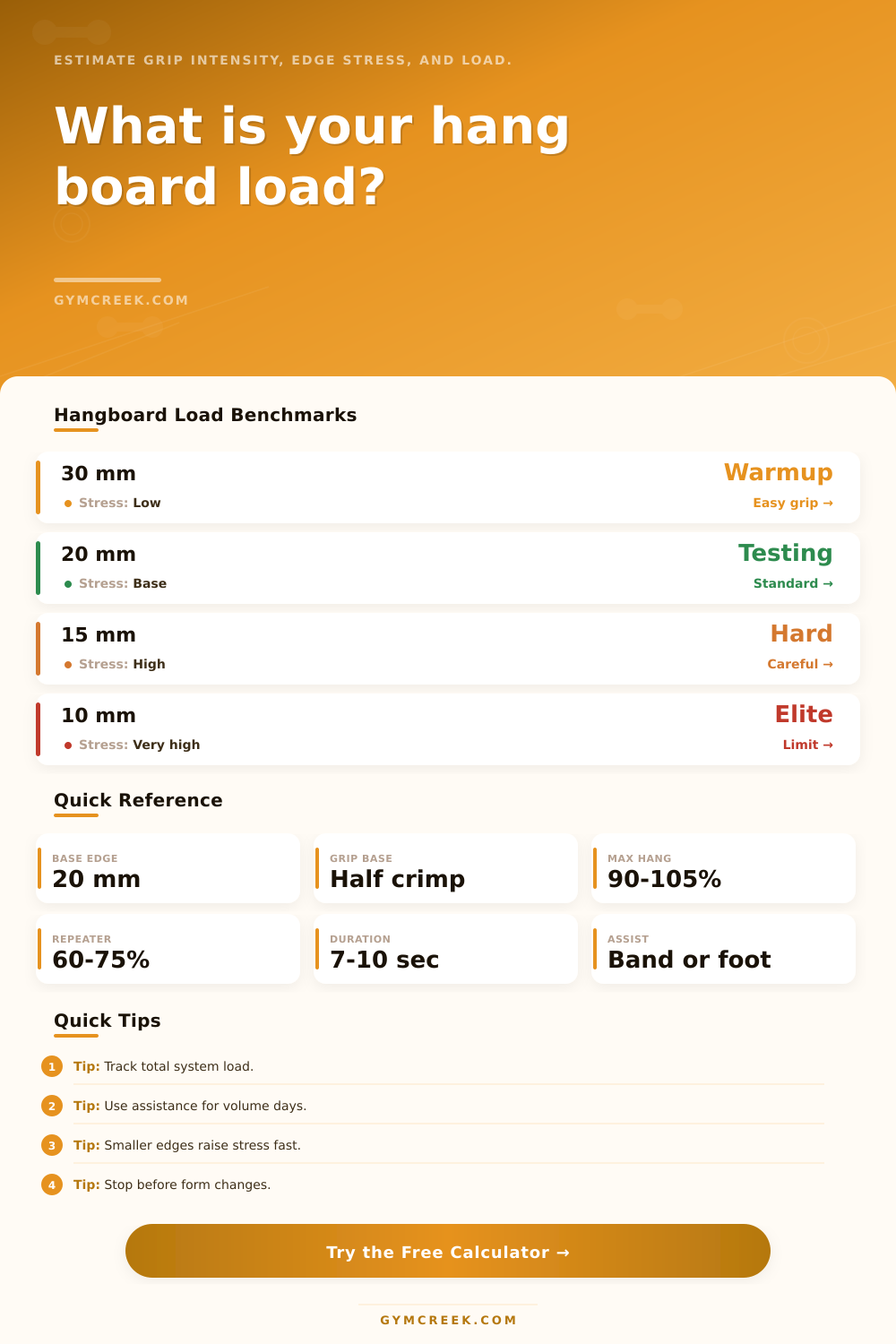
| 30-45 mm | Low | Warmups | Good control |
| 22-29 mm | Moderate | Repeaters | Stable grip |
| 18-21 mm | Base | Testing | Standard edge |
| 14-17 mm | High | Advanced | Reduce load |
| 10-13 mm | Very high | Limit work | Low volume |
| 6-9 mm | Extreme | Specialists | Use caution |
| Grip Type | Factor | Finger Demand | Best Context |
|---|---|---|---|
| Open hand | 0.92 | Lower | Warmups |
| Half crimp | 1.00 | Baseline | Testing |
| Full crimp | 1.18 | High | Rare testing |
| 3-finger drag | 1.08 | Moderate | Pockets prep |
| 2-finger pocket | 1.28 | Very high | Specialized |
| Pinch block | 1.10 | Thumb heavy | Pinch force |
| Formula | Variables | Output | Why It Matters |
|---|---|---|---|
| System load | Body, load, assist | Actual hang load | Tracks intensity |
| Edge stress | Edge, load | Stress score | Compares holds |
| Grip factor | Grip type | Adjusted demand | Flags risk |
| Density | Reps, sets, rest | Fatigue index | Guides volume |
| Target load | Goal, weight | Add or assist | Plans session |
💡Tips
You are hanging on by two fingers, your hands is slipping as you climb a sharp edge, and gravity is pulling down on your forearms with painful force. When most climbers think about using their hangboard they only consider how much pain they can endure. More pain equals better right? Wrong. It is a very dangerous myth that leads to more time off from injuries instead of building more strengthly. Understanding the actual load placed on your tissues makes all the difference between productive training and self-sabotage.
And this load has far less to do with willpower then you might imagine; it’s largely dependent upon geometry. But it’s not just about body weight. It’s also about the system load, which is your body weight plus any added weight, minus the help from counterweights or bands. The calculator does all that math for you freeing you to focus on doing it correctly instead of guessing.
How to Train Fingers Safely and Smartly
By switching to a narrower edge, you reduce surface area of contact. This condenses the same total force into a smaller foot-print, placing greater concentrated stress on your joints and fingertips. While a 20-millimeter edge might be standard for testing, when we drop down to 15 millimeters or less, the physiology change significantly. That transition turn an easy strength move into a risky one that you need to think about carefuly.
The other equally important part of the equation is grip type. When a hand is hanging from a hold with an open hand, there’s more tissue distributing the load and the tendons is held in a relatively safe position. Therefore, an open-hand hang would of been best during a rebuild phase or warm up. Half-crimps are good for when you want a baseline for normal strength work. Two finger pockets and full crimps adds much greater risk factors. Climbers often fail to recognize this difference because they assume that any kind of hang are the same. In reality, an open hand hang at 80% of your bodyweight may put less stress on your flexor tendons then a pocket hang at 50%. Knowing this helps you train smarter instead of simply training harder.
The last two variables is rest interval and session density. Do you need to tear down tissue or develop endurance? Short rest periods and short durations with maximum repetitions create a “metabolic burn,” but it’s just below the threshold of failure. Max hang protocols calls for long recovery times between sets to fully reset both muscles and nervous systems. Randomly mixing the two results in junk volume, either a lot of work done at too low an intensity, or too little recovery after high-intensity bouts. Knowing which goal changes allows you to dial-in every workout perfectly.
If you’re on the edge and want to add 10 pounds, don’t go shorten the edge or cut down your rest period. Everything you do here depends off experience. Somebody new coming in hot off the wall with two fingers in a pocket are asking for trouble. Building up finger strength take years; and it’s got to be done slowly and correctly.
These charts on your tool are a fast way to know what kind of stress you’ll meet by using various grips and edge sizes. Use them as a reality check when planning things out. If they tell you you’re pushing the envelope too much, then back off. Bigger edges or lighter loads aren’t signs of being weak; they’re signs you’re going to last longer. Training your fingertips is a marathon of tiny gains from months to years of climbing practice. How do you protect and how do you strengthen? It’s all measured in inches… and that’s what makes it a marathon. These variables can be tracked objectively and without emotion. It’s data driven training that helps keep you healthy and on the wall longer. The more you train with data, the better your fingers becomes as a tool instead of a liability. Next time you have your fingers hooked in, consider the physics.