Handball Calorie Calculator
Estimate team handball calories from match or practice time, playing position, jump shots, fast breaks, defensive contact, rest ratio, and body weight with MET-based logic.
📌Presets
Presets load realistic handball scenarios and recalculate instantly; adjust minutes or burst counts to match your session.
⚙Calculator
Handball calorie snapshot
Enter body size, minutes, position, breaks, shots, contact, and rest ratio to estimate calories.
📊Fitness Metrics
🧮Formula Cards
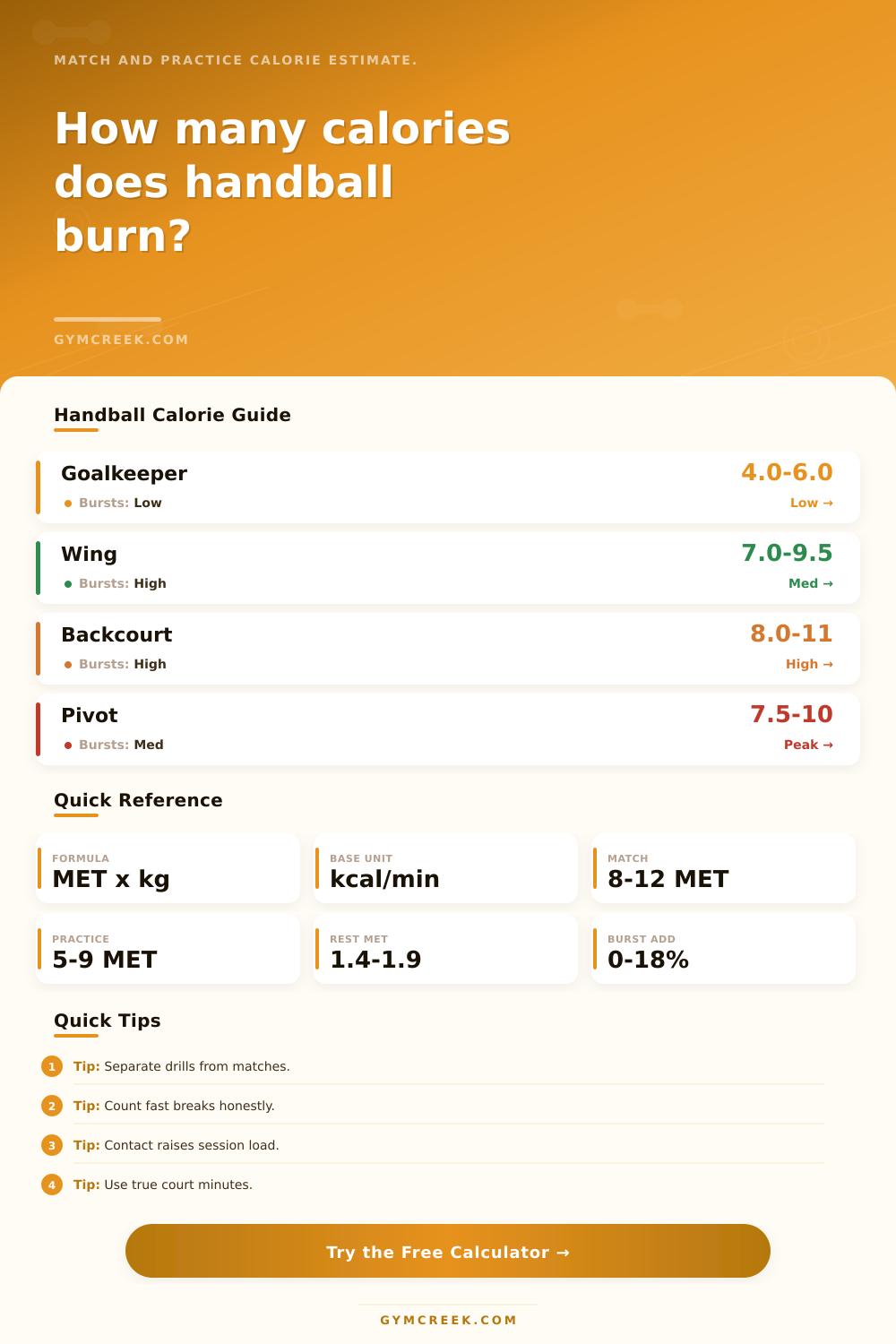
Calories per minute = MET x 3.5 x body weight in kg / 200. Active handball time and lower-intensity rest time are calculated separately.
Recreational games, practice, scrimmage, competitive matches, conditioning drills, and tournament blocks start from different base MET values.
Position demand, jump-shot rate, fast-break rate, defensive contacts, contact level, and court involvement adjust the active MET within a practical range.
Mifflin-St Jeor estimates BMR from age, sex, height, and weight, then the selected activity multiplier gives a TDEE comparison.
📑Reference Tables
| Session Type | Light | Moderate | Hard |
|---|---|---|---|
| Recreational game | 4.8 MET | 6.2 MET | 7.6 MET |
| Technical practice | 4.2 MET | 5.6 MET | 7.0 MET |
| Full-court scrimmage | 5.8 MET | 7.4 MET | 8.8 MET |
| Competitive match | 6.8 MET | 8.4 MET | 10.2 MET |
| Conditioning drills | 6.4 MET | 8.2 MET | 10.8 MET |
| Position | Load Pattern | Modifier | Watch Input |
|---|---|---|---|
| Goalkeeper | Explosive saves | 0.78x | Shot volume |
| Wing | Sprints and angles | 1.05x | Fast breaks |
| Backcourt | Jump shots | 1.10x | Jump shots |
| Center back | Transitions | 1.07x | Involvement |
| Pivot | Contact screens | 1.12x | Contact load |
| Scenario | Duration | Rest Ratio | Typical Load |
|---|---|---|---|
| Skills practice | 60-90 min | 35-55% | Moderate |
| League match | 60-80 min | 25-40% | High |
| Scrimmage night | 75-120 min | 30-45% | Mixed |
| Tournament block | 120-240 min | 35-55% | Fatigue high |
| Formula | Variables | Output | When Used |
|---|---|---|---|
| MET kcal | MET, kg, min | Calories | Main estimate |
| Active split | Duration, rest | Work min | Session rhythm |
| Burst density | Shots, breaks | Modifier | Pace check |
| Mifflin BMR | kg, cm, age | Baseline | Daily context |
💡Tips
It’s halftime. Thirty sweaty minutes left on the clock, and you’re spent, standing on a tacky gym floor, wondering how many calories you’ve just burned. Your legs feel heavy. Your lungs is burning.
But knowing how many calories you realy burned would be important if you’re trying to lose or maintain weight, or better understand what your body can handle. There is difference between feeling tired and using energy. And handball? It’s physical; explosive stop-and-go movement is nothing if not chaotic.
Why a Calculator Helps You Count Calories in Handball
While a simple stopwatch can measure time, it fails to capture the metabolic cost of running down a fast break or diving for a save. What’s required is a model tuned to the ebb and flow of game.
Exercise: Most folks think of physical activity as a flat line of exertion. But in handball? It is not exactly like that. There are big spikes in intensity, such as standing still for three minutes followed by sprinting for six seconds followed by jumping for two second. This creates huge changes in how much energy you actualy use.
An average number cannot account for this if you use one number for all your activities. Enter the calculator, which uses information you input about your workouts to perform the math for you. You don’t need to guess at what happens to overall energy spending when you throw in some short sprints here or there. Dead ball time counts too, but at a lower burn-rate. The calculator accounts for this.
Why’s this important? Because it helps keep you from thinking all 60 minutes on the court are full-on intense.
And “hard” work depends heavily on position: A backcourt shooter’s day is very different than a goalkeeper’s. The latter spends much of their day sitting still, then explodes laterally or dives when the shot happens. The former is on the move, always pivoting and taking jump shots that cost a lot of energy.
In terms of energy, every time you spring upward to block or shoot, there’s a big price tag attached. You can enter the number of fast breaks and jump shots you took as one of the tools’ entries; it adjusts accordingly.
Time spent isn’t everything; what you do with that time matter, too. Adjusting your weight by a pound won’t help as much as counting your fast breaks in earnest.
Another complicating factor is defensive contact. Handball is not a non-contact sport. You’re pushing, screening and grappling, so your muscles is never off-duty as they has to engage to keep your balance. Playing a more contact-heavy line increases your session’s workload. This is compared to light technical drill, where your body has less need to stabilize itself.
As you can see from the reference table on the page, each type of session shifts the baseline metabolic equivalent. For example, a competitive match begin at a higher base than a recreational game; add in a position and contact level modifier and that base adjusts upward again. It paints a picture of what your actual effort is instead of a generic average.
The one thing that throws most people off on rest ratio is that you’re not going to run for the entire sixty or even seventy-five minutes during an actual match. You have dead balls, timeout subs, halftime break subs and substitutions throughout the match. So you should of account for those stops to get it right. So if you go into the entire length of the game thinking that the entire time was spent running you’ll grossly overestimate your burn.
By adjusting your rest percentage based off how much time you spend sitting on the bench, the estimate becomes grounded in reality. In the example above, maybe you were in the building for an hour but only played for 40 minutes. The tool splits the difference here. It figures out what your burn would be while you were actively playing at high intensity and when you were resting at a lower intensity.
What’s also helpful is seeing the session in context (after all), burning five-hundred calories during a game doesn’t sound like much until you realize that your body requires two-thousand calories simply to exist that day.
Your total daily energy use is calculated based on your weight, height, and age; this helps you understand how your handball session stacks up against everything else that goes into running your day. Is it a huge part of your day? It is a little something extra added onto an already active lifestyle. Knowing that will help you figure out whether or not you’re in a deficit and should be eating more to recover, or if this session is just a small addition to an already active lifestyle.
It’s hard to measure how much handball you play, but that’s why it’s so fun and also so difficult to master, it never slows down for even a second or two. It never gets boring; it demands something different from you in an instant.
When you’re counting all those little things going on in a game (the contact), the sprints, the jumps, it goes from “I’m exhausted” to “Here’s exactly how I got here.” Knowing exactly what you did lets you trust the number.
So next time you get on the court, count the jumps, notice how many times you burst off the floor and feel the contacts. Those are tiny parts of the game, but they compound to become the actual cost of playing.