Gymnastics D Score Calculator
Total difficulty value, connection value, and composition requirements for a routine using event-aware presets and editable scoring inputs.
📌Presets
Presets fill difficulty counts, connection counts, and requirement credits, then calculate the D score.
⚙Routine Setup
💪Difficulty Values
The calculator sorts skills by value and counts only the highest allowed elements before adding any manual DV adjustment.
🔗Connection Value
✅Composition Requirements
D score snapshot
Enter difficulty counts, connection values, and composition credits.
📊Routine Grid
📑Reference Tables
| Letter | Value | Role | Routine use |
|---|---|---|---|
| A-B | 0.1-0.2 | Base | Fill early count |
| C-D | 0.3-0.4 | Core | Routine backbone |
| E-F | 0.5-0.6 | High | Score builder |
| G-J | 0.7-1.0 | Elite | Risk element |
| Profile | Count | CR max | Best for |
|---|---|---|---|
| WAG style | 8 | 2.5 | Floor, bars, beam |
| MAG style | 10 | 2.5 | Six apparatus |
| Developmental | 8 | 2.0 | Optional levels |
| Custom | Manual | Manual | Meet rules |
| Connection | Credit | Example use | Watch |
|---|---|---|---|
| Small | 0.1 | Simple link | Directness |
| Medium | 0.2 | Hard series | No pause |
| Large | 0.3 | Elite combo | Rule limit |
| Series | Custom | Dismount rule | Event only |
| Component | Formula | Output | Audit |
|---|---|---|---|
| DV | Top skills | Skill sum | Sort high |
| CV | Links plus cap | Bonus sum | Check cap |
| CR | Requirements | 0 to max | Event list |
| D score | DV + CV + CR | Total | No E score |
💡Tips
That’s no arbitrary wishful thinking; it’s the score you construct, brick by brick, even before your foot hits the mat. The D score, as it applies to moddern gymnastics, is a measure of the difficulty of what you’ve tried, nothing about whether you executed it well or poorly. If there isn’t enough acknowledged complexity in your routine, then your starting point remains unchanged, even though you stuck all your landings perfecty. On the other hand, you may have some sloppy executions on an impressive string of skill and still end up with a high starting value because the judges rewarded you for taking chances. To judge correctly… Or coach your gymnast to do so, you just need to understand the difference.
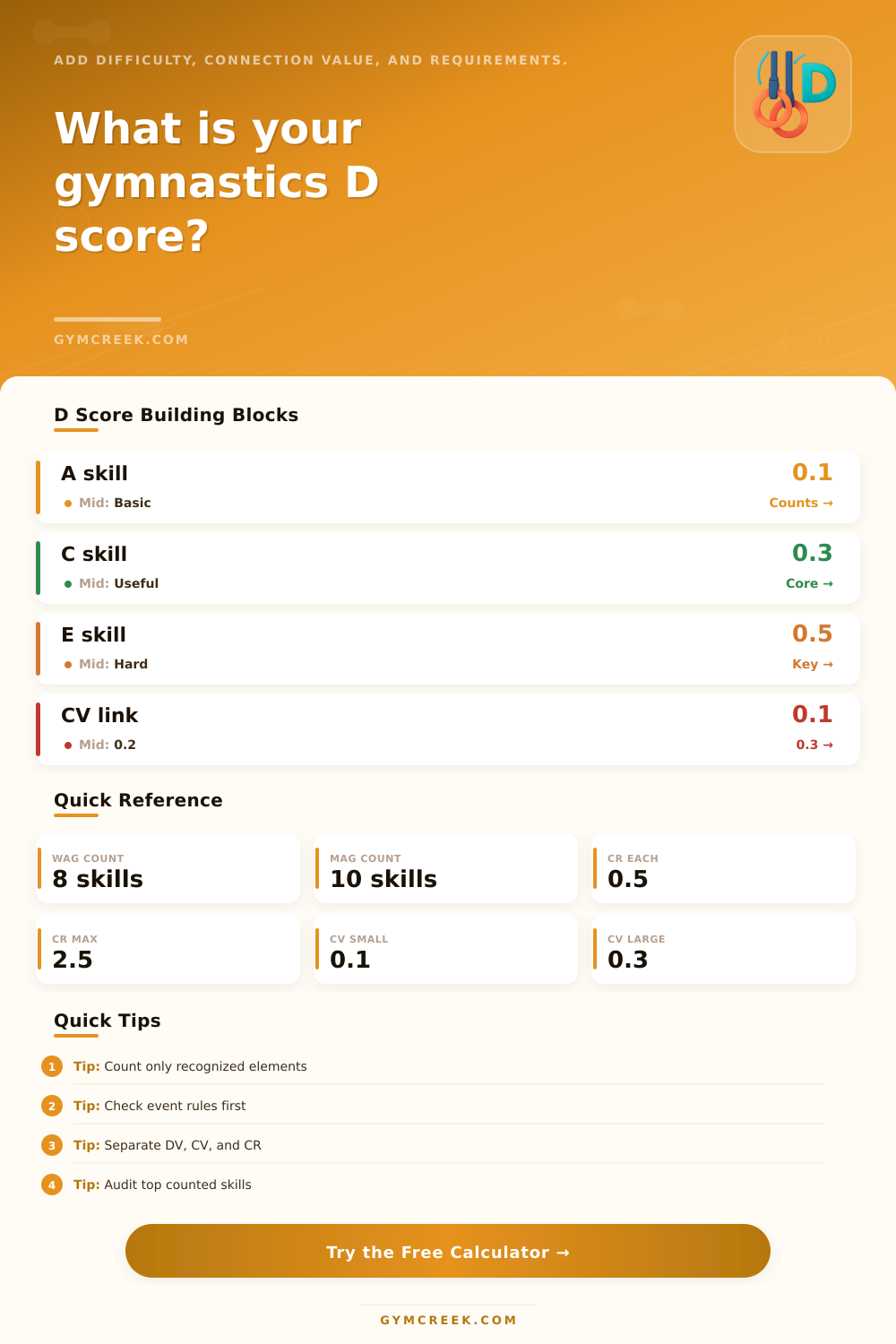
You input your connection values and your skill counts into the calculator above, and it spits out the answer so you don’t get lost in the code book. It goes through all of your A skills (and beyond, if you have any B, C, D, etc., all the way up to rare J-level elements) and figures out which of the most challenging ones truly contribute to your overall score. For beam and floor in Women’s Artistic Gymnastics, typically just the top eight element are counted. On men’s routines, they may need ten counted skills.
How Gymnastics Scores Are Built
That number creates a strategy decision. Should I fill up with a couple hard E skills where there is a chance of an execution deduction? Or should I space out the difficulty on safer D and C connections? The tool allows you to immediately see that tradeoff so you don’t have to pull out a rulebook each time you adjust something.
And then there’s composition requirements. These are little mandatory things… A strength hold on rings, for example, or an acro series on beam, that earn half of a point if performed in their entirety. They don’t seem like much, and maybe you could get away with not doing one, but they eat away at your maximum possible score quicker than any little balance mistake can. In order to use the calculator, you must flag each of these requirements as either complete, partially complete, or missing altogether.
And this is good; it makes you honest when you’re planning. If you see a big fat D value on your computer score sheet, but notice there are three requirement left unchecked, then you know your actual start score will be much lower. This is a tiny bit of administration that’ll save you from some painful surprises in competition.
And finally, there’s connection value, the bonus points added when skills are linked directly together with no intervening steps. That’s what many people misunderstand about the code most of all. Linking two easy B skills may get you a tenth of a point; linking five complicated ones could get you up to three tenths. The code strictly limits how much bonus value you can bank from connections alone, so the calculator sets a limit based off the event rules you choose) on the amount of connection bonus you receive. After hitting that connection bonus cap, any additional linked skills will not add any further D score benefit. Then it becomes purely cosmetic.
Many coaches spend far too much time chasing connection bonuses long after they’ve reached their limit, and waste precious practice time trying to eke out points that will never materialize. It’s all laid out nicely on the page with the reference tables, explaining exactly how each tier of skill contributes to the overall score. A and B don’t often go very far; they take up space and aren’t necessarily going to get you much closer to top of the standings. C and D are the meat of most competitive routines. E skills and above increase your D score (or whatever tier it is) but carry risk of falling on your face, which tanks your E score. You have to know how to balance the books.
An entire routine full of E skills sounds great on paper but may fall apart because of the form break/fall deduction penalty. A slightly different rule set is used for younger developmental levels. These levels require fewer skill and give some credit for things that seniors must do perfectly. This tool automatically compensates for the profile. Changing it over to the developmental set ensures you aren’t expecting more than a young gymnast can provide. It’s a reminder to all that the code evolves as the gymnast does. No point trying elite difficulty at optionals level 6 when the foundations aren’t there.
In short: the D score is a goal, not a report card. It’s a measure of intention. Your ultimate ranking will depend entirely on how well you execute the routine. But your ceiling, your maximum possible ranking on any given day; depends on your starting point. Stress test that ceiling using the calculator. Enter your best skills. Then plug in your most probable downsides: missed connections, inevitable downgrades. What’s the difference? That is your real range of possibilities. That is what it says about your preparedness. Never would one high number tell you as much as the gap between two.
This is architecture; this is building a routine. Knowing exactly how many bricks you have before you begin laying them out is the only way to be certain the house will stand when the music shuts off.