Gymnastics Calorie Calculator
Estimate gymnastics calories from event focus, tumbling passes, apparatus rotations, conditioning share, practice duration, rest ratio, skill level, and adjusted MET logic.
📌Presets
Presets load realistic practice profiles, then recalculate with body size, event demand, rest, tumbling density, and conditioning share.
⚙Calculator
Gymnastics calorie snapshot
Enter practice structure and event demand to estimate gymnastics calories.
📊Fitness Metrics
🧮Formula Cards
Calories per minute = MET x 3.5 x body weight in kg / 200. The calculator applies separate METs to apparatus work, tumbling, conditioning, warm-up, and rest.
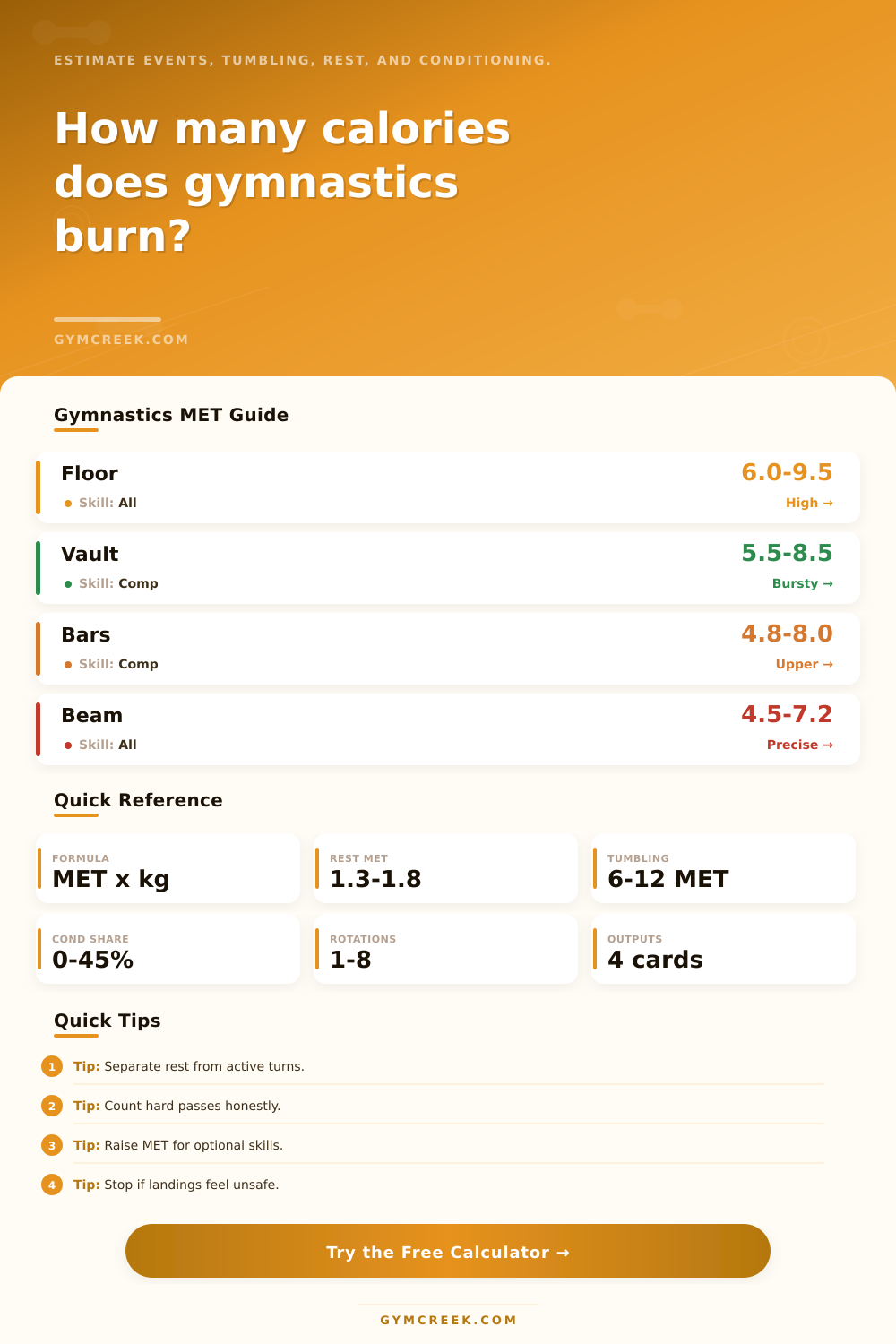
Floor, vault, bars, beam, all-around, trampoline, rhythmic, and men's rotations start with different MET bands, then skill level raises or lowers the active demand.
Tumbling passes and full routines increase load by adding burst work and density modifiers. Apparatus rotations divide the work into a useful per-rotation estimate.
Mifflin-St Jeor estimates BMR from age, size, and gender, then the activity multiplier estimates TDEE so the session can be compared with a full day.
📑Reference Tables
| Event Focus | Easy | Team | Hard |
|---|---|---|---|
| All-around | 4.8 MET | 6.5 MET | 8.2 MET |
| Floor exercise | 5.5 MET | 7.4 MET | 9.8 MET |
| Vault power | 5.0 MET | 6.8 MET | 8.7 MET |
| Bars | 4.8 MET | 6.2 MET | 8.0 MET |
| Beam | 4.3 MET | 5.8 MET | 7.4 MET |
| Trampoline | 5.2 MET | 7.2 MET | 9.5 MET |
| Skill Level | Modifier | Practice Pattern | Use When |
|---|---|---|---|
| Beginner | 0.82x | Basics | New skills |
| Recreational | 0.92x | Class turns | Weekly class |
| Compulsory | 1.00x | Team sets | Level 3 to 5 |
| Optional | 1.12x | Hard series | Level 6 plus |
| Elite | 1.25x | Short turns | NCAA pace |
| Workload Signal | Light | Moderate | Heavy |
|---|---|---|---|
| Tumbling passes | 0 to 8 | 9 to 24 | 25 plus |
| Rotations | 1 to 2 | 3 to 4 | 5 plus |
| Conditioning | 0 to 10% | 11 to 25% | 26% plus |
| Rest ratio | 0 to 15% | 16 to 35% | 36% plus |
| Formula | Variables | Output | When Used |
|---|---|---|---|
| MET kcal | MET, kg, min | Calories | Main burn |
| Pass load | Passes, level | MET add | Tumbling |
| Rest burn | Rest MET, min | Rest kcal | Pauses |
| TDEE share | Kcal, TDEE | Percent | Daily view |
💡Tips
On the apparatus, gymnastics is a brutal metabolic engine disguised as art. The elegance you witness watching a floor routine doesn’t include the oxygen debt in your lungs or the lactate in your muscles. That disconnection create difficulty in estimating calorie burn in gymnastic practice. Recovery and nutritional decisions for most gymnasts are based largely on guessing. They think that an hour of running equals a two-hour practice because, well, they run for an hour. Usually that’s not true.
How long a gymnast is on piece of equipment is only part of what determines the energy needed. Once you input your unique set of training variables, the calculator does the rest (see it in action above). It’ll split out the workout into rest, warm-up, conditioning and active skill work. That’s important: Even though you’re standing in line for vault, you’re still burning calories (even if they aren’t at a high intensity). Ignore that low-intensity background burn and you’ll underestimate overall energy expenditure. Overestimate it, however, and you’ll inflate the numbers unrealistically, assuming that every minute is spent at peak performance. The calculator take both of those into account by requesting conditioning share and rest ratio.
How to Estimate Your Gymnastics Calorie Burn
For example, compare a floor exercise pass to a beam routine. Even though it may have a slightly lower calorie burn per minute, beam is an isometric control activity that requires significant mental focus, taxing the nervous system. Meanwhile, floor exercise include explosive tumbling passes that increase heart rate into anaerobic zones. Because of this, the calculator allows you to choose your skill level and event focus. This helps it account for your needs. An elite gymnast performing complex releases on uneven bars will have a different metabolic profile compared than a beginner who is just learning to do simple shapes on beam. The skill level modifier modifies the Metabolic Equivalent of Task values based off the intensity of what you’re doing. It knows that a difficult pass take more energy then a standard drill.
Another important input is tumbling passes. Tumbling passes are short blasts of maximum power. They’re hard on the fast-twitch muscle fibers. Twenty hard passes during your practice? That’s a lot of density and it shifts total energy demand of the practice. You can enter how many passes were completed and what they weighed. The higher the energy cost of each pass (such as a power pass versus a round-off back handspring combo), the greater the energy burden. That’s where the detail allows you to see why you may be wiped out after one practice but not another, even if they lasted the exact same amount of time.
You often feel the secret burn during conditioning. Core work, plyometrics and circuits is a big part of many gymnasts’ practices. They’re also metabolically demanding activities. You can use the conditioning load and share sliders to tweak that variable. Light mobility work doesn’t burn as many calories as a heavy leg circuit. Learn about it so you can eat to match. If you ignore the calories you calculated in your head, you might under-eat after a heavy gym session, which will cause fatigue and poor recovery over time.
There’s no such thing as “doing nothing” at rest. You’re still recovering from whatever activity you just did, whether it’s stress or exercise-related. There’s some amount of recovery going on, even while standing still. This is what the rest ratio in the tool accounts for. It also avoids a trap many people fall into: thinking that if they don’t do something active, then there’s no caloric burn. Sitting around waiting your turn on the vault for 10 minutes? Those minutes still contribute to your total daily energy expenditure. That’s another 10 minutes of overall energy expended in the day.
The page with the reference tables makes this clear, and shows how different skill levels and focus events change the baseline numbers. Your diet should reflect your workload. Eat like an athlete if you train like one. Crash if you train with elite intensity but eat for recreational activity. You will stall out if you believe all calories is created equal. You would of also over-consume because of bogus caloric math. Alignment is key.
The calorie estimates are just that, estimates, nothing more. Tune in. You know when you’re running low or full-throttle. Listen to yourself. Want more? Slow down. Need to slow down? Get going. They’re numbers. A place to start. Consistency and your own self-awareness are the rest.