Gym Macros Calculator
Estimate gym-friendly calories, protein, carbs, fat, training-day targets, rest-day targets, and per-meal macros from your body stats, lifting split, cardio, NEAT, protein style, carb preference, and meal count.
📌Gym-goer presets
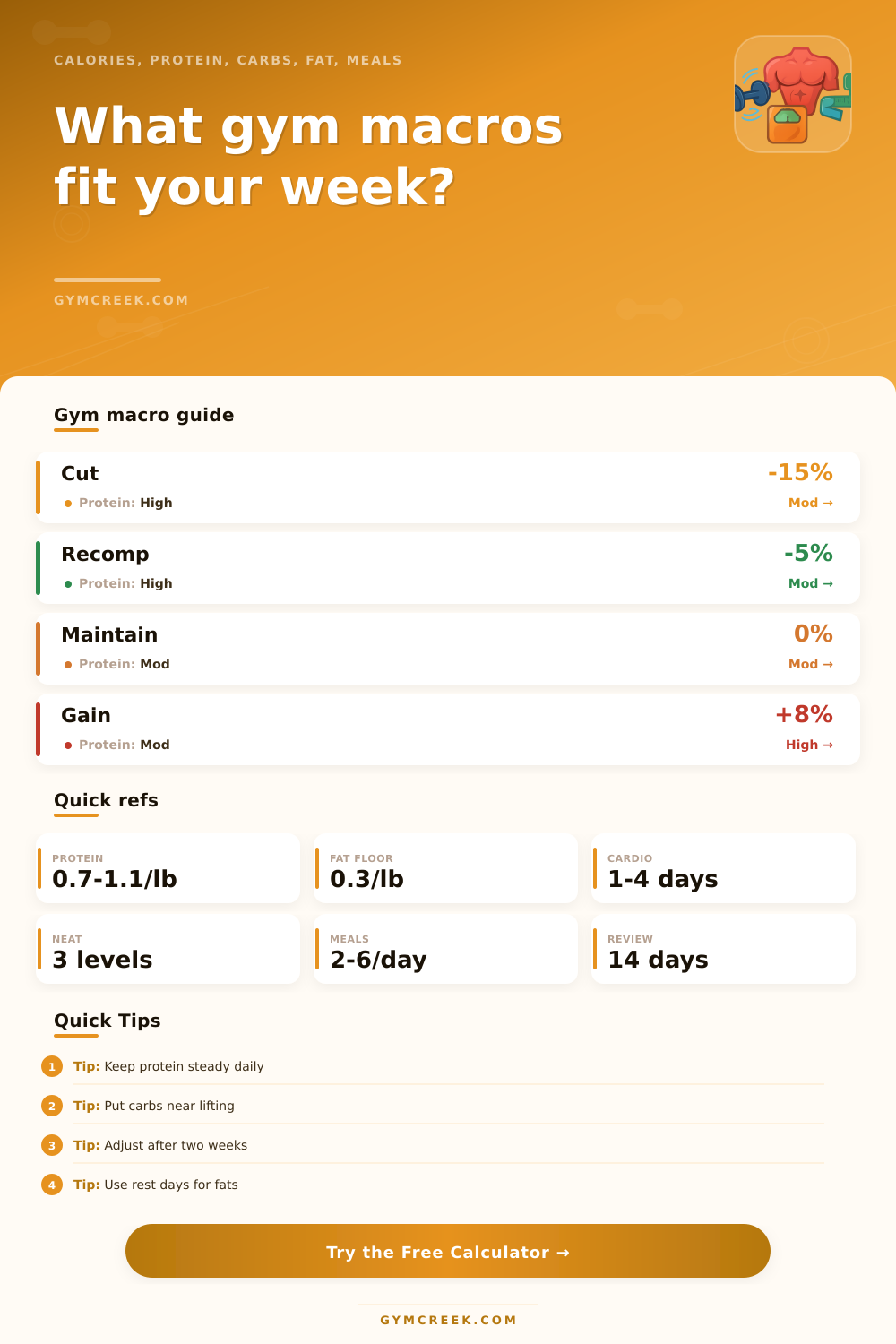
Presets are starting points for general gym training. Replace them with your actual lifting days, cardio days, steps, and meal schedule.
⚙Calculator inputs
Your gym macro targets
Enter your body stats and weekly training pattern to calculate calories, macros, training-day splits, rest-day splits, and meal macros.
📊Metrics grid
📑Reference tables
| Goal | Calorie change | Protein cue | Carb cue |
|---|---|---|---|
| Fat loss | About 10% to 20% below TDEE | Higher to protect lean mass | Keep more around lifting |
| Recomposition | About 0% to 8% below TDEE | Balanced to high | Moderate, based on performance |
| Maintenance | Near estimated TDEE | Moderate and consistent | Flexible split |
| Lean gain | About 5% to 10% above TDEE | Moderate to balanced | Enough for session volume |
| Size gain | About 10% to 14% above TDEE | Moderate | Higher carbs if digestion is good |
| Split | Typical days | Fuel pressure | Best fit |
|---|---|---|---|
| Full body | 2 to 4 days | Moderate whole-session demand | Beginners and busy schedules |
| Upper/lower | 3 to 5 days | Balanced volume | Recomp or steady gain |
| Push/pull/legs | 4 to 6 days | Higher glycogen demand | Hypertrophy blocks |
| Body-part split | 4 to 6 days | Moderate daily demand | Accessory-focused training |
| Strength + hypertrophy | 3 to 5 days | Heavy plus back-off work | Strength and size phases |
| Choice | Macro effect | Use when | Watch point |
|---|---|---|---|
| Balanced protein | About 0.9 g/lb or 2.0 g/kg | Most gym goals | Consistency matters more than precision |
| Higher protein | About 1.05 g/lb or 2.3 g/kg | Cutting or appetite control | Do not starve carbs if lifts drop |
| Plant-forward | About 1.0 g/lb or 2.2 g/kg | More plant proteins | Spread protein across meals |
| Higher carb | Lower fat, more carb calories | High volume lifting | Keep fat above the floor |
| Lower carb | Higher fat, fewer carbs | Preference or appetite control | Watch training pumps and output |
| Calculation | Formula basis | Inputs used | Purpose |
|---|---|---|---|
| BMR | Mifflin-St Jeor | Sex, age, weight, height | Baseline daily energy estimate |
| Lean mass | Weight x (1 - body fat) | Body weight, body fat | Context for protein and goal pressure |
| Gym workload | MET-style weekly exercise add-on | Lifting days, cardio, minutes, intensity | Captures training beyond NEAT |
| Macro split | Protein x4, carbs x4, fat x9 | Calories, goal, preference | Converts calorie target into grams |
| Day split | Weekly macro balance | Training days, carb bump | Creates training and rest-day targets |
| Meals per day | Protein pattern | Carb timing | Best fit |
|---|---|---|---|
| 2 meals | Larger servings | Place one meal near training | Simple tracking or fasting window |
| 3 meals | Classic breakfast, lunch, dinner | Even split works well | Most schedules |
| 4 meals | Moderate portions | Pre and post workout are easy | Hypertrophy and recomposition |
| 5 to 6 meals | Smaller repeated servings | Useful for higher calories | Lean gain with high food volume |
💡Tips
Many people begins to track there macronutrients because many people want to make more predictable gains from their gym routine. People want to understand why they experience varying gains from weeks to weeks or why they experience a stall in there performance despite following the same gym routine. Although the calculator can give a starting point to each individual, they must understand what each of these variables measure and why each of these variables is important for that individual’s specific body and week.
Many of the body measurements will provide the body with a baseline estimate for its energy requirements. Factors like body weight and height will give the equation an idea of the amount of tissue in the body that require fuel. Age and sex will allow for the estimation to be adjusted according to the metabolic rates of those individuals of different ages and body types.
How to Use a Macronutrient Calculator
Body fat percentage can provide context for protein requirements, as the protein will target the lean mass within the body. While none of these measurements are perfect, they will help estimate the bodys energy requirements without introducing inaccuracy before the individual begins their gym routine. The individual’s training routine is another important variable in the equation.
The number of lifting days, the length of each lifting session, and the level of effort that an individual puts into their workouts will all affect their energy requirements. The same can be said for their choice of cardio, although not as significant. Non-Exercise Activity Thermogenesis (NEAT) accounts for activities that are not related to their training routine, as the equation may ignore those activities.
The rising number for these activity variable will impact the individual’s total energy requirements. This is why two individuals with the same body measurements may require significantly different amount of energy to suit their bodies and activities. The selection of a goal will determine the change in the calories that the individual will consume.
If the goal is to lose fat, the calories will be reduced to create a calorie deficit, and the goal will aim to maintain the protein intake of the individual. A lean gain target will require the individual to consume more calories then their energy requirements to support their training and recovery. A body recomposition goal will require the individual to both lose body fat and maintain their muscle, a goal that can only be achieved with a small calorie deficit and high protein intake.
The calculator will select these goals automatically when the individual defines their goal, but they must be chosen according to the bodys response to the macronutrient tracking program. Other variables include protein styles and the carbohydrate preference for the individual. Some individuals may require more protein when they are in a caloric deficit, while others may require more carbohydrates to sustain their strength and performance during their training sessions.
A fat floor will also be included to ensure that the fat intake is not so low as to adversely affect the bodys natural fat hormone. These preferences and styles allow for the individual to change the macronutrient split without having to change the entire program. The output of the calculator will provide the target for the individual over a two week period.
This output, however, is not a permanent target. The individual must compare this target to their body statistics and gym performance. Should the individual’s gym performance drop and their sense of hunger increase, that indicates that the calorie deficit is too significant.
Should the individual be gaining weight at a rapid rate, that indicates that the surplus of calories should be reduced. An even split of macronutrients is a starting point for the individual, but an even split of carbohydrates may be required for better performance during gym session. By maintaining the protein intake throughout the week, the individual has eliminated one variable, but introducing a variable for carbohydrates allows for the bodys performance in the gym to be maintained.
The reference tables will provide examples of the split of macronutrients and protein styles for individuals with various goals. These tables are not rules to the individual, but they are examples of the variables that has worked for many lifters. While the bodys needs or schedule may ignore the tables, they provide a starting point for the individual for their macronutrient tracking.
The most common mistake with the macronutrient calculator is treating the result of the calculator as the individual’s final result. The second most common mistake is changing many variable at once when an individual experiences a stall in their performance. Instead, only one variable should of been changed and held at that rate for the two week period.
The macronutrient calculator will make the calculations for the individual, but it is the measurement and adjustment to the variables that create the gains in strength and performance over the course of many month.