Grip Width Bench Calculator
Estimate a repeatable bench press grip from biacromial shoulder width, arm length, bar rings, federation limits, goal, comfort score, and range-of-motion preference.
📌Bench Grip Presets
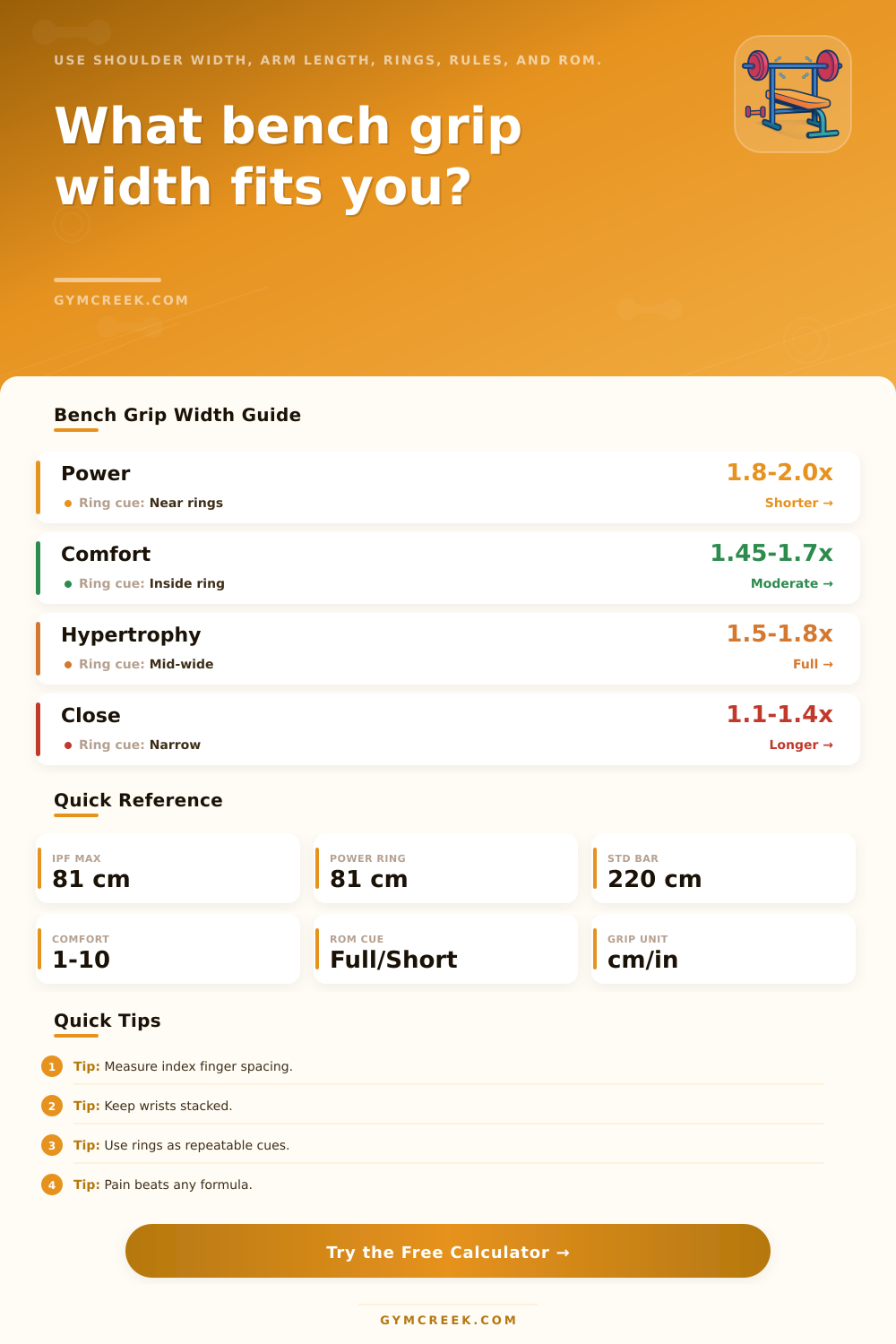
Widths are index-finger to index-finger on the bar. Use the recommendation as a starting point, then test a few warm-up sets before loading heavy.
⚙Calculator
Bench grip snapshot
Enter your measurements and bench goal to estimate a repeatable grip width.
📊Grip Metrics Grid
📑Reference Tables
| Grip Lane | Shoulder Multiple | Typical Goal | Watch For |
|---|---|---|---|
| Close grip | 1.10-1.40x | Triceps strength and longer ROM | Wrist stack and elbow path |
| Moderate grip | 1.45-1.70x | Shoulder-friendly volume | Stable touch point |
| Wide grip | 1.75-1.95x | Competition leverage | Shoulder comfort and control |
| Maximum grip | Near rule cap | Shortest legal ROM | Rule compliance and pec strain |
| Bar Marking | Common Distance | How To Use It | Practical Cue |
|---|---|---|---|
| Power rings | 81 cm apart | Legal max reference for many federations | Index on or inside ring |
| Olympic rings | 91 cm apart | Weightlifting-style reference | Usually too wide for powerlifting cap |
| Dual rings | 81 and 91 cm | Check which ring you are touching | Use the inner power ring for rules |
| Unmarked bar | Varies | Measure from the bar center | Tape equal marks for symmetry |
| Bench Goal | Grip Bias | ROM Bias | Setup Note |
|---|---|---|---|
| Competition strength | Moderate-wide to legal max | Shorter and repeatable | Practice commands and pauses |
| Hypertrophy volume | Moderate to mid-wide | Fuller controlled ROM | Prioritize pec tension over max width |
| Shoulder comfort | Moderate or slightly narrow | Comfortable touch range | Reduce flare and keep wrists stacked |
| Close-grip triceps | Narrower than shoulders x 1.4 | Longer ROM | Keep elbows under the bar |
| Speed bench | Competition grip or slightly in | Repeatable bar path | Use the same ring cue every set |
| Adjustment | When It Applies | Calculator Effect | Training Check |
|---|---|---|---|
| Low comfort | Comfort score under 6 | Moves grip inward | Pain-free warm-up sets first |
| Long arms | High arm-to-shoulder ratio | Allows more width | Keep forearm vertical at touch |
| Full ROM goal | Muscle or technique work | Moves grip inward | Controlled chest touch |
| Rule cap | IPF-style max selected | Caps width at 81 cm | Index fingers cannot exceed rings |
💡Tips
The grip width is key to everything else in the bench press. If you have a few inches too much width, your shoulders will start complaining before set even ends. If you use too little width, bar travels further than it needs to, which takes away power while adding extra work. Most people choose something that felt okay at some point in time and stick with it for years. It’s good enough till it isn’t.
So ultimately, what are you optimizing? If you’re a competition lifter, you are probably looking for the minimum range of motion possible while following your federation rules. That generally mean riding the edge of their max allowable width. If you’re interested in shoulder longevity, maybe you want a grip that moves your elbows into a safer position while taking some load off your shoulder joint’s front. Or if you’re a muscle-growth lifter, perhaps you’d settle in middle as this gives up mechanical advantage but gives you chest involvement through a wider range.
How to Choose Your Grip Width
Arm length and grip width are counterintuitive for most of us. For example, longer arms will generally be able to tolerate a wider grip without feeling pinched in the shoulder, whereas shorter arms may actualy feel better inside the rings. Your comfort score matters: if your shoulders are already banged up from pressing then bringing the grip in is almost always the smartest play instead of pushing through it with the hope that it feels better tomorrow.
The calculator above does all math for you, after you input your dimensions. But again, understand what those inputs represent; there is real tradeoffs between mechanical advantage and joint stress, along with rules you train under. An additional wrinkle is with bar markings. Rings is a common way to mark most power bars, and they’re placed based off the legal limit of most federations. So you get a visual repeatable cue without having to measure each and every time out. With Olympic bars, the rings tend to be bigger, which can result in what feels like a competition grip on one bar being too wide on another. Having the same ring as your cue will help eliminate little differences that creep into place when eyeballing it the next time you set it up.
This is by far the biggest error. Grip width is not set in stone. As you grow older and/or your goals evolve, your grip should of and will likely change. What worked for you when you were 20 pounds lighter or three years younger may no longer work due to a nagging shoulder issue or prolonged time away from training. Instead, use this suggestion as a guideline and try several warm-up sets before you try lifting your maximum weights.
The little things matters a lot more than most realize. Half an inch in either direction can impact the path of the bar. It can also affect how your elbow flares and how your wrist stacks on top of your forearm at the bottom. These small nuances compound into hundreds of rep every week. It’s not about having a single “right” grip forever; it’s about knowing what each adjustment does so that you can make adjustments as your goals (and your body) change.