Grip Endurance Calculator
Estimate max hold time, relative hand load, repeat-set fatigue, and endurance score from bodyweight, external load, hold style, and recovery.
📌Presets
Presets load realistic grip profiles and immediately calculate hold capacity, per-set decay, and workload.
⚙Calculator
Grip endurance snapshot
Enter bodyweight, load, and hold settings to calculate grip endurance.
📊Grip Metrics Grid
📑Reference Tables
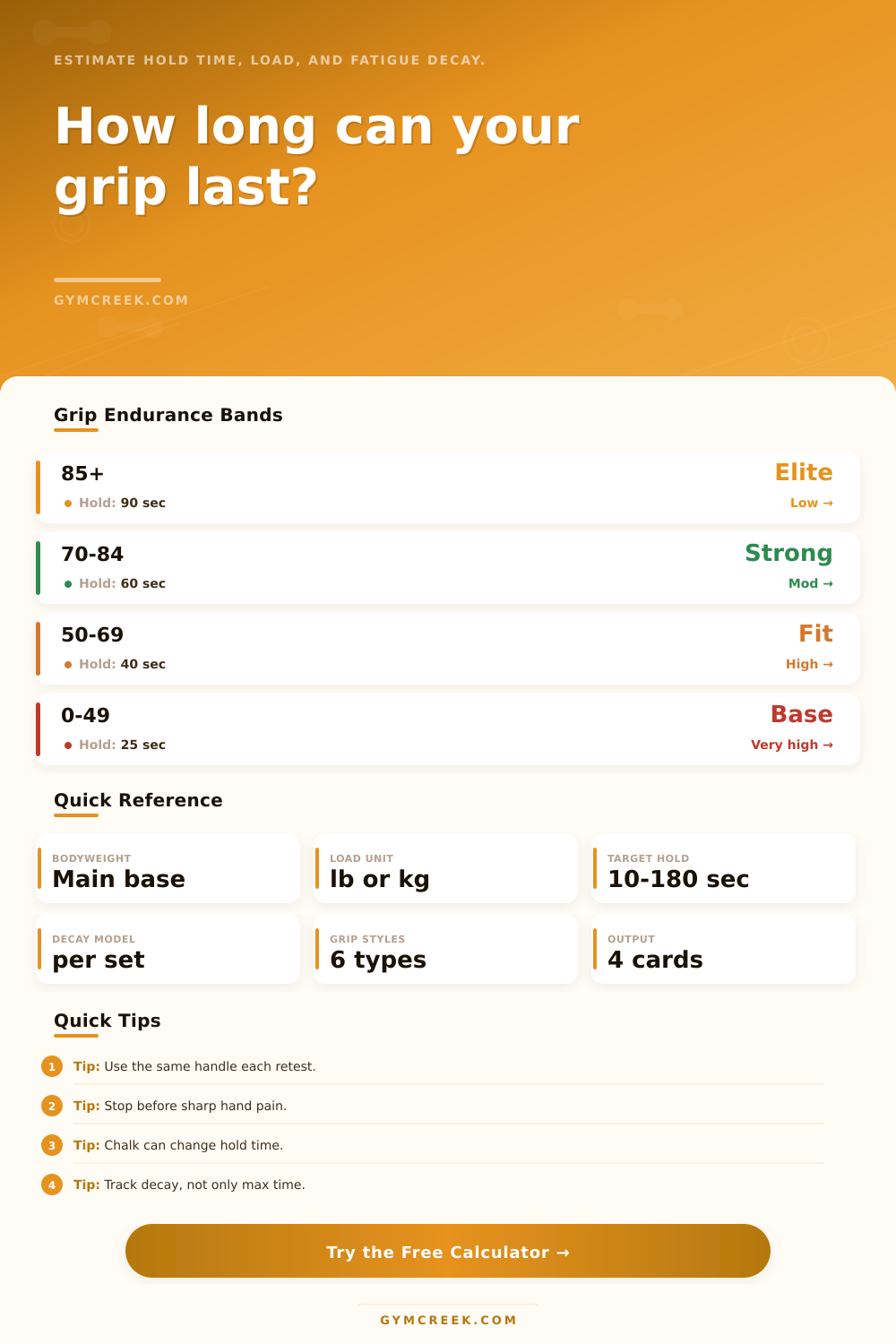
| Endurance Score | Band | Typical Hold | Retest Focus |
|---|---|---|---|
| 85-100 | Elite | 90+ seconds | Loaded repeats |
| 70-84 | Strong | 60-90 seconds | Higher density |
| 50-69 | Fit | 35-60 seconds | Capacity work |
| 30-49 | Base | 20-35 seconds | Easy volume |
| 0-29 | Starter | Under 20 seconds | Technique first |
| Grip Style | Bodyweight Share | Handle Factor | Best Use |
|---|---|---|---|
| Dead hang bar | 100% | 1.00 | Bodyweight tests |
| Weighted hang | 100% | 1.08 | Max endurance |
| Farmer handles | 0% | 1.04 | Carry events |
| Deadlift hold | 0% | 0.92 | Barbell lockout |
| Towel grip | 100% | 1.32 | OCR and rope |
| Pinch block | 0% | 1.45 | Thumb strength |
| Variable | Effect | Model Use | Watch Point |
|---|---|---|---|
| Relative load | Higher demand | Shortens hold | Compare to BW |
| Target time | Pass score | Sets risk band | Use exact sec |
| Rest period | Recovery gain | Slows decay | Keep consistent |
| Effort level | All-out estimate | Normalizes hold | Avoid guesses |
| Handle type | Grip friction | Load factor | Retest same |
| Formula | Inputs | Output | Purpose |
|---|---|---|---|
| Effective load | BW, load, style | Hand demand | Fair comparison |
| Hold curve | Load ratio | Max seconds | Capacity estimate |
| Decay curve | Sets, rest | Last set time | Repeat fatigue |
| Density index | Total time, rest | Work density | Session stress |
💡Tips
We tend to think of grip strength as a trivial display of skill: You grab a dynamometer, record your score, publish it on the internet, and bask momentary in the glow of your improved forearms. But we’re realy only looking at half of the equation. Real-world grip potential isn’t strictly related to absolute crush-force. It’s also related to how long you can sustain a grip while your body desperately tries to give up.
Whether you’re doing a set of pull-ups, carrying heavy bucket on a work site, or grasping a bar during an obstacle race, what limits your performance is rarely muscle failure. In most cases, it’s your fingers coming loose before the muscles fail. That’s why most folks screw up with grip work, they train it for maximum tension, instead of holding it for as long as possible. Just because you’re big-biceped doesn’t mean you can do a straight-up dead hang for thirty seconds. Your tendon need to be trained for sustained loading.
Why Grip Endurance Matters More Than Strength
The calculator above does all the math for you when you input your weight (bodyweight + external load), how you hold it, and so on. No more conversions or guesswork about coefficients. It takes the raw numbers you provide and spits out something real: an estimation of how long your hands can handle this specific exercise before giving out. That’s important because it tells you what your limit is. This will guide your training so you build up capacity without burning your tissue out.
And then there’s handle difficulty, which you’ll want to factor in as well. Some grips like a rough piece of rope or a heavy towel can be harder than others (like a smooth metal bar). For this reason, the tool includes certain factors for each type of grip. For example: it knows that managing the friction of hanging from a towel requires greater skill than gripping a normal knurled bar. Why? Because life isn’t always clean. When you’re out climbing or participating in a strongman event, you won’t have time to pick and choose ideal handles. Train with only ideal equipment, and watch how you perform when conditions become less ideal. The calculator makes you come to terms with that fact: it lets you test those harder variables in simulation.
But fatigue isn’t linear either. It doesn’t tick down like a battery percentage. Sometimes the drop-off in following sets are steep due to insufficient rest periods in each set. The results will show you this with its decay metric. So if you do forty-second long sets on one day and find yourself dropping to fifteen seconds on the last set, you know your rest periods is insufficient. People get that wrong. They assume more volume = greater endurance, when sometimes it just means poorer quality reps. Knowing about that decay curve helps you tweak rest times or back off the load to keep the effect productive rather than destructive.
Now let’s put all this information in perspective with the reference tables that show your position on general fitness benchmarks. It’s nice to see a score in the elite band, but what good does that do you if your decay rate shows that you’re not very consistent? If your max effort is an elite grip but lasts for just one rep, then what? Consistency over several sets is the key. That’s why focusing on a single personal record isn’t as helpful than building up overall work density and total hold time. Think of density as how much work you can squeeze out of a session before your form start to break down.
Make sure all variables are the same when testing yourself again. Use the same hand position, the same amount of chalk, and the same bar. A few seconds change in hold time can mean something small like a little more or less friction on the bar. Any kind of gain or loss will hide behind this.
Stop just short of feeling any sort of sharp pain. If you feel numb, that’s a sign to take a rest, but if you’re feeling pain, stop completely. It’s a fine line, but it protects your long-term health. The grip training add up to tiny injuries in the wrist and fingers. It takes weeks, months, and years to learn how to manage that load. This is what sets an amateur apart from someone who can train for decades without injury.
Your hands are ultimately your interface between you and the physical world. They have to be tough and strong. The calculator lets you quantify their toughness, with a number, giving you a starting point to measure load, time, and decay. It allows you to turn the vague feeling of fatigue into measurable quantities: time, load and decay. Use these figures to direct your training. Develop the ability to withstand increased effort, recover more efficiently in-between, and recognize your connective tissue’s limitations. Today your forearms may look impressive, but when the going gets tough it’ll be your endurance which gets you back to base.