Grappling Calorie Calculator
Estimate calories burned in BJJ, wrestling, judo, submission grappling, and MMA grappling sessions using MET equations, body weight, round structure, rest time, drilling volume, and live resistance.
📌Presets
Each preset loads a realistic grappling profile and recalculates the estimate from round, drill, and rest timing.
⚙Calculator
Grappling calorie snapshot
Enter session structure and intensity to estimate total grappling calories.
📊Grappling Metrics
🧮Formula Cards
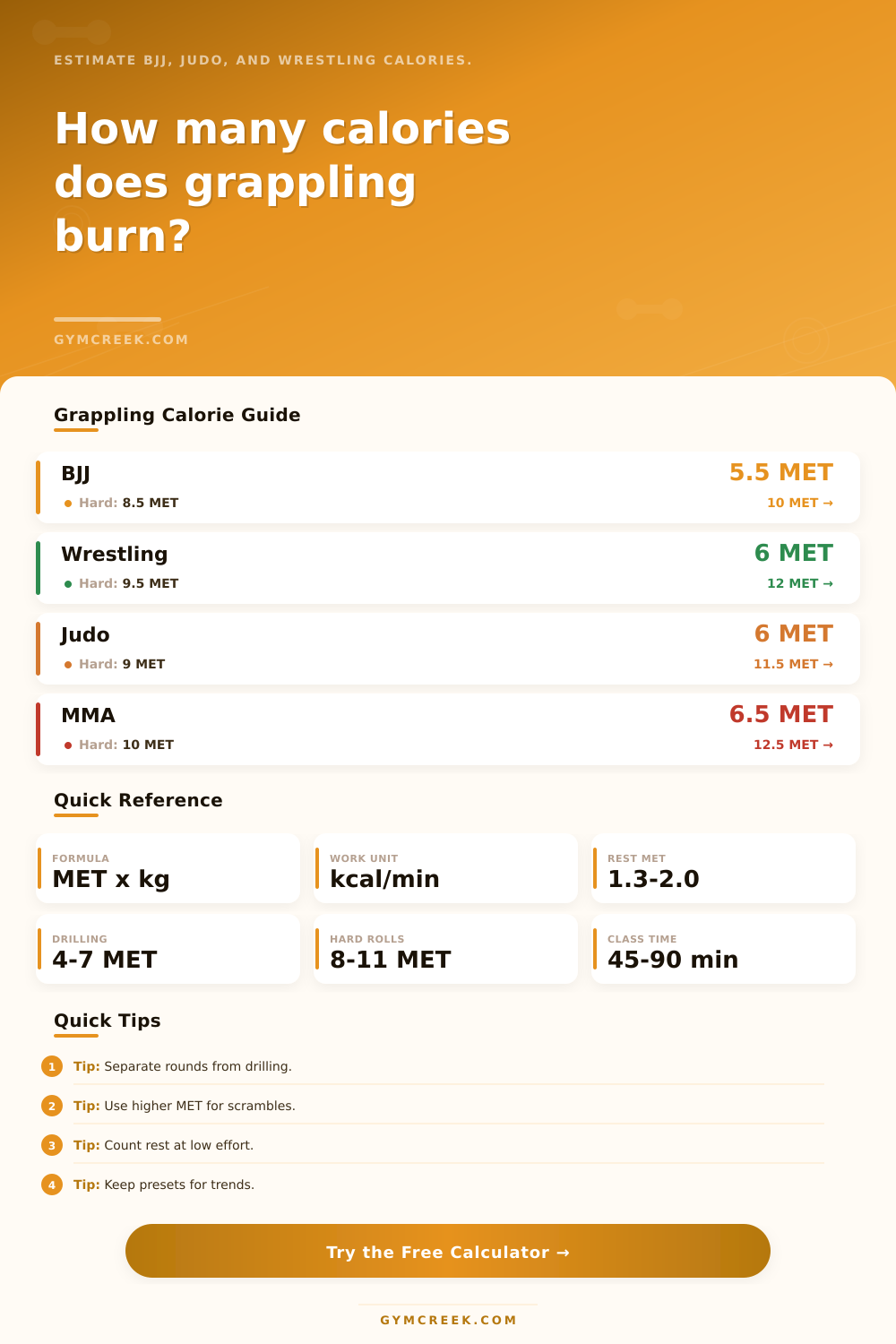
Calories per minute = MET x 3.5 x body weight in kg / 200. This powers live rounds, drilling, warm-up, and rest segments.
Base MET comes from grappling style and intensity, then partner resistance, standing share, scramble load, and gear tune the estimate.
Live rounds use the highest adjusted MET, drilling uses focus-specific MET, warm-up uses movement MET, and rest uses low recovery MET.
Mifflin-St Jeor estimates BMR, activity level estimates TDEE, and the calculator compares session calories against that daily total.
📑Reference Tables
| Style | Light | Moderate | Hard |
|---|---|---|---|
| Brazilian Jiu-Jitsu | 5.5 MET | 7.2 MET | 8.8 MET |
| No-Gi grappling | 5.8 MET | 7.6 MET | 9.4 MET |
| Wrestling | 6.2 MET | 8.4 MET | 10.4 MET |
| Judo | 6.0 MET | 8.0 MET | 9.8 MET |
| MMA grappling | 6.5 MET | 8.8 MET | 10.8 MET |
| Session Type | Live | Drill | Best Use |
|---|---|---|---|
| Fundamentals | 2-4 rounds | 25-40 min | Skill base |
| Open mat | 6-10 rounds | 0-10 min | Rolling volume |
| Competition prep | 6-12 rounds | 15-30 min | Hard pace |
| Judo randori | 5-8 rounds | 15-25 min | Throws and grip |
| Modifier | Low | Normal | High |
|---|---|---|---|
| Partner resistance | 0.92x | 1.00x | 1.16x |
| Standing share | 0-15% | 20-40% | 50%+ |
| Scramble load | 0.94x | 1.00x | 1.13x |
| Gear load | 1.00x | 1.03x | 1.06x |
| Formula | Variables | Output | When Used |
|---|---|---|---|
| MET kcal | MET, kg, min | Calories | Main estimate |
| Weighted MET | Segments, time | Avg MET | Session mix |
| Mifflin BMR | kg, cm, age | Baseline | Daily context |
| TDEE share | kcal, TDEE | Percent | Training load |
💡Tips
After work you walk into gym, tie on your gi, and is immediately assaulted by the scent of sweat. You’re pumped up to go. You roll three solid rounds with someone stronger then you. You get your escapes drilled in and walk away feeling like you’ve just run a marathon, except that it’s only been forty-five minutes.
That’s the part where grappling become such a brutal metabolic event. It’s not just about sweat. It’s about how much energy it cost you to move one person while they actively attempt to move you back.
Why Grappling Burns More Calories
Cardio doesn’t burn same number of calories per minute like most folks think. That myth is destroyed the moment you step onto mat. A chaotic scramble vs. A slow technical drill makes a huge difference.
When you’re drilling, you’re moving through space in a cooperative way. Your heart rate remain manageable as you pick up mechanics. But what happens when your partner shoot a double leg or pulls guard? Suddenly, it’s not about exercise, it’s about solving a physical puzzle under pressure.
Plug in your round structure and weight into calculator on this page, then forget about guessing if your session was light or heavy. The math will be done for you.
So what’s the variable? Resistance. If your training partner is cooperative and rolls through your move with you, you may burn five-hundred calories in one hour. However, if your partner increase resistance, this will skyrocket as it has nothing to do with time but rather friction.
You can think of this friction as if you were driving a car. The same speed on flat highway consumes less gas than crawling up a steep hill. That’s grappling. It is always the hill. And the steeper the hill, the more fuel burnt.
That’s why partner resistance are such a crucial piece of the equation. It shifts baseline metabolic cost to match the effort required by the exchange. It also changes things when it comes to standing exchanges.
A lot of grappler overlook the fact that clinch work and takedowns activate whole posterior chain. So not only do you recruit more muscle mass than simply staying grounded, but the muscles that fire include your legs, back, and hips all at once. This raises the metabolic cost if you raise percentage of time spent standing since you’re now stabilizing balance and lifting your bodyweight against gravity.
You’ll get more output in a shorter period of time, and it’s efficient work. This vertical emphasis makes wrestling tend to burn more than traditional BJJ, as the table on page illustrates by style.
They fail to account for their rest properly. They believe that if they are not doing something with effort, then they’re not burning calories during rest. That’s wrong. Your heart rate will be up. You’ll be sweating. You’ll be breathing hard. You’ll be active recovering, which results in much higher calorie burn than sitting on couch.
Include this in your overall tally instead of thinking of rest as a no-calorie activity. This helps keep things honest and prevents you from underestimating how many calories you burn. If you don’t, you are only accounting for the time you spend actualy touching mat.
Then there’s gear. Carrying a gi adds weight and retains heat. Literaly. Every movement requires more metabolism. That doesn’t mean you’ll realize it mid-session, but when you’re going at it for an hour of grappling, that extra weight add up. Your heart has to pump even harder, moving that weight while keeping you cool. It’s like wearing boots instead of socks when you run.
And there you have it: The final output provides a snapshot of your probable caloric expenditure. But the true value lies in composition of this burn.
Knowing that most of this burn comes from live rolling allow you to structure your training to match. High intensity and high volume lead to fat loss. Drilling improves technique. So if you’re looking to lose weight, you do both. But if you want to work on your technique, you can drill more. The numbers tell you the strategy.
No more guessing about having a good workout. You now know exactly what you did. And when you walk off mat next time, you’ll know why you feel that way. You are not just tired. You feel tired in a specific way. That’s price of entry into the sport.