Grams to Calories Converter Calculator
Convert protein, carbohydrate, fat, fiber, alcohol, and custom ingredient grams into calories, then compare the total with your calorie target, meals, and estimated daily energy needs.
◎Presets
Each preset loads realistic macro grams, servings, body context, calorie targets, and TEF assumptions. You can edit every field after loading.
⚙Calculator
Gram conversion snapshot
Enter grams to convert macros into calories.
▦Fitness Metrics Grid
▣Reference Tables
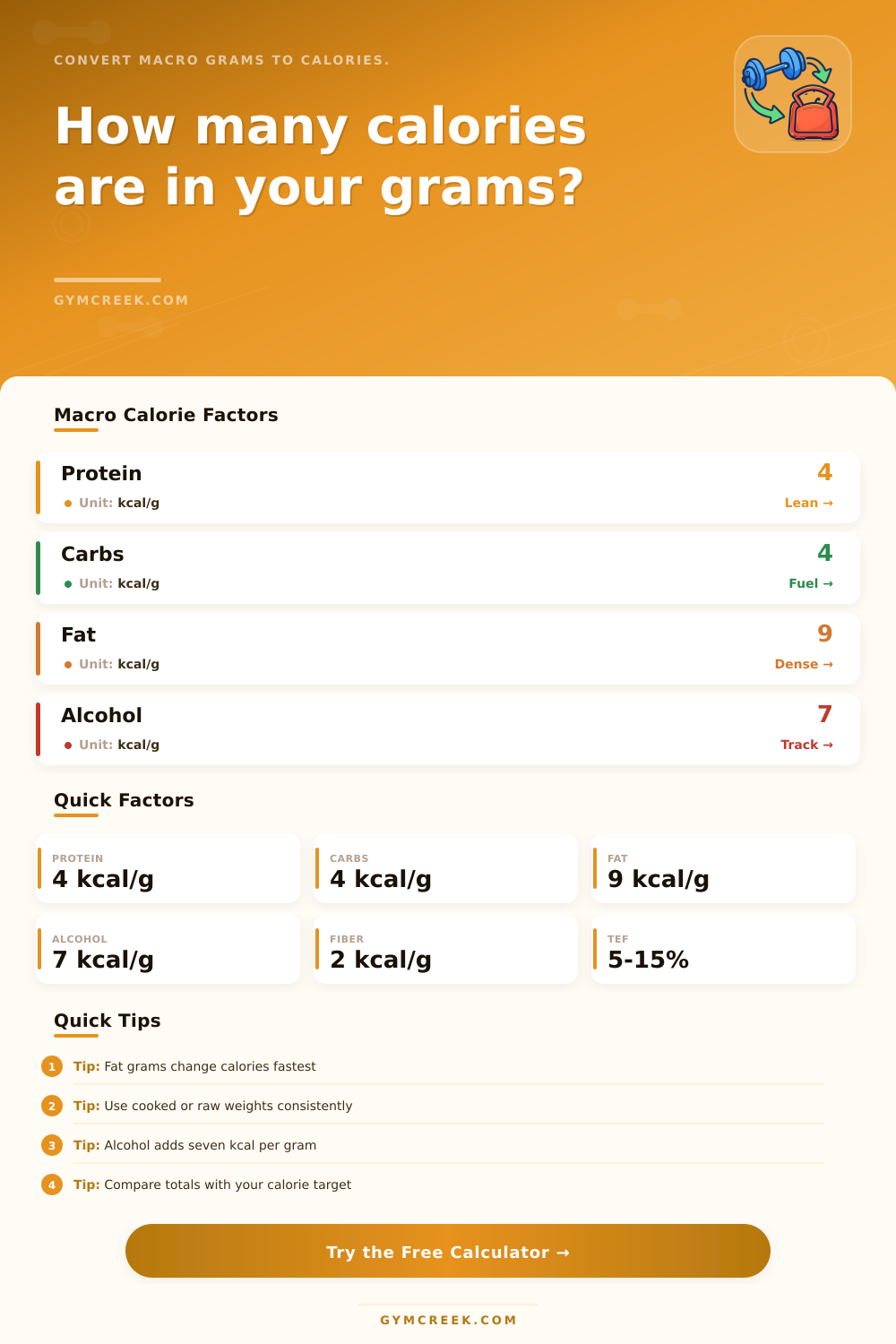
| Nutrient | Calories per gram | Formula | Use note |
|---|---|---|---|
| Protein | 4 kcal/g | protein grams × 4 | Useful for satiety and lean mass planning |
| Carbohydrate | 4 kcal/g | carb grams × 4 | Main training fuel in mixed diets |
| Fat | 9 kcal/g | fat grams × 9 | Most calorie dense macro |
| Alcohol | 7 kcal/g | alcohol grams × 7 | Adds energy but is not a performance target |
| Example amount | Protein | Carbs | Fat |
|---|---|---|---|
| 10 grams | 40 kcal | 40 kcal | 90 kcal |
| 25 grams | 100 kcal | 100 kcal | 225 kcal |
| 50 grams | 200 kcal | 200 kcal | 450 kcal |
| 100 grams | 400 kcal | 400 kcal | 900 kcal |
| Goal | Total signal | Macro clue | Review note |
|---|---|---|---|
| Fat loss | Below target | Protein steady | Check weekly average intake |
| Recomposition | Near target | Protein higher | Compare strength and waist trend |
| Maintenance | Close to TDEE | Balanced mix | Scale may drift from water |
| Lean gain | Small surplus | Carbs support training | Review rate every 2 to 3 weeks |
| Output | Formula | Inputs used | Purpose |
|---|---|---|---|
| Macro calories | grams × kcal/g | Protein, carbs, fat, alcohol | Convert nutrition grams to energy |
| Fiber context | fiber grams × selected factor | Fiber mode | Handle label differences |
| BMR | Mifflin-St Jeor or Katch | Age, sex, size, body fat | Estimate resting calories |
| TEF | macro kcal × TEF rates | Macro mix and TEF mode | Estimate digestion cost |
◇Tips
When people say count the calories, do they mean just weigh food and multiply? Yes, but no, you’re only halfway there. Why do you want to count the calories? Because you have to know where they come from. You have to know what happens to energy once it’s in your body.
You get grams of fat, carbs, protein, fiber, and potentially alcohol on a nutrition label. They all seem kind of similar until you see them converted to energy units. Your body convert them at those rates, and that is why you use these tools.
Why Tracking Calories Matters
The traditional model give equal weight to both protein and carbohydrates. They each yield about four kilocalories per gram. Fat, on the other hand, are far denser. It yields nine kilocalories per gram. A hundred grams of fat is more than twice as calorically dense then a hundred grams of protein. For the same amount of calories, you could consume two times the volume of lean protein (or complex carbs) as oils or nuts.
When tracking macros, understanding where your energy come from matters even more than just hitting a total calorie number. Where you get those calories from does matter. It will impact satiety levels, affect how hungry youll be an hour after eating and what kind of performance youll see in training.
Enter your numbers into calculator above, and it’ll do the math for you. But what’s it doing under the hood? It’s separating total carbohydrates from fiber. Why? Because your body doesn’t digest fiber the same way that it digests starch and sugar.
The tool will count fiber at either zero kilocalories per gram (if you choose to ignore it) or two kilocalories per gram (if you choose higher fiber factor). If most of your carbs come from whole grains and vegetables, assuming they’re all equivalent at four kilocalories per gram will overestimate how much you’re eating. It’s best to assume lower fiber factor in order to get a realistic picture of usable energy.
Another one that knocks most folks out of whack: alcohol. Its dense at seven kilocalories per gram. That puts it squarely in-between fat and carbs. But unlike both of those macros, alcohol doesn’t offer any nutrition whatsoever. And each gram you log on there are simply additional energy; no help to your muscles and no help to your recovery. A single craft beer or glass of wine isn’t as innocent as you might think. Those little guys will sneakily add up.
When you put your weight into the tool, itll account for that automatically. You just has to be truthful with yourself about the quantity. But then we’re also talking about the thermic effect of food; the fact that your body expends calories simply when eating them. Digestion is most expensive with protein. Alcohol and fat has almost zero cost.
There’s a blanket assumption in the calculator for this cost. It calculates your net calories, which are more accurate than just looking at your gross intake. It also calculates your total after conversion. It compares this to a daily baseline based off your activity level and body stats. That puts it into some kind of context: Does that meal fit within the rest of your day? Have you already spent your budget for the day?
One common error is mixing weight types (i.e., raw and cooked). When cooking chicken breast, it lose some water. The resulting cooked version is lighter in weight, but it has the same amount of calories per ounce of dry matter. You’ll get an inaccurate log if you weigh it before cooking and then consume it after cooking without accounting for the change.
The only way to make any data useful is consistency. Choose one method and use it consistantly. Let the numbers direct your changes over time rather than worrying about being perfect on a given day. Use these tools as aids in taking the guess work out of how and when you fuel. This provide a starting point from which to play around confidentally.
When you actualy understand how many calories those grams equal, you quit guessing. Quit going with your gut. Start making smart decisions regarding what goes onto your plate. It’s not rocket science. The challenge come in tracking it truthfully. Consistency is key. Trust the process. Let the numbers speak for themselves.