Good Morning Load Calculator
Estimate a smart good morning bar weight from your hinge strength, rep target, RPE, tempo, variation, and planned session volume.
📌Presets
Presets load realistic good morning sessions and auto-calculate the recommended working load.
⚙Calculator
Good morning load snapshot
Enter a strict estimated max and calculate a working load.
📊Fitness Metrics Comparison
📑Reference Tables
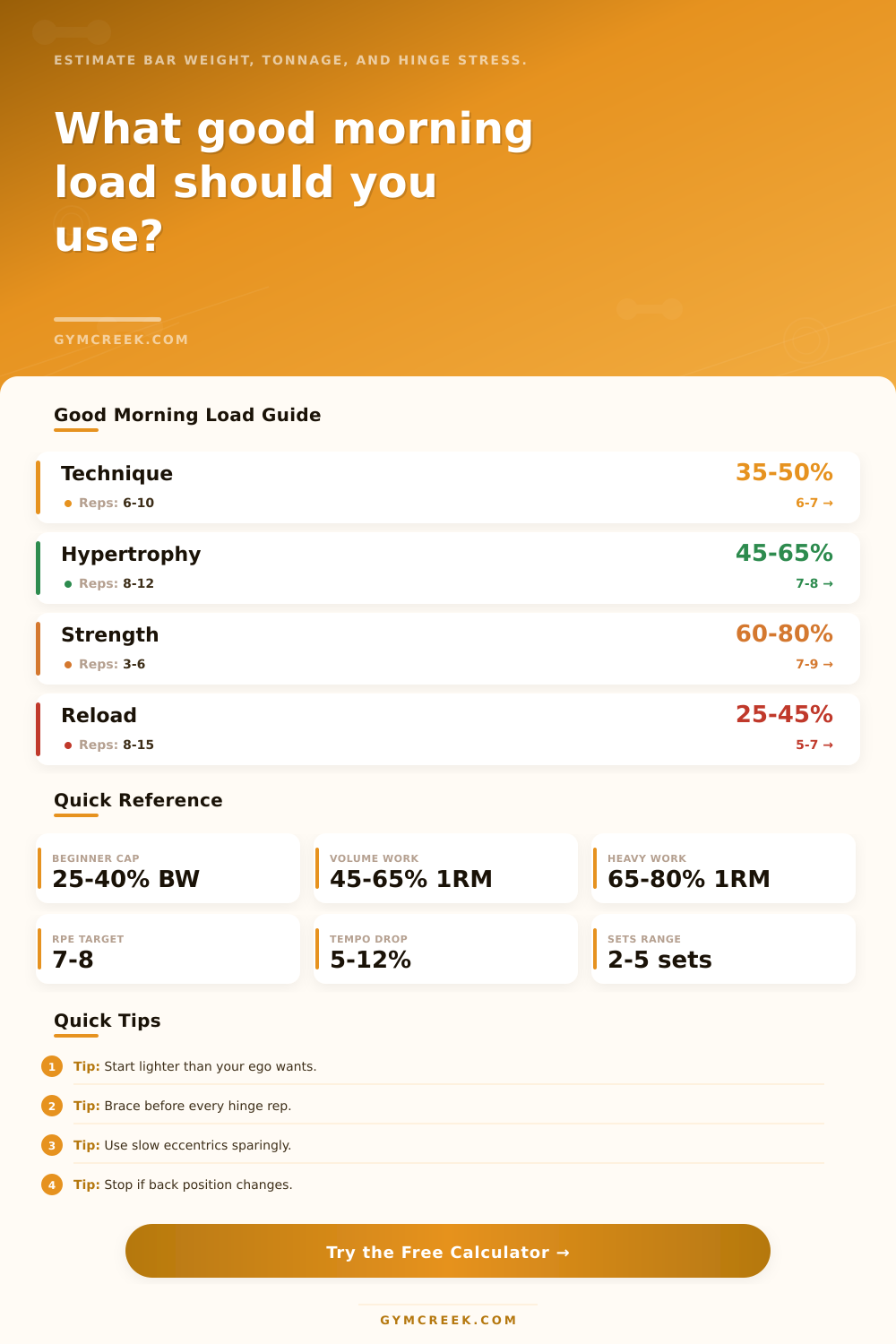
| Purpose | Typical Load | Reps | Practical Use |
|---|---|---|---|
| Technique practice | 35-50% 1RM | 6-10 | Groove hinge position and bracing |
| Hypertrophy | 45-65% 1RM | 8-12 | Add posterior-chain volume |
| Secondary strength | 60-80% 1RM | 3-6 | Build squat and deadlift support |
| Deload or reload | 25-45% 1RM | 8-15 | Keep movement quality easy |
| Variation | Load Factor | Why It Changes | Best Fit |
|---|---|---|---|
| Standing barbell | 0.95x | Classic bar path and familiar setup | General strength work |
| Safety bar | 1.00x | Stable shoulder position and camber | Volume and comfort |
| Seated | 0.78x | Less hip drive and stricter torso demand | Upper-back control |
| Banded or chain | 0.72x | Variable resistance changes lockout load | Speed and deload work |
| Zercher | 0.68x | Anterior hold limits load and bracing | Strict trunk strength |
| Bodyweight Ratio | Novice | Intermediate | Advanced |
|---|---|---|---|
| Conservative | 20-30% BW | 30-45% BW | 45-60% BW |
| Working volume | 30-40% BW | 45-65% BW | 60-80% BW |
| Heavy exposure | 40-50% BW | 65-80% BW | 80-100% BW |
| Use caution | Over 50% BW | Over 80% BW | Over 100% BW |
| Formula | Variable | Use | Notes |
|---|---|---|---|
| Epley inverse | 1RM / (1 + reps/30) | Rep load estimate | Works best for 1-12 reps |
| RPE adjustment | -2.5% per RPE below 10 | Leaves reps in reserve | RPE 8 is roughly -5% |
| Variation factor | 0.68x to 1.00x | Adapts to exercise style | Stricter variations load lower |
| Stress score | %1RM x reps x sets | Session load check | Higher score means more fatigue |
💡Tips
The Good Morning Calculator This is a tough exercise for good reasons; it exposes any weakness in the posterior chain. It demands spinal control; I’d say most people forget how to hinge correctly in the gym. But when done without loading like a powerlifter, it’s still a great hip and back strengthener. That’s where ego comes into play: You think you can use the same weight to hinge as you do to squat? Well, the mechanics of each are totally different so guesswork isn’t going to cut it. Having a structured approach to estimating your starting weight is much better.
Now that you know your target rep range and your strict max, plug it into the calculator up top and let it do the math for you. This prevents the most frequent error: anchoring every variation on a single fixed number (i.e., your 1RM). Because good mornings aren’t simply heavy squats with a different bar position, the tool accounts for variation, RPE, and tempo.
Why You Should Start With Light Weight
A slow, paused repetition performed at forty percent of your max might cause greater hinge stress than a quick rep at eighty percent. Why? Fatigue accumulates differently across the body. For example, while the quads may be fried, the erectors might still is standing tall. Without considering tempo and going straight for weight, you’re likely to round out long before your hips ever come near parallel.
But don’t base your starting number on your back squat’s one rep max, or any other movement, for that matter. Find your true one-rep maximum for the good morning specifically, and as a novice, these numbers rarely match up. Most folks haven’t ever really even tested out how much they could hinge in isolation. Use your best guess, but estimate conservatively based off whatever you think you could perform with perfect form across five repetitions.
Then the calculator works backwards from that to determine your starting percentage; which for hypertrophy will probably be somewhere between 50-60%, and for technique work might dip as low as the thirties. It isn’t arbitrary: These percentages corresponds to when the nervous system is able to take the volume without sacrificing form. The importance of variation is massive here. You can load up more with a safe bar good morning because your shoulders are stable. However, the anterior hold messes with core stability, so you’ll be forced down heavily with a Zercher good morning.
The table on this page shows this clearly; strict variations require lower absolute weights to keep yourself safe. Don’t compare bar weight to somebody who’s using a different set-up. Instead, pay attention to the control during the eccentric phase and the tension felt in your lats. This is one of those lifts where RPE plays an important role, perhaps more so than for any other compound exercise.
Missed reps on good mornings will be unforgiving; go heavy and mess up a rep and you’ll snap a vertebra before knowing what hit ya. RPE accounts for this, and gives you enough extra energy to keep your spine in a neutral position during the set. Don’t get tempted to put on more weight if the output says you’re lifting something too light. You’re building posterior chain endurance, not seeing how much weight you can push past your breaking point. Let volume handles the workload. Take it slow and make sure you’re progressing.
Only increase the weight if all reps in the set look exactly like the first rep. When you feel like your bar isn’t going as fast or your depth isn’t quite as deep on the final rep, you’ve reached failure for that workout. Don’t go any further. You want to expose yourself to load while maintaining proper form. Don’t just occasionally blast hard and screw up your form. Think of these recommendations from the calculator as a beginning range, not a commandment. Use your sense of how your back feels post-three sets to adjust accordingely.
So how do you know what’s what? Squatting and deadlifting is training for maximal strength. This is not a maximal strength exercise. It is an exercise of work capacity and structural integrity. It is a support exercise. It is an exercise that removes the weak link(s) from your kinetic chain, which in turn makes everything else stronger.
Load it light and respect the movement. Allow the accumulated volume to develop the armor necessary to lift more weight with the heavier exercises. Brace hard, start lighter than your ego demands, and never forget: spinal health favors consistency over intensity every time. You should of seen how much better you feel when you do not rush things.