Golf Calorie Calculator
Estimate calories burned during golf from holes played, walking and cart split, bag carry method, course elevation, swing count, range practice, warmup, and body weight.
📌Presets
Each preset loads a realistic golf profile and recalculates the calorie estimate immediately.
⚙Calculator
Golf calorie snapshot
Enter round structure and practice time to estimate total golf calories.
📊Fitness Metrics
🧮Formula Cards
Calories per minute = MET x 3.5 x body weight in kg / 200. This drives walking, cart, range, warmup, and swing estimates.
Round minutes are split by walking percentage. Walking uses higher golf MET values, while cart time uses lower riding golf MET values.
Carrying, pushing, rolling terrain, hills, and quick pace multiply the walking MET to reflect extra course movement load.
Range time uses a practice MET, while extra swing volume adds a small stroke-load adjustment based on swings above baseline.
📑Reference Tables
| Golf Mode | Base MET | Typical Time | Best Use |
|---|---|---|---|
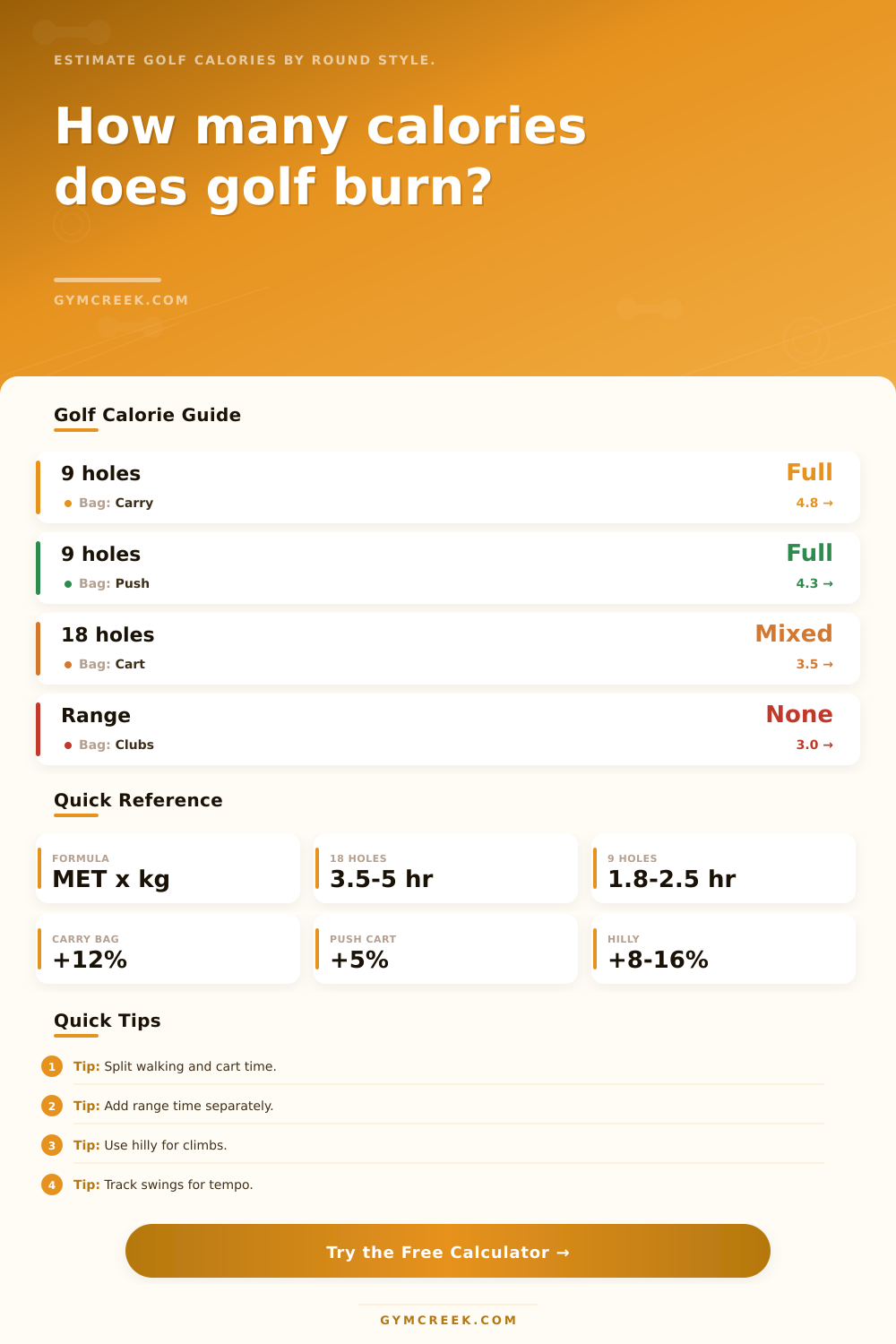
| Walking, carrying | 4.8 | 3.5-5 hr | Full round load |
| Walking, push cart | 4.3 | 3.5-5 hr | Lower back load |
| Walking, caddie | 3.8 | 3.5-5 hr | Light club load |
| Riding cart | 3.0 | 3.5-4.5 hr | Short walks only |
| Driving range | 3.0 | 15-90 min | Practice block |
| Course Profile | Modifier | What It Means | Example |
|---|---|---|---|
| Flat | 1.00x | Little climbing | Parkland flat |
| Rolling | 1.06x | Some slopes | Most public courses |
| Hilly | 1.12x | Frequent climbs | Upland course |
| Very hilly | 1.18x | Long climbs | Mountain layout |
| Round Type | Holes | Time | Walking Share |
|---|---|---|---|
| Quick nine | 9 | 105-150 min | 70-100% |
| Standard 18 | 18 | 210-300 min | 60-100% |
| Cart scramble | 18 | 240-330 min | 20-55% |
| 36-hole day | 36 | 450-600 min | 50-100% |
| Formula | Variables | Output | When Used |
|---|---|---|---|
| MET kcal | MET, kg, min | Calories | Main estimate |
| Split round | Walk %, time | Minutes | Cart/walk mix |
| Swing load | Swings, holes | Add-on kcal | High volume play |
| Mifflin BMR | kg, cm, age | Daily burn | TDEE context |
💡Tips
So when you finish on the eighteenth green, what’s the first thing that comes to mind? It might be your score, sure, but it might also be the sudden hushed sound of your legs whispering: “Okay, I’ll take you home, but first, let’s see if we’re up for walking back to the car.”
Golf is a sport in which you swing a weighted stick around hundreds of times over five miles of uneven ground. You then wonder why your legs is suddenly making this quiet humming noise, as in, “Hey, buddy, are you ready to go home now?” That’s when the calories are burned.
How to Burn More Calories Playing Golf
Most golfers estimate how many calories they’ve burned by estimating length of time the round took. But time is a poor proxy for exertion. If you play a slow four-hour round using a cart, you’ve burned a fraction of the calories compared to a brisk, two-hour round walked with a bag on your back, and there is a reason for this.
The biggest variable here? Walking. By definition, a bag of clubs add a lot of resistance to each step you take. The standard metabolic equivalent for walking golf while carrying clubs is roughly four point eight, which is comparable to moderate hiking. That figure decreases somewhat when you’re pushing a bag rather than carrying it, since you’re not holding any extra weight at that point, but you’ll be using your legs and core more then if you’d just ridden.
And as far as riding: That’s its own form of exercise, generally hovering around three point zero METs. That’s right up there with casual walking (or even light yard work). To save yourself from having to guess what kind of round you had, a social event or cardio workout, the calculator above will do the math for you, once you establish that breakdown.
It’s all about elevation. On a flat parkland course, it is easy on your metabolism and your joints. Add some hills and your glutes and quads works exponentially harder. A hilly course adds up to sixteen percent more energy expenditure than a flat course according to the reference table on the page. Elevation changes everything and it matters most if you’re managing weight or trying to reach a certain fitness goal. A mountain course isn’t the same as a links layout. Your heart rate will be higher from steep inclines, changing what was meant to be a relaxing round into an unintended interval training session.
And finally, there’s the practice factor. Lots of guys will do 20 minutes on the range before they even step foot on the first tee. But it adds up. Putting requires less energy than swinging a driver. Practice time and volume of swing add up individually to account for tools used. This means you don’t inflate how much you think you burned during an entire round based off the assumption that everything in golf is at maximum output for every single minute. Mobility work and warmups also add up (but are lower intensity). If you include those chunks of time as well, you get a full picture of what the day cost you energetically, not simply the time you spent between tee boxes.
You might wonder how your personal fitness level affects this, too. If you’re an athlete training hard five days per week, you’ll burn fewer calories on the course compared to someone who sits at their desk for work. To put it into context, the calculator takes your weight, age, and typical activity level to calculate calorie burn in relation to what you need each day. That can give you a better idea as to whether golf is helping (or hurting) your progress towards your health goals. In other words, an 18 hole-walk is a pretty decent portion of a weekend warrior’s recommended amount of moddern intensity exercise during the week.
This isn’t a diagnostic number. It’s an estimate and it doesn’t need to be precise. But use these numbers as a directional guide to give yourself an idea of just how many more calories you’ll burn walking vs. Riding. You can now make an educated decision when it comes to playing your round. Do you value burning as many calories as possible? Walk, carry the bag, and select a hilly course. Or maybe you’d rather save some energy for chatting. Ride the cart, hit fewer hills, and go from there.
The numbers makes sense; it’s up to you to apply them based on your personal values for the round. But in the end, golf is a surprisingly athletic endeavor. Though it looks like lounging around, your body works to hold you upright, swing the club and move yourself along. Those numbers make you realize just how physically demanding this sport can be.
It may cause you to think about that last uphill trek toward the clubhouse less as an obligation, more as well-earned fatigue. While the scorecard informs you where the ball ended up, the calorie counter lets you know what price you paid for getting there. And while both contribute to the overall experience, only one shows you how much sweat, er, blood, sweat and tears, you put in during the day.
You should of seen the effort. It’s actualy hard work. It dissapears when you get into flow. One more round might be better than staying home.