Golden Ratio Physique Calculator
Compare your current body measurements with classic proportion targets for waist, shoulders, chest, arms, thighs, and calves using height, frame size, and current ratios.
📌Presets
Targets are proportion estimates, not medical standards. Use consistent tape placement and compare trends across several weeks.
⚙Profile And Measurements
Your proportion map is ready.
Review your target ranges, current ratios, and largest measurement gaps.
📊Live Benchmarks
📘Reference Tables
| Measurement | Formula Used | Best For | Context |
|---|---|---|---|
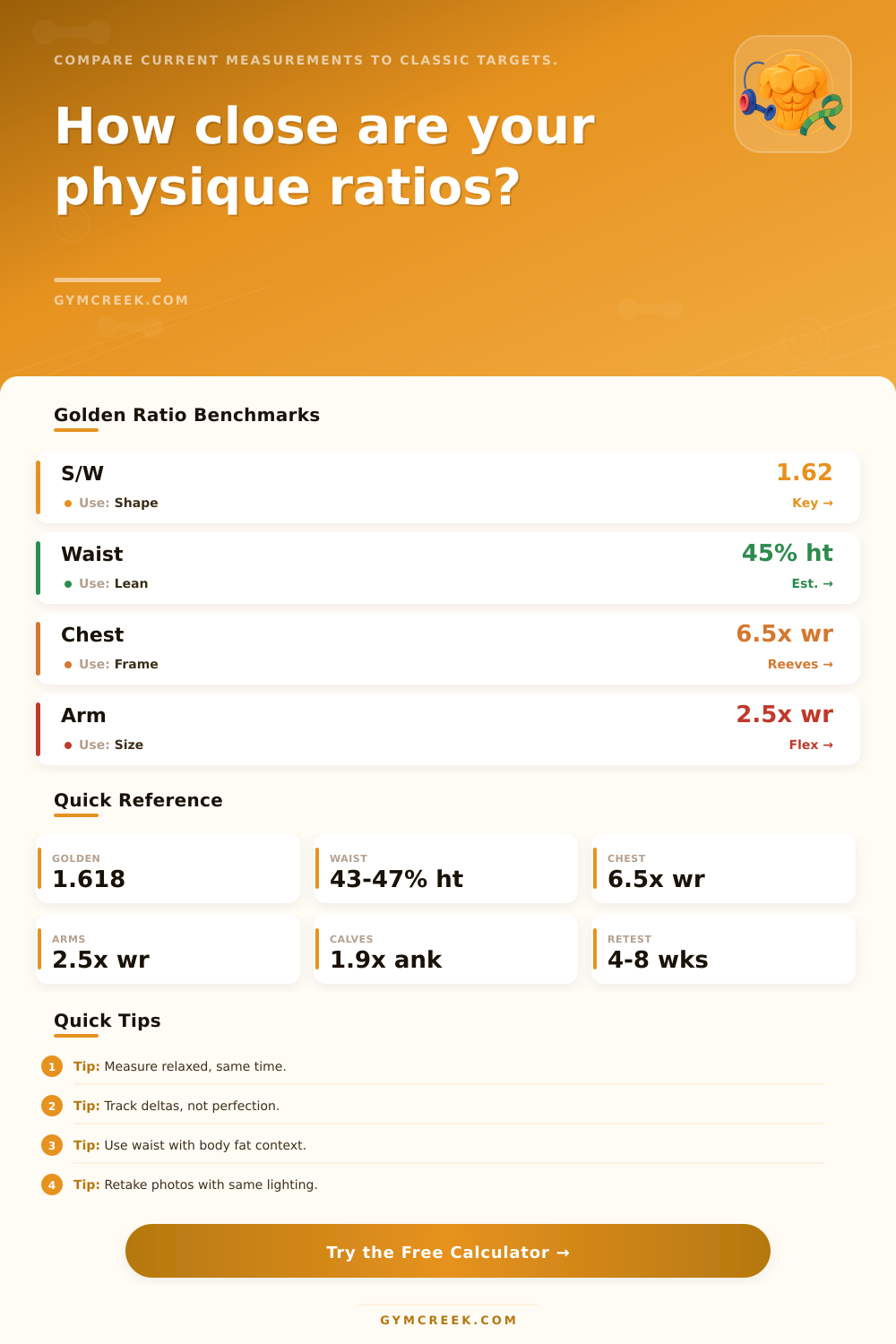
| Waist | Height x 0.43 to 0.47 | Lean visual baseline | Higher body fat usually raises the number. |
| Shoulders | Waist x 1.50 to 1.62 | V taper comparison | Measured around delts, not bone width. |
| Chest | Wrist x 6.3 to 6.8 | Frame-based target | Classic model inspired by Steve Reeves style ratios. |
| Upper arm | Wrist x 2.35 to 2.55 | Arm size estimate | Use flexed arm consistently on both sides. |
| Calves | Ankle x 1.75 to 1.95 | Lower leg balance | Genetics and tendon length affect appearance. |
| Current Ratio | Typical Range | Reading | Use With |
|---|---|---|---|
| Shoulder / Waist | 1.45-1.70 | Main taper indicator | Waist and delts |
| Chest / Waist | 1.25-1.45 | Torso balance | Chest and leanness |
| Hip / Waist | 1.10-1.45 | Pelvis and glute balance | Goal template |
| Arm / Wrist | 2.20-2.70 | Frame-adjusted arm size | Wrist size |
| Calf / Ankle | 1.60-2.05 | Frame-adjusted calf size | Ankle size |
| Scenario | Likely Priority | Check First | Retest Cadence |
|---|---|---|---|
| Lean bulk | Chest, arms, shoulders | Waist drift | Every 4 weeks |
| Recomposition | Waist down, muscle up | Body weight trend | Every 4-6 weeks |
| Classic physique | Symmetry gaps | Shoulder/waist ratio | Every 6 weeks |
| Strength focus | Waist context | Chest and thigh balance | Every 8 weeks |
| Formula | Variables | Output | Limitation |
|---|---|---|---|
| Golden ratio | Waist x 1.618 | Shoulder target | Visual ideal, not a rule. |
| Height waist | Height x factor | Waist target | Depends on leanness. |
| Frame chest | Wrist x factor | Chest target | Wrist is only one frame marker. |
| Delta scoring | Current vs target | Gap ranking | Does not rate health. |
💡Practical Notes
The golden ratio is an mathematical equation that provides a blueprint for determining the visually appealing physique. While many individual focus on building muscle mass or losing body fat, individuals can neglect the importance of the relationship of each muscle group within the body. The golden ratio focus on the relationship of each muscle group to one another rather than the total amount of muscle that an individual possess.
Therefore, an individual should focus on the proportions of your body rather than the size of its muscles. The golden ratio’s focus on the V-taper suggest that the slope from an individual’s wide shoulders to their narrow waist is the most visually appealing to the human eye. The V-taper’s relationship to the shoulder and waist width indicate that if an individual increases their shoulder width but their waist width increase at a faster rate, the V-taper will decrease.
Build a Balanced Body with the Golden Ratio
An individual with a smaller waist will have a shallower V-taper and is, therefore, a key component to creating that visual illusion of a V-taper. An individual must understand their frame size as it determine what physical measurements is appropriate for the body. An individual with a larger bone structure will require more muscle mass than an individual with a smaller bone structure.
Wrist and ankle measurement are the best measurements to use to adjust the target measurements for each muscle group to the individuals physical skeleton. An individual should always account for their frame size when determining the perfect muscle group measurements for that individual. The waist is a critical measurement in the golden ratio.
While the waist is a critical element of the golden ratio, it is also the most volatility measurement of an individual’s physique. An individual’s waist measurements will change based on their body fat. An individual’s target waist measurement should be viewed as a sliding scale.
The waist will change during a bulking phase as compared than the target measurement. However, the difference between the two measurements will determine whether an individual should be performing a cut or a bulk phase to gain more muscle mass. Many bodybuilders focus on the muscles that is most visible to the average individual in a mirror.
By failing to balance the muscles in the lower body, an individual may have an impressive upper body but lack the balance need for a perfect physique. The relationship between the calves and the ankles or the thighs and the height of the individual could see indications of imbalance in the lower body. If an individual has the target measurements for their upper body but their calves dont meet the target measurement, they must focus more on their calf muscle training.
The timing of when an individual take their measurements is crucial to understanding the actual progress that they are making in terms of muscle building. The waist measurements will change due to the meals that an individual eat. The muscle group will change based on the carbohydrates that an individual consumes.
Therefore, take the measurements at the same time of day when an individual is in a relaxed state of mind. Track the measurements over a four to eight-week period to provide an indication of the actual change to an individual’s body. Finally, an individual must remember that the golden ratio is a guide for muscle building, not a law.
An individual’s genetics will determine the way that their body carry the fat and the way that their muscles attach to their bones. The perfect ratio to suit each individual will never be possible due to the different bone structures of each person. However, the golden ratio is of more use to an individual who train with the golden ratio as a way to focus on their training needs rather than the weight that they lift on the bar.