Goblet Squat Weight Calculator
Estimate your goblet squat max, target training load, weekly squat volume, and bodyweight strength ratio from one honest set.
📌Presets
Each preset loads a realistic goblet squat scenario and recalculates estimated max load, target weight, tonnage, and squat ratio.
⚙Calculator
Goblet squat snapshot
Enter a clean working set to estimate load targets, volume, and relative strength.
📊Fitness Metrics Comparison
📑Reference Tables
| 1RM to body weight | Male benchmark | Female benchmark | Reading |
|---|---|---|---|
| Patterning | Under 0.30x BW | Under 0.22x BW | Learn bracing and depth |
| Beginner | 0.30-0.45x BW | 0.22-0.35x BW | Solid entry strength |
| Novice | 0.45-0.65x BW | 0.35-0.50x BW | Good loaded squat base |
| Intermediate | 0.65-0.85x BW | 0.50-0.70x BW | Strong goblet standard |
| Advanced | Over 0.85x BW | Over 0.70x BW | Very high for goblet style |
| Goal | Target zone | Typical reps | Weekly sets |
|---|---|---|---|
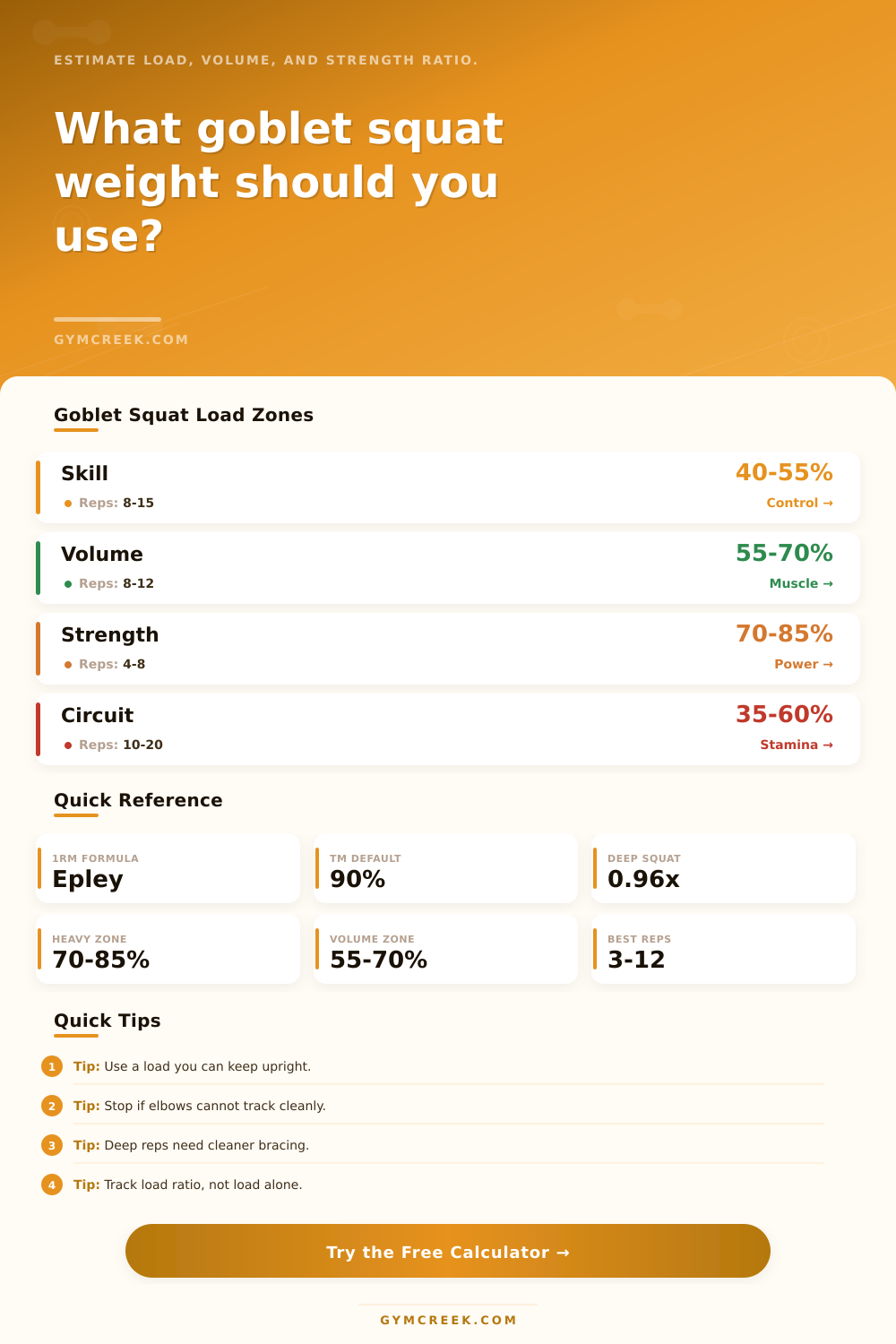
| Technique and mobility | 40-55% 1RM | 8-15 reps | 3-8 clean sets |
| Leg hypertrophy | 55-70% 1RM | 8-12 reps | 6-14 hard sets |
| Strength focus | 70-85% 1RM | 4-8 reps | 4-10 hard sets |
| Conditioning circuit | 35-60% 1RM | 10-20 reps | 4-12 total sets |
| Return to squatting | 35-55% 1RM | 6-12 reps | 2-6 careful sets |
| Depth or tempo | Estimate factor | Why it changes | Use note |
|---|---|---|---|
| Parallel depth | 1.00x | Standard comparison | Main reference |
| Deep squat | 0.96x | More range of motion | Harder estimate |
| Box target | 0.98x | Consistent bottom point | Good for tracking |
| Limited depth | 1.04x | Shorter range | Do not overstate |
| Paused bottom | 0.97x | Less bounce | Cleaner control |
| Slow eccentric | 0.95x | Higher time under tension | Harder reps |
| Formula | Calculation | Best use | Role here |
|---|---|---|---|
| Epley | Load x (1 + reps / 30) | 1-12 reps | Main max estimate |
| Brzycki | Load x 36 / (37 - reps) | 1-10 reps | Cross-check estimate |
| RPE reserve | Reps plus reps in reserve | RPE 6-10 sets | Effort adjustment |
| Training max | Estimated 1RM x 90% | Practical loading | Safer planning base |
| Load ratio | 1RM / body weight | All lifters | Relative strength |
| Scenario | Common load | Reps | Expected signal |
|---|---|---|---|
| Beginner patterning | 15-35 lb / 7-16 kg | 8-12 | Depth and posture first |
| Home kettlebell work | 35-53 lb / 16-24 kg | 8-15 | General lower body base |
| Hypertrophy block | 45-80 lb / 20-36 kg | 8-12 | Leg volume and bracing |
| Strength emphasis | 70-120 lb / 32-54 kg | 4-8 | Heavy goblet challenge |
| Conditioning circuit | 20-60 lb / 9-27 kg | 10-20 | Stamina and repeatability |
💡Tips
Picking an inappropriate kettlebell weight is going to strain your knees or your lower back so don’t treat this as a guessing game. Typically, the issue isn’t a lack of effort; it’s that you’re forcing bad mechanics by using too much weight. Your goal is to have a number in mind that falls within your ability but still gives you some reserve to maintain good posture. Ego is the enemy, and people let their ego win out over structure, and then they wonder why progress stalls after two weeks.
With just one working set, you don’t have to guess anymore. You’ll never again wonder what your real maximum is; now you’ll know exactly where you’re at. All you do is enter the load used, your bodyweight and the number of clean rep performed. Then the calculator above does the rest: It plugs all this raw data into proven strength formulas such as Brzycki or Epley and spits out a theoretical one-rep max; your starting point.
How to Choose the Right Kettlebell Weight
Now you can select a percentage range depending on your goal (raw strength vs. You can select a percentage range depending upon your goal, such as building muscular endurance. And voila, you have concrete targets for next Tuesday’s session instead of vague fatigue levels.
This all starts to change based off how deep you squat. Stopping at thigh-parallel requires much less ankle and hip mobility than dropping below parallel. Going deeper also put more emphasis on your hamstrings and glutes. This reduces the focus on your quads and creates a longer time under tension. So if you’re squatting lighter weights but still hitting full depth, that weight is really carrying some heavy loads. In fact it’s doing more heavy lifting then a heavier weight squatted very shallowly.
To account for this, the tool lowers its estimate as you choose paused or deep variations. This acknowledges that it becomes increasingly difficult to maintain control at the bottom of the lift as we gets tired. Without this, we might accidental overestimate our ability to use momentum to bounce out of the hole. That can be a very dangerous trap in functional training.
Most of the breakdown in home gym workouts occurs in the area of volume management. “I’ll do four sets, I figure that’s enough.” But what if you’re going really heavy on each set and performing those four sets across three sessions a week? Then you may have accumulated more than your body can recover from. By tracking how many pounds you’ve moved in a given week, you can determine whether you’re either overtraining (too much) or under-training (not enough).
When you find yourself flat-footed and sluggish, a look at that weekly volume number will often show the fact that you’re just piling up too much stress without enough rest. It is a tiny detail, yet huge to long-term progress.
The ratio of your numbers against others’ makes those numbers come alive. Seeing how much more you can goblet squat than your bodyweight is a relative measure of your strength. This holds true regardless of whether your mass change. Does your strength increase with your size? That’s what it allows you to know. It forces you out of thinking in terms of absolutes. How strong are you?, and into thinking in terms of function. How well do I move my body?
Adding more pounds each workout might not be progress. Maybe today is about deepening the range of motion or cleaning up the tempo; maybe it’s about dropping the load by ten percent. How do you know? With the calculator. It tells you when you’ve got some wiggle room, and when you need to stand pat on form.
It shows you the road ahead in a logical way that respects the body’s desire for consistent training over erratic hero cycles. You begin developing real strength instead of chasing imaginary numbers. Not only will you lift more today, but you’ll move better tomorrow. And that’s what keeps back straight and the knees quiet for years to come.