Goal Date Weight Calculator
Estimate the pace, calorie target, macro targets, checkpoints, and feasibility needed to reach a goal weight by a chosen date.
◎Goal Date Presets
Presets load complete examples with body stats, target date, activity, calories, adherence, and macro settings. Change any field after loading one.
⚙Calculator Inputs
Goal date weight snapshot
Enter your deadline and body stats to estimate the required pace.
▦Fitness Metrics Grid
▣Reference Tables
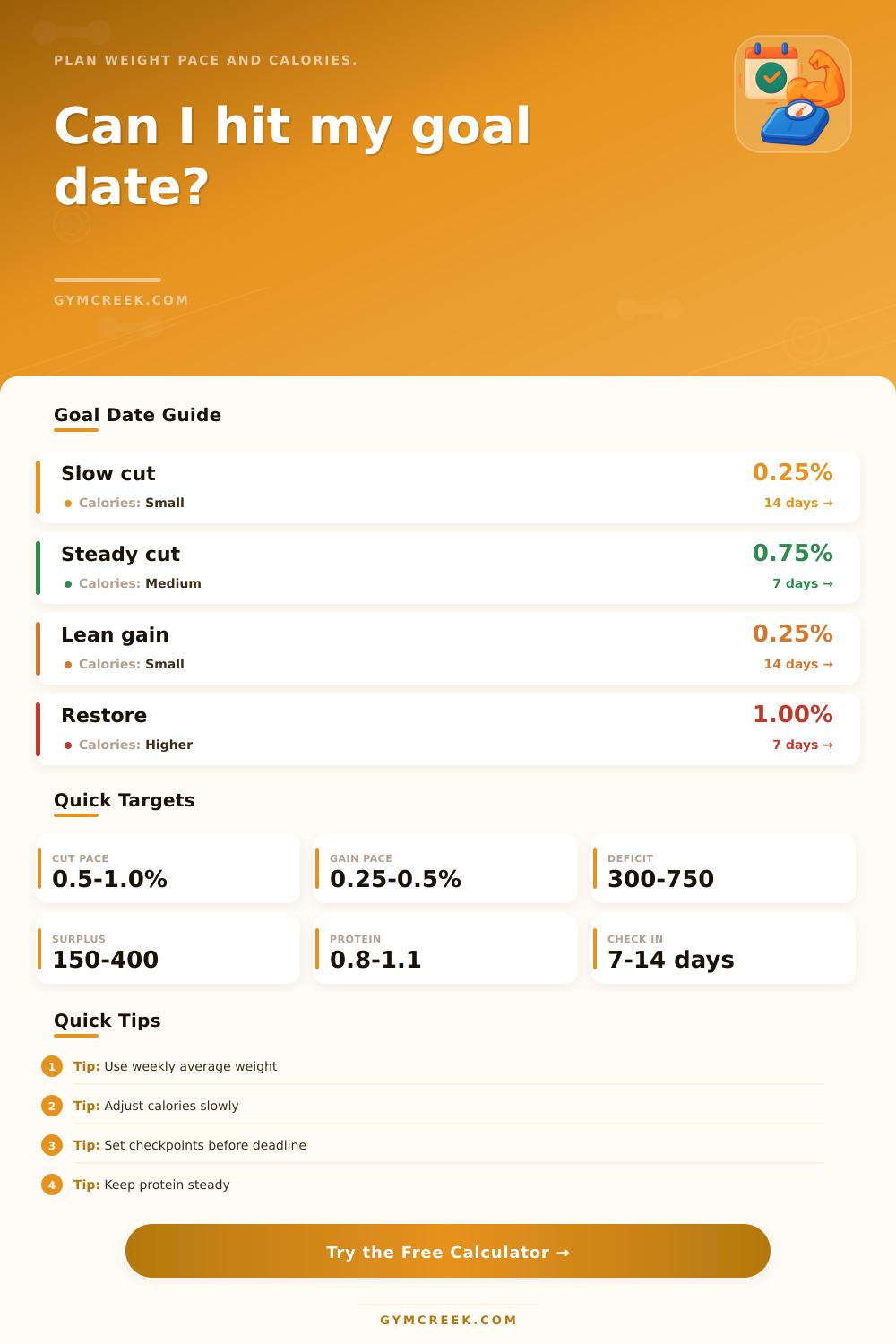
| Goal type | Typical weekly rate | Calorie style | Best use |
|---|---|---|---|
| Conservative fat loss | 0.25-0.50% body weight | Small deficit | Lean, busy, or performance focused |
| Standard fat loss | 0.50-1.00% body weight | Moderate deficit | Most planned cuts |
| Lean muscle gain | 0.10-0.50% body weight | Small surplus | Limit excess fat gain |
| Restoration gain | 0.75-1.25% body weight | Higher surplus | Use with professional support |
| Daily change | Signal | Scale trend | Adjustment rhythm |
|---|---|---|---|
| Under 200 kcal | Subtle | Slow and noisy | Review 14-21 days |
| 200-500 kcal | Manageable | Clear trend | Review 7-14 days |
| 500-750 kcal | Demanding | Faster trend | Watch recovery and hunger |
| 750+ kcal | Aggressive | High pressure | Extend date or get guidance |
| Timeline | Check-in focus | Weight method | Decision |
|---|---|---|---|
| Week 1 | Water and routine | Daily weigh-ins | Do not overreact |
| Weeks 2-3 | Trend accuracy | 7-day average | Adjust 100-150 kcal |
| Midpoint | Deadline reality | Compare target line | Change date if needed |
| Final week | Stability | Same conditions | Avoid extreme changes |
| Output | Formula | Inputs | Purpose |
|---|---|---|---|
| BMR | Mifflin-St Jeor | Age, sex, size | Base metabolism |
| Lean BMR | Katch-McArdle | Lean mass | Body fat known |
| TDEE | BMR x activity | BMR and multiplier | Maintenance calories |
| Goal calories | Weight gap x 3500 | Deadline and adherence | Daily target estimate |
◇Tips
There’s a date when you want to be able to fit into something, and then there’s your present weight. On paper, this appears like magic. In real life, it’s arithmetic. When most of us try to lose weight, we don’t lack motivation for losing weight; we know how to diet, but we struggle with understanding what our timeline demand from us before we even start. You can only plan around, not negotiate with, metabolism and gravity.
A deadline creates an urgency that lets you see your goals without any time-wasting procrastination. After plugging in your numbers, the calculator does the work for you. You will no longer have to guess whether your desired outcome is actualy possible. It uses normal metabolic equations to estimate how many calories you need just to maintain your current weight. Next, it multiplies this figure based off your level of physical activity. How many calories do you need to maintain your weight based on your lifestyle? Finally, it tells you exactly how much of a calorie deficit/surplus you should of aim for each day to hit your desired weight by a certain deadline. No more guesswork. Just a simple roadmap.
Why Consistency Is More Important Than Speed
This is why consistency beats intensity here. If you’re losing weight too quickly, it’s either a) not sustainable fat loss or b) you’re burning away your muscle and adapting your metabolism. There are charts of the safe pace bands included as part of the tool. This is because biology can only handle so much. Going too fast hurts your energy levels, makes you hungrier, and make it more difficult to stay on track long-term. Adherence trumps intensity, all day, everyday.
The feasibility output is something to be checked as well. If the speed needed exceed the suggested range, the system will flag that as “demanding” or “aggressive.” That’s not a challenge; it’s a warning sign. It is a reminder that maybe you should change the deadline instead of starving yourself. Successful transformations are almost always slow. They are slow enough to form habits and recover. You’ll see that in the calculator before committing to an unrealistic plan.
When cutting, maintaining muscle is a critical factor, which means eating enough protein! To do that, the tool allows you to target certain macros. By keeping protein constant, but lowering carbs (or fat), you’ll stay full, strong, and happy. To understand more about how your calories impact hunger & recovery, check out the reference section.
If you go too large, every meal becomes a negotiation. You won’t know what’s okay vs not. Go too large, and every meal becomes a negotiation. Go too small, and you might get bored, but at least you’re normal. Better to be bored then broken.
I realized there were checkpoints. A single day’s weight isn’t reliable, because it varies based off water retention, sodium consumption, and hormone levels. To filter this noise, the calculator recommends checking back in every ~2 weeks. This gives your body time to adjust to the new energy balance. It takes patience (a mechanical requirement) if you want accurate data.
Adherence might be the most underemphasized variable in all fitness plans. On paper, your calorie target may be ideal. But if you adhere to it 6 days a week instead of seven, then the math shift. Enter an expected level of adherence into the tool, and it’ll adjust the necessary deficit accordingly. It will bend, not break. That’s what makes a plan resilient. Breakable plans is no good. Bendable ones keep you marching onward.
As much as calorie-counting is about hitting a number on a scale, it’s also about expectation management. You can see what’s possible with the numbers, but how you choose to eat day-to-day makes all the difference. It’s no different whether you’re trying to gain muscle for a strength contest or cut for a summer wedding. Use the tools at hand, start from wherever you are, and keep in mind that the deadline isn’t the finish line; it’s just a mark along the road.
Show up even if the scale doesn’t move because the process is more than just a number; it’s the journey. And consistency makes a difference over time.