Glycogen Depletion Calculator
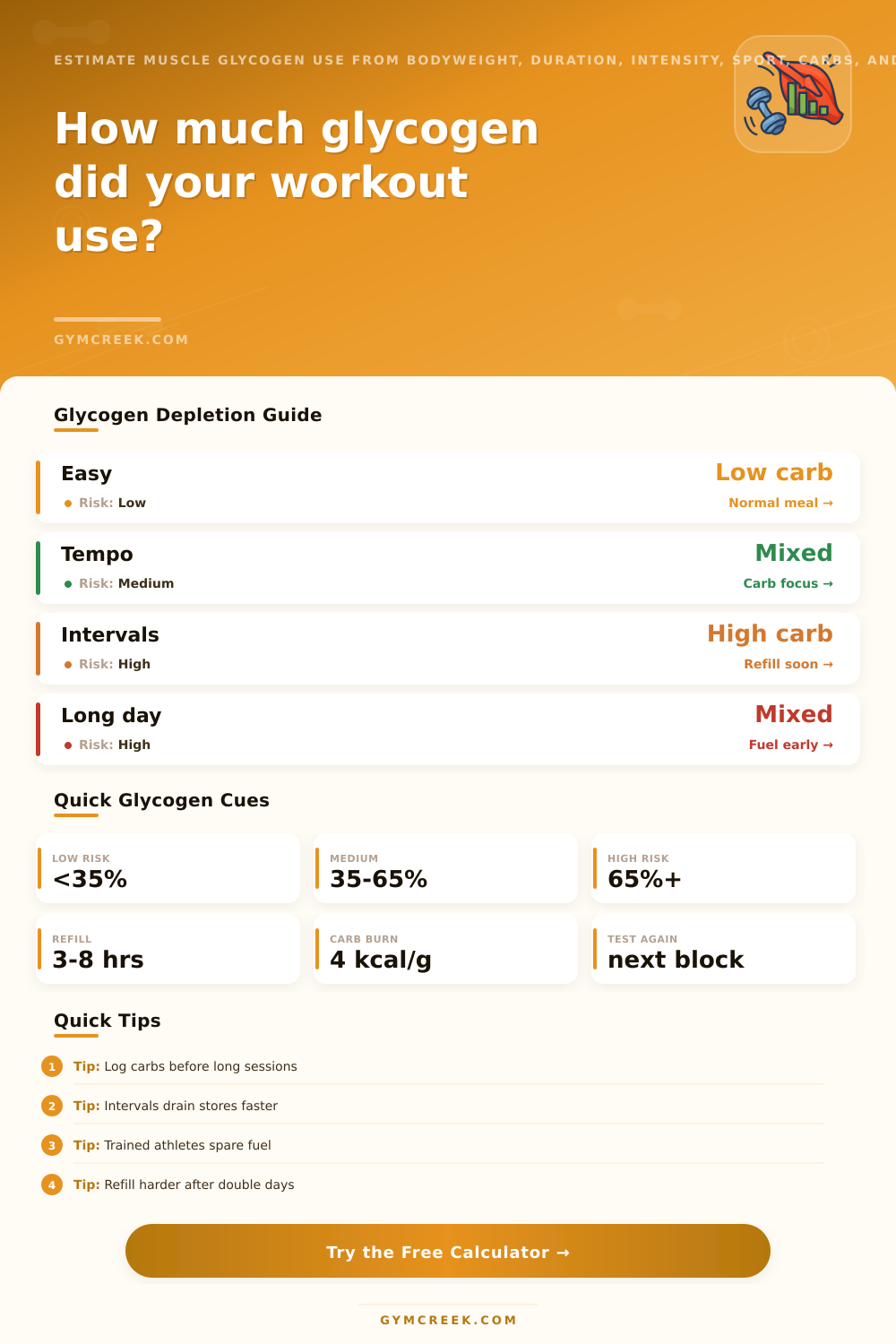
Estimate how much muscle glycogen a session may use from bodyweight, workout duration, intensity, modality, carbohydrate intake, training status, muscle mass estimate, and workout protocol.
📌Glycogen Session Presets
Presets load realistic training situations. Adjust the numbers after loading to reflect your own body size, session structure, fueling, and recent carbohydrate intake.
⚙Calculator Inputs
Glycogen depletion snapshot
Your estimated glycogen use, remaining stores, depletion risk, and refill target update from the session inputs.
📊Metrics Grid
📑Reference Tables
| Intensity | Typical fuel mix | Glycogen pressure | Best interpretation |
|---|---|---|---|
| Easy aerobic | Lower carbohydrate share, especially in trained athletes | Slow depletion unless duration is long or starting stores are low | Useful for base work and recovery sessions, but long sessions still add up |
| Steady endurance | Mixed fuel with meaningful carbohydrate use | Moderate depletion over 60-150 minutes | Watch accumulated fatigue if the next day is hard |
| Tempo or threshold | High carbohydrate share | Fast depletion even when the workout is not very long | Pre-session carbs and post-session refill matter more |
| VO2 intervals | Very high carbohydrate share during work bouts | High local muscle glycogen use with incomplete recovery between reps | Often feels drained even when total minutes look modest |
| Sprint repeat work | Highest local carbohydrate dependence | Severe local depletion in active fibers | Results can understate local leg or arm fatigue |
| Modality | Active muscle pattern | Calculator adjustment | Practical note |
|---|---|---|---|
| Running | Large lower-body demand with impact cost | Higher kcal rate and broad leg muscle involvement | Hills, surges, and heat raise glycogen use quickly |
| Cycling | Concentrated leg demand with lower impact | Moderate kcal rate, high local quadriceps demand | Power data usually improves the estimate if tracked separately |
| Rowing or ski erg | Upper and lower body active together | Broad active muscle estimate with high carb use at hard efforts | Technique changes energy cost and local fatigue |
| Strength training | Local muscle groups with rest periods | Lower whole-session kcal but high local glycogen stress | Heavy volume days may drain target muscles more than the total suggests |
| Mixed conditioning | Repeated whole-body bouts | Higher protocol multiplier and active mass fraction | Short rests and dense circuits increase carbohydrate dependence |
| Starting status | Approximate store setting | When to choose it | Risk cue |
|---|---|---|---|
| Carb loaded | High grams per kg of muscle | You had high carbs, taper, or a dedicated refill day | Depletion risk usually needs long or hard work |
| Normal mixed diet | Moderate-high stored glycogen | Usual eating with no major prior depletion | Medium workouts are normally recoverable |
| Partial refill | Reduced stores before training | Previous hard day, travel, low appetite, or short recovery | Moderate sessions may feel flat late |
| Low carb or fasted | Low muscle and liver support context | Intentional low-carb day or early fasted work | High-intensity work is harder to sustain |
| Already depleted | Very low start estimate | Back-to-back events or under-fueled training block | Use conservative outputs and prioritize recovery |
| Component | How it is estimated | Why it matters | Limitations |
|---|---|---|---|
| Muscle glycogen capacity | Estimated muscle mass multiplied by grams stored per kg muscle | Sets the size of the fuel tank being depleted | Body composition and recent diet can change the true value |
| Exercise energy cost | MET-like modality factor times bodyweight and duration | Estimates total exercise calories before fuel split | Power meters and lab data can be more precise |
| Carbohydrate share | Intensity, modality, protocol, training status, and stress modifiers | Converts energy cost into carbohydrate demand | Individual fat oxidation differs widely |
| During-session carbs | Carbs per hour multiplied by duration and absorption factor | Offsets part of the glycogen requirement | Gastric tolerance and timing affect actual availability |
| Recovery target | Glycogen used plus priority multiplier and bodyweight cap | Gives a practical refill range after the workout | This is not a meal plan or medical nutrition prescription |
💡Tips
Glycogen is another form of carbohydrate that sits inside the muscle fiber of the body. Glycogen function as a fuel source for the body when the individual puts forth physical effort. Individuals typicaly do not notice their glycogen levels until they begins to feel fatigued or they can no longer maintain the same physical pace.
At this point, individuals may begin to wonder how much the body has use of glycogen and how much of that glycogen must be replaced. With the glycogen calculator described in this article, individuals can use the mathematical calculation to determine these amount. This calculator will help an individual move from a state of uncertainty regarding glycogen depletion to one of clarity regarding the amount of glycogen that the muscle has burned.
Use the glycogen calculator to see how much glycogen you burn
To use this calculator, an individual must first enter the detail regarding the exercise that was performed, including its duration and intensity. The longer that an individual performs an exercise or the higher the intensity level, the more the body will use glycogen. For instance, an individual performing a steady ride will use less glycogen then an individual performing high intensity interval training for the same length of time.
Additionally, the modality of exercise can impact how much glycogen is used. For instance, running will use more glycogen than strength exercises that utilize smaller muscle group. These variables will impact the glycogen depletion estimate that the calculator projects.
An individual’s starting glycogen level and carbohydrate intake will determine the amount of glycogen that they have available at the start of an exercise session. An individual that consume more carbohydrates the day before exercise will have more glycogen levels than an individual that consumes few carbohydrates. These variables will allow the calculator to calculate the starting store of glycogen that an individual possesses.
This value will ensure that the calculator determine the remaining amount of glycogen that an individual has rather than making an assumption about that remaining amount. An individual’s training status will also impact there glycogen level. Well-trained endurance athletes has higher glycogen levels and can utilize more of that glycogen during easier form of exercise.
Therefore, two individuals with the same training status who perform the same exercise will have different amount of glycogen and fatigue in their muscles. During an exercise session, an individual can fuel their exercise by consuming carbohydrate. The glycogen calculator will account for the amount of carbohydrate that an individual consume during exercise.
This will impact the amount of glycogen that can be replenished during the recovery period following exercise. If the next exercise session occur in close proximity to the exercise session that is being calculated, the individual has a limited time in which to consume carbohydrate to replenish glycogen store. The tables that are provided with the glycogen calculator allow an individual to determine how the intensity, modality, and starting glycogen levels of an exercise session impact the amount of glycogen that is depleted during that exercise.
These tables will allow an individual to understand why individuals that start their exercise with low glycogen levels will burn more glycogen. Additionally, the tables will allow an individual to understand why the second exercise session in one day will deplete glycogen at a higher rate than the first exercise session. This is due to the fact that glycogen store are never completely replenished between exercise sessions.
External factor such as exposure to heat, dehydration, stress, and sleep will impact glycogen levels as well. An option for stress will allow the glycogen calculator to account for these external factor. The glycogen calculator will provide an estimate of the amount of glycogen burned, but it will allow an individual to compare the amount of glycogen an individual burned during different exercise sessions within several week.
An individual can use the glycogen calculator to determine whether a period of training has depleted their glycogen or whether they are maintaining a healthy level of glycogen. If an individual calculates the glycogen level after performing a period of training, the glycogen calculator will allow that individual to prioritize the consumption of carbohydrate during the next meal that the individual consumes. If an individual calculates their glycogen level after performing modest levels of exercise on an easy day, they can reduce the amount of effort that they must expend to replenish their glycogen level.
With the use of this calculator, an individual can recognize their glycogen level in relation to the amount of training that they perform and the diet that they consume. If an individual recognize that their glycogen levels are low prior to the start of important exercise session, they can use the glycogen calculator to determine if the consumption of carbohydrate the day before will impact their glycogen level.