Glute Bridge Load Calculator
Estimate loaded bridge strength, hip-thrust carryover, effective system load, range of motion, pause difficulty, and a practical glute activation score.
📌Bridge Presets
Each preset updates bodyweight contribution, bar load, ROM, pause duration, RPE, and setup style before calculating.
⚙Calculator
Glute bridge snapshot
Enter load, reps, RPE, setup, pause, and ROM to estimate your bridge loading.
📊Metrics Grid
📑Reference Tables
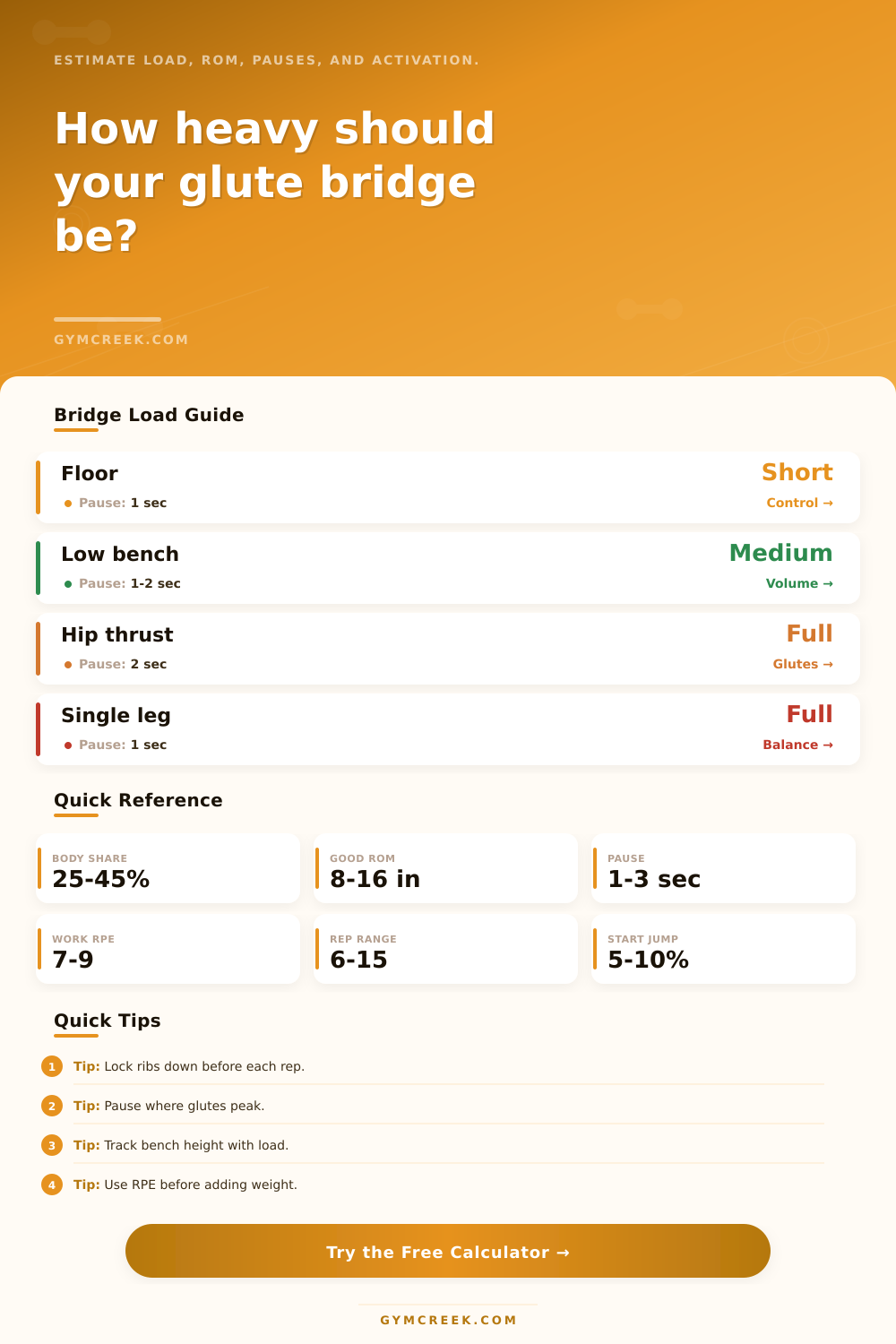
| Setup | Body share moved | ROM pattern | Best reading |
|---|---|---|---|
| Floor glute bridge | About 25-30% | Shorter hip rise | Control and return to load |
| Barbell floor bridge | About 30-35% | Moderate hip rise | Bridge strength with stable torso |
| Low bench thrust | About 34-38% | Medium-full hip rise | Glute load with easier setup |
| Bench hip thrust | About 38-45% | Full hip extension | Highest loaded glute output |
| ROM range | Imperial | Metric | Interpretation |
|---|---|---|---|
| Short | 4-7 in | 10-18 cm | Floor, rehab, or partial reps |
| Moderate | 8-11 in | 20-28 cm | Most floor bridges and low benches |
| Full | 12-16 in | 30-41 cm | Hip thrust range for many lifters |
| Very long | 17+ in | 43+ cm | Check bench height and rib position |
| Pause | Difficulty effect | Activation signal | Use case |
|---|---|---|---|
| 0 sec | Lowest | Low-moderate | Power or speed focus |
| 1 sec | Moderate | Good | Standard working sets |
| 2 sec | High | Very good | Hypertrophy and lockout control |
| 3+ sec | Very high | Strict | Technique and activation checks |
| RPE | Bridge reps left | Load action | Watch point |
|---|---|---|---|
| 6-7 | 3-4 reps | Add load if form is clean | May be too easy for strength |
| 7.5-8 | 2 reps | Good working range | Keep full lockout pauses |
| 8.5-9 | 1 rep | Heavy productive range | Avoid lumbar extension |
| 9.5-10 | 0 reps | Test or peak only | Do not chase sloppy reps |
💡Tips
For most lifters, the glute bridge is a numbers game. If you look at weight on your hips, you think that’s all there is to it. That’s not true. Your load is only one component. The other components are how far you move, amount of body mass you’re moving, and the pause at the top. If you neglect those factors, you’ll feel lower back pain or inconsistancy in your progress.
When you input your information into this calculator, it does math for you. It will help you determine whether doing a heavy glute bridge on the floor is more harder than a lighter hip thrust with a hold.
More Than Just Weight
But not all bridges are created equal. For example, a floor bridge has limited range of motion and a very heavy torso. Your spinal erector and hamstrings does most of the work. Using a bench to perform a hip thrust alters the leverage. You increase your upper back elevation and change center of mass. Because of this, you can create deeper stretch at bottom position. This leads to more glute activation. And it changes distribution of the load as well. There is less body weight and more external load.
The tool demands that your set-up. It adjusts the bodyweight contribution based off whether or not you’re using floor, a low box or a standard bench.
Strength equals range of motion. Pushing two-hundred pounds does nothing unless you can also raise yourself three inches. It is not strength training, it is about momentum. Real glute strength come when you move your hips through an entire vertical distance. Benching need at least a dozen inches and sometimes much more. As the table of references shows: shorter ranges are about control. Longer ones call for real extension power.
I know measuring your range of motion sounds boring. But it separates a working set from a warm-up one. If you don’t know what height to measure, then those load numbers means nothing.
The pauses eliminate the cheating. Dipping at the top, or bouncing out of bottom: these are common errors among most lifters. It helps because they’re using some form of elastic energy. That bounce comes to a halt when you perform a one-second pause. Your glutes stays engaged. Your hips don’t put weight on your spine. The calculator takes this into account. Two seconds? That doubles the difficulty (or even more). To make the set more difficult, you don’t have to add weight. All you need to do is stop moving.
Tempo counts too. Slowing down the descent creates tension without increasing peak load. This is good for both your lower back and for building muscle.
The last variable is RPE. If you’re training at eight or nine, that’s when you leave yourself with one or two reps in reserve. For strength, that’s where you want to be. At a 10, you start grinding… Sacrificing form for ego.
Those are the factors the tool uses to estimate your one-rep max. And it’ll give you a target that’s realistic. It’ll also provide a glute activation score. That helps guide you on whether you’re isolating target muscle well. If the score is high, then you’ve got a good combination of setup, range of motion and pauses. They focus on the glutes, not the hamstrings. It’s all about technique, and tracking progress through consistency. If you get your form right, then you’ll tack on five more pounds each week.
Maybe you want to knock off a new personal record so you take short cuts with your form and pick up the pace. It makes it a bit easierer. Lock those ribs down. You must control that descent. Holding into that top position. Those are things that will make the number come. It’s not about lifting the biggest bar; it’s about moving it properly.