Girth Body Fat Calculator
Estimate body fat from tape measurements using the U.S. Navy circumference method, averaged readings, and unit-aware girth inputs.
📌Presets
Each preset fills realistic tape readings, including repeated neck, waist, and hip measurements so you can see how the estimate changes.
⚙Calculator
Tape body fat snapshot
Enter girth readings and calculate the Navy circumference estimate.
📊Tape Snapshot
📑Reference Tables
| Site | Male Method | Female Method | Tape Cue |
|---|---|---|---|
| Height | Standing | Standing | No shoes |
| Neck | Below larynx | Below larynx | Level tape |
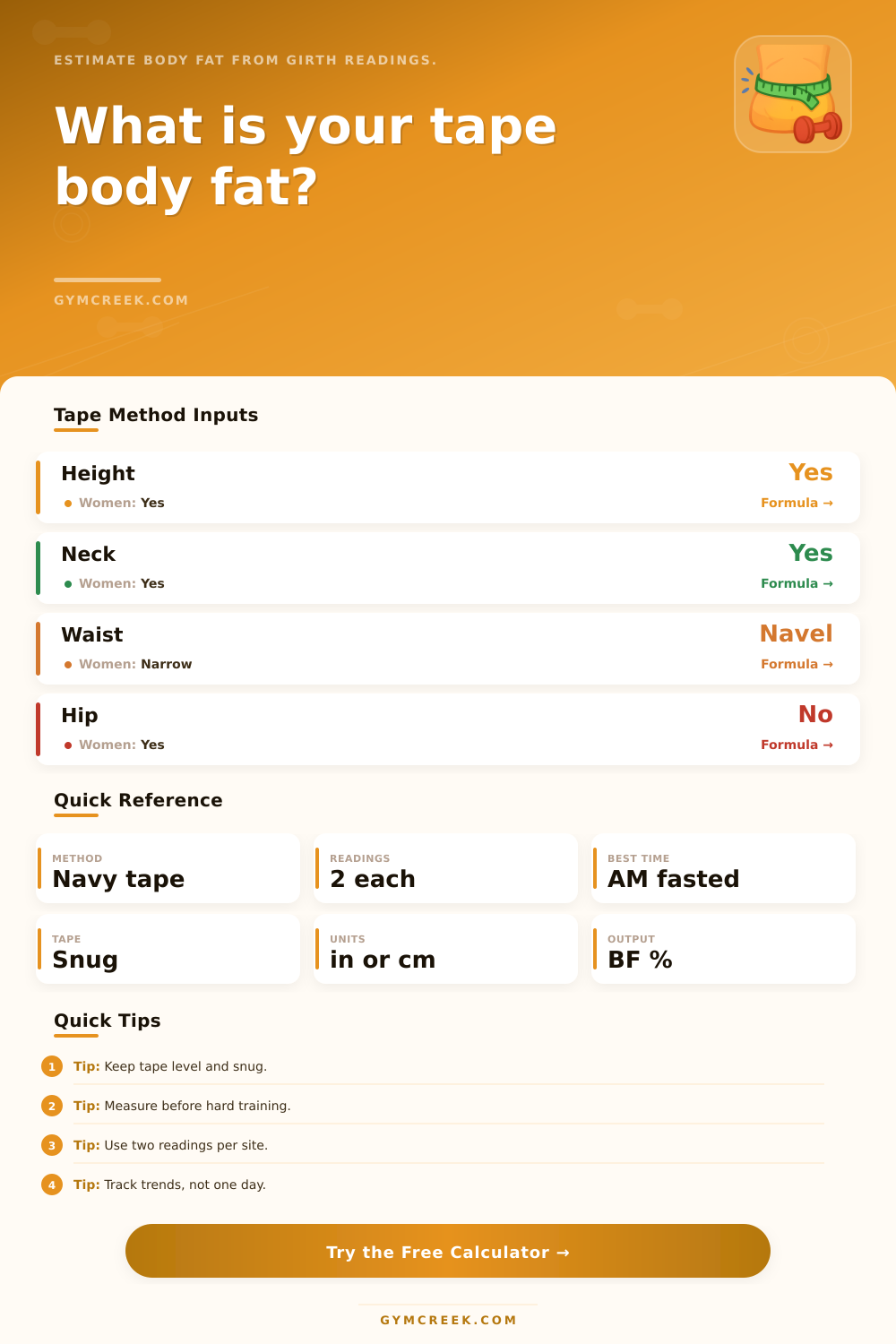
| Waist | At navel | Narrowest | Normal breath |
| Hip | Not used | Widest point | Feet together |
| Category | Men | Women | Training Note |
|---|---|---|---|
| Essential | 2-5% | 10-13% | Very low |
| Athlete | 6-13% | 14-20% | Sport lean |
| Fitness | 14-17% | 21-24% | Lean fit |
| Average | 18-24% | 25-31% | Common range |
| Higher | 25%+ | 32%+ | Track trend |
| Scenario | Best Time | Repeat Gap | Action |
|---|---|---|---|
| Weekly check | Morning | 0.25 in | Use average |
| Post meal | Later day | 0.5 in | Flag result |
| After pump | Post lift | 0.5 in | Retest AM |
| New tape | Any time | 0.25 in | Compare twice |
| Formula | Variables | Units | Use |
|---|---|---|---|
| Navy men | Height, neck, waist | Inches | Male estimate |
| Navy women | Height, neck, waist, hip | Inches | Female estimate |
| Lean mass | Weight and BF% | Any | Progress check |
| Target weight | Lean mass and target BF | Any | Goal context |
💡Tape Tips
But here’s the thing with scales: It doesn’t tell you if your change in weight is from muscle gain or water loss. It simply tells you total body mass. So you’re left to guess what’s really happening underneath the number.
And this is how most people quit within weeks of starting their fitness journey. They start thinking “I’m working hard for nothing” when in fact the opposite is often true. You could very well have lost inches around middle while keeping more weight, which means you are becoming leaner. You could also gain weight while losing fat.
Why Scales Are Not Enough
You will find out soon enough. That’s the key: Understanding what is really happening under the surface vs. This is what you see when you step onto the platform. It’s also important to remember: A scale reads only one dimension of a three-dimensional problem (body composition). By measuring your girths (including your hips), neck and waist, you’re putting some sort of context around volume of your mass. These circumference numbers fill the gap between a number on scale and your overall shape.
What the scale won’t tell you at all, for example, is if you’ve lost inches from your midsection or not. Once you enter these girth values into the calculator above, it does the rest of the work for you, no need to get tangled up with unit conversions and logarithmic equations. It simply takes the Navy method, a method used for decades to estimate body fat without the need for special equipment, and runs it through your personal inputs. So what you end up with is a percentage reflecting your actual state much better then a number on the scale ever will.
The key isn’t absolute accuracy. It’s consistency. Don’t worry about getting a DEXA scan or using a medical grade caliper to monitor changes: A basic flexible tape measure is enough…if used properly. Measure at the same time of day (ideally in the morning after waking, before breakfast) when your body is most stable or hydrated. Use no clothing between the tape measure and your skin. Use minimal compression of your tissue (squeezing will cause a smaller measurement than what you realy want).
If you repeat measurements twice at any given location, and they’re within 1/4-inch, you’ve got all the information you need. A tiny bit of error isn’t a problem because you’ll be monitoring trends across multiple weeks rather than trying to be perfect on one random day. You’d be surprised how much of an impact the inputs have.
The initial height input create the base of the equation. The neck size factors in upper-body muscle mass and bone structure. The waist input measures abdominal fat, which is the biggest variable to change during most training cycles. Hip circumference is optional, but provides important context for women, whose fat storage locations varies substantially from men’s. Skewing the estimate because of such physical differences would make the tool useless; fortunately, the program defaults to adjusting formula to match user-selected gender. As such, it accounts for your unique anatomy and lets you input multiple measurements over time. Averaging those small discrepancies results in a more stable number, ideal for those of us struggling to get the tape measure on exactly the same spot each week.
But here’s the thing: A piece of data doesn’t tell you much. It takes time to understand what output means. So if your neck gets bigger and your waistline gets smaller (but your overall weight remains unchanged), you’re probably in a state of recomping. That’s good news. It shows you’re losing body fat and gaining muscle. This is one of the most wanted forms of fitness improvement, because it improves health without losing strength.
Unfortunately, too many people give up after not seeing results on the scale. But failing to track their body measurements allows that to happen. By capturing both numerical and visual proof of change, it keeps you in the game longer.
Similarly, knowing how you’re doing in relation to broader norms is helpful. Your numbers won’t be used as a measure of personal worth when you understand they apply only to categories. Athletes’ bodies has lower body fat percentages than typical people’s, and those who train for fitness tend to sit somewhere more in the middle. When you place yourself into one of these buckets, it gives your numbers some perspective. And it keeps you from freaking out about a number going up or down by a bit; which falls completely within the norm. The reference table (on the page) makes all of this clear.
Check what category you fall into to see whether your guess fits with how you train. Yes, body composition is a marathon, not a sprint. You don’t have to obsess over any given day’s water weight fluctuations or how “puffy” you feel after eating something salty, because that’ll pass. Little things add up over time. Small changes compounded over months are what lead to noticeable changes. Average out the week, track month-to-month trends, and go from there.
The tape measure is a simple tool but it’s honest if you pay attention. And it tells us that when we talk of making progress, we’re not always talking about shedding numbers; we’re also gaining strength, altering our shapes, and feeling better in our bodies. Hold onto that tape, take consistent measurements at the same times, and let information tell you what’s coming next, not your ego.