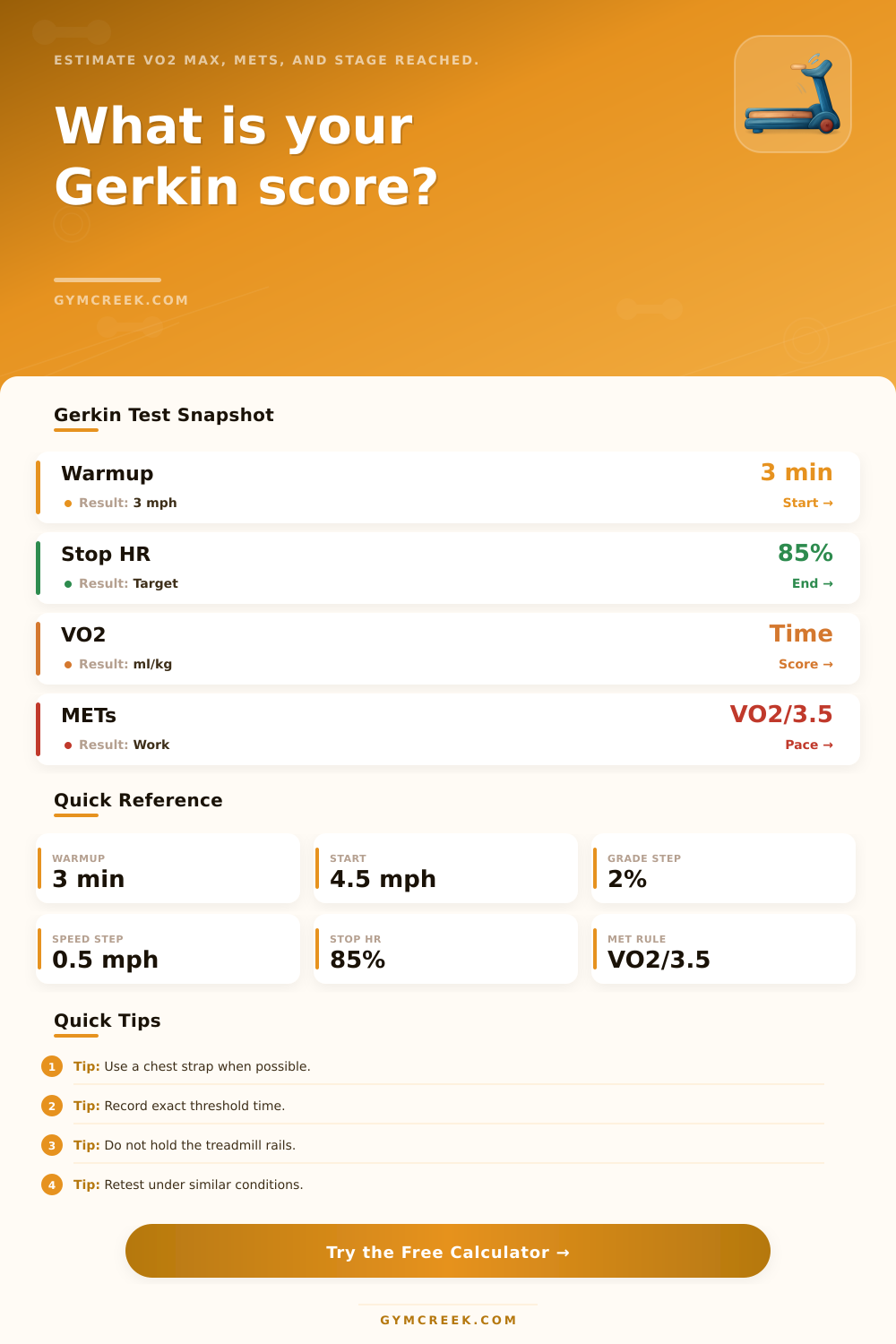
Gerkin Fitness Test Calculator
Estimate Gerkin treadmill test VO2 max, METs, target heart rate, stage reached, and aerobic fitness category from your recorded test time and treadmill data.
📌Presets
Each preset loads a complete Gerkin test scenario and recalculates immediately.
⚙Calculator
Gerkin fitness test snapshot
Enter your test details to calculate VO2 max, METs, and stage context.
📊Fitness Metrics
📑Reference Tables
| Stage | Time total | Speed | Grade |
|---|---|---|---|
| Warmup | 0:00-3:00 | 3.0 mph | 0% |
| 1 | 3:00-4:00 | 4.5 mph | 0% |
| 2 | 4:00-5:00 | 4.5 mph | 2% |
| 3 | 5:00-6:00 | 5.0 mph | 2% |
| 4 | 6:00-7:00 | 5.0 mph | 4% |
| 5 | 7:00-8:00 | 5.5 mph | 4% |
| 6 | 8:00-9:00 | 5.5 mph | 6% |
| Stage | Time total | Speed | Grade |
|---|---|---|---|
| 7 | 9:00-10:00 | 6.0 mph | 6% |
| 8 | 10:00-11:00 | 6.0 mph | 8% |
| 9 | 11:00-12:00 | 6.5 mph | 8% |
| 10 | 12:00-13:00 | 6.5 mph | 10% |
| 11 | 13:00-14:00 | 7.0 mph | 10% |
| 12 | 14:00-15:00 | 7.0 mph | 12% |
| VO2 max | Fitness signal | METs | Interpretation |
|---|---|---|---|
| Under 30 | Low | <8.6 | Build base |
| 30-39 | Developing | 8.6-11.1 | Steady work |
| 40-49 | Good | 11.4-14.0 | Solid capacity |
| 50+ | High | 14.3+ | Strong aerobic |
| Formula | Inputs | Output | Purpose |
|---|---|---|---|
| Gerkin VO2 | Time, BMI | VO2 max | Submax estimate |
| ACSM run | Speed, grade | Work VO2 | Stage load |
| Tanaka HR | Age | Max HR | Target stop |
| Mifflin | Size, age | BMR | Context only |
| Check | Good signal | Watch point | Why it matters |
|---|---|---|---|
| Stop HR | Near 85% | Below 80% | May under-test |
| RPE | 15-18 | Under 13 | Effort too easy |
| Rails | No support | Held rails | Inflates score |
| Recovery | 20+ drop | Under 12 | Monitor fatigue |
| Scenario | Total time | Stage | Common result |
|---|---|---|---|
| Beginner | 6-8 min | 3-5 | Developing |
| Trained | 9-11 min | 6-8 | Good |
| High fit | 12-14 min | 9-11 | High |
| Max run | 14+ min | 12+ | Very high |
💡Tips
The Gerkin fitness test is a method that allow a person to measure their aerobic capacity using a treadmill. To perform the Gerkin fitness test, the person must step onto the treadmill and follow a specific protocol for vary the speed and the incline of the running treadmill. One of the benefits of using the Gerkin fitness test is that it allow for the collection of data regarding the bodys ability to perform at these stages of the test.
Because the protocol for the Gerkin fitness test is so simple to follow, the test provides value to those who perform it through the explanation that the results provide regarding their physical state. Many organization use the Gerkin fitness test due to the fact that the rules of the test allow for individuals to track their physical fitness over time. For instance, fire departments and police academies use the Gerkin fitness test because the rules of the test do not change.
How to Do the Gerkin Fitness Test
This allows for those organizations to compare the physical fitness of each individual over time. The Gerkin fitness test begins with a warm up for the individual. Following the warm up, each individual performs one minute stages that increase in speed or incline until they either reach the target heart rate or they reach a point where they decide to end their performance of the test.
The length of time that the individual performed the test and their heart rate at the end of the test can be used to estimate the maximum amount of oxygen that an individual can uptake. The calculator will perform the calculations for the Gerkin fitness test for the individual. The individual must understand each of the variable for the test.
For instance, the age of the individual can have a major impact upon their maximum heart rate for the test. Therefore, a length of time performed at the age of thirty five will not necessarily mean the same as an individual of fifty five years of age. Additionally, the body mass index of the individual can have an impact upon the test because the strength of the individual can change the amount of work that that individual performs on the treadmill.
Thus, the amount of oxygen that the body can uptake will change according to that variable. However, the protocol for the test remain the same. The training of the individual can have an impact upon the performance of the Gerkin fitness test.
For instance, individuals who perform interval training will typically reach later stages of the Gerkin fitness test than individuals who do not incorporate interval training into their running program. As such, the result of the Gerkin fitness test will be different for individuals with different levels of training. Additionally, the individual can rate how they feel during the Gerkin fitness test.
For instance, if an individual has a high heart rate but low level of exertion, they may have reached the target heart rate for other reason than performance fitness. However, if an individual has a moderate heart rate but high level of exertion during the Gerkin fitness test, they may be unfamiliar with the movement or they may have paced themselves badly during the test. The various choices of heart rates impact the length of the Gerkin fitness test for each individual.
For instance, people commonly use the “220 minus age” formula to calculate the maximum heart rate of an individual. However, that formula can overestimate the true maximum heart rate of an individual. The Tanaka formula is another calculation that provides an estimate for the maximum heart rate of an individual, and the Tanaka formula tends to provide a number that is more closer to the true heart rate of that individual.
If an individual has calculated their maximum heart rate during a previous session of Gerkin fitness test, that number can be used instead of the estimated formulas. The tool allows you to switch between these different formulas for heart rate so that you can view the effect that each formula has upon the outcome of the Gerkin fitness test. Recovery heart rate is another measurement of your cardiovascular system.
Recovery heart rate measures the drop in your heart rate from your final measured heart rate to your heart rate measured after one minute of the Gerkin fitness test having concluded. A drop in heart rate indicates that your aerobic fitness is good, though hydration and temperature can impact recovery heart rate. This measurement is presented to you on the calculator to help show your recovery heart rate alongside your estimated uptake of oxygen.
Using the handrails can impact the Gerkin fitness test. By using light contact with the handrails, individuals can reduce the energy expended for balance. Using more force with the handrails reduce the energy needed for forward propulsion.
Using the handrails will increase the estimated oxygen uptake rate compared to not using the handrails. It is important to note whether the individual used the handrails during the Gerkin fitness test. The stage of the test that was reached and the length of time spent on the Gerkin fitness test provide context to the oxygen uptake rate estimate.
Even though both individuals may have the same uptake of oxygen during the Gerkin fitness test, they may have reached that rate through different method. An individual may reach the early stages of the Gerkin fitness test and stop due to an increase in heart rate. Another individual may have passed the early stages but may have reached the later stages with a lower percentage of heart rate.
The structure of the Gerkin fitness test can be useful in interpreting the test result. The tables provided for reference indicate the expected rates of uptake of oxygen during the Gerkin fitness test. These tables are not target that should be aimed for during the Gerkin fitness test.
If an individual lands within the middle of the range for their age, they can use that result to indicate their current aerobic fitness. This result can be compared with their own physical strength and abilities during the day. Common mistakes include treating the Gerkin fitness test as if it is a race.
Individuals should not treat the Gerkin fitness test as a race to encourage an increase in heart rate beyond the target heart rate. It is important to note the reason that the Gerkin fitness test ended. Gerkin fitness test may end for various reason.
The calculator helps to ensure that the outcome of the test is reliable by noting the reason for the tests end. To reduce error in Gerkin fitness test results, the individual should perform the test under similar condition. Using the same treadmill, heart rate monitor, and performing the test at the same time of day will ensure the most accurate result.
Small change to these variables can create an altered estimation of the uptake of oxygen without a change in aerobic fitness. This calculator allows for the input of previous test data to be preset for the individual to enter into the test to reduce error in data entry. The result of the Gerkin fitness test is only an estimate of the oxygen that is taken up during the test.
As an estimate, it is not as precise as measuring oxygen uptake in a laboratory. The estimate is based on a series of assumption about an individual’s body. These assumption are generally accurate for the majority of adults.
However, an individual’s movements during the Gerkin fitness test may differ from the assumption required of those performing the test. Despite these difference, the Gerkin fitness test can still provide an individual with a snapshot of their current aerobic fitness level.