Calories Burned Gardening Calculator
Estimate gardening calories from body weight, task type, active duration, posture mix, carried loads, digging intensity, heat, breaks, and weekly sessions.
📌Gardening Presets
Presets are starting points for active garden work. Adjust breaks, loads, and heat for your real session.
⚙Calculator Inputs
Gardening calorie snapshot
Enter garden work details to estimate calories, MET band, active minutes, work density, and weekly burn.
📊Gardening Metrics Grid
📑Reference Tables
| Task | Base MET | Typical movement | Best use |
|---|---|---|---|
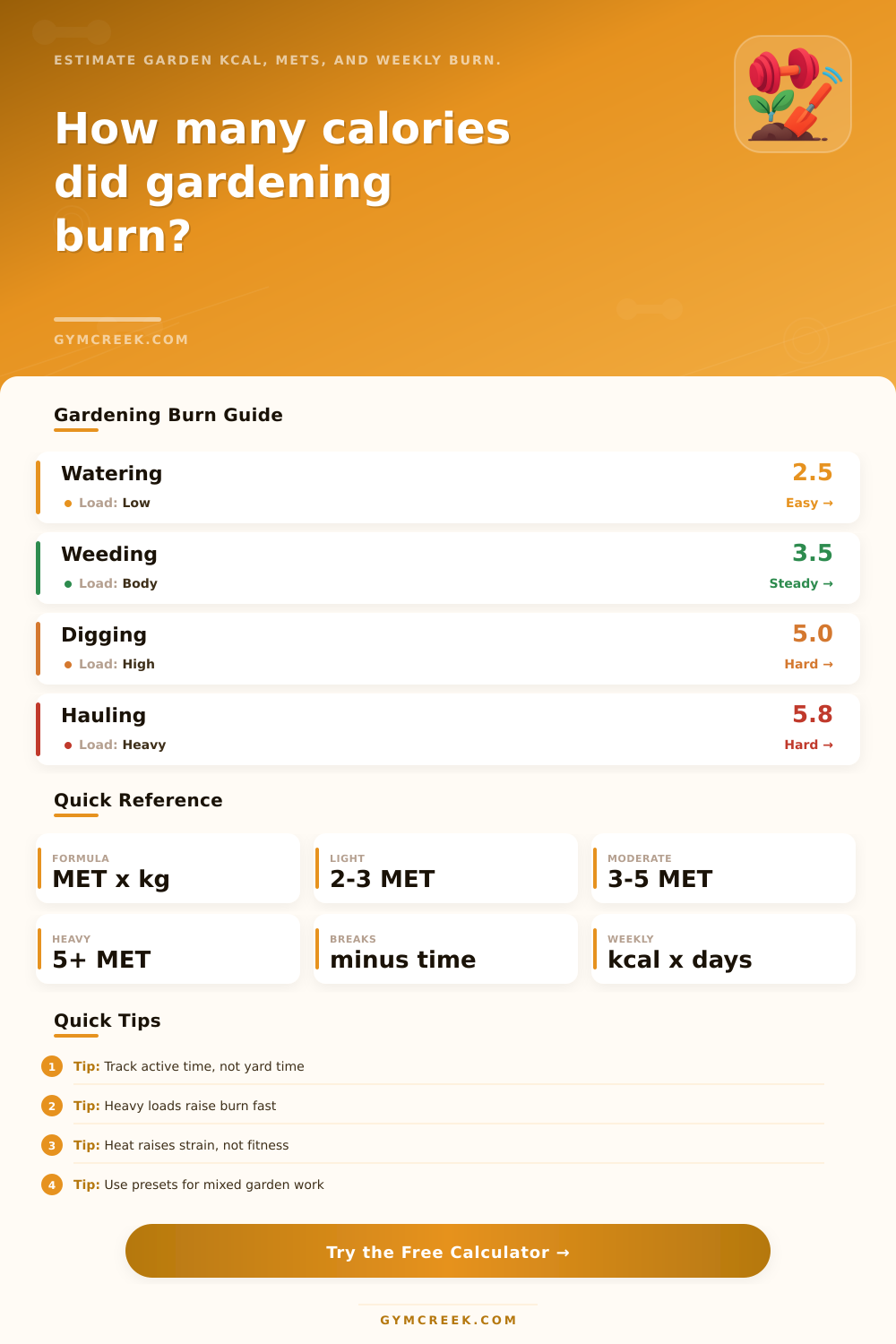
| Watering and light tending | 2.5 | Slow walking, standing | Watering cans, hose work, gentle checks. |
| Weeding by hand | 3.5 | Bending, pulling, kneeling | Flower beds, borders, vegetable rows. |
| Planting and transplanting | 4.0 | Squat, lift, reach, refill | Seedlings, containers, row planting. |
| Raking leaves or debris | 4.3 | Continuous upper-body sweep | Leaves, clippings, light yard cleanup. |
| Push mowing or edging | 5.5 | Steady walking resistance | Manual or self-propelled lawn work. |
| Digging or turning soil | 5.0 | Shovel, lift, rotate, reset | Bed prep, compost turning, soil loosening. |
| Hauling soil, compost, or mulch | 5.8 | Carry, dump, spread, return | Bags, buckets, wheelbarrow loads. |
| Heavy landscaping mix | 6.2 | Loaded, awkward, repeated work | Rock, soil, edging, bed renovation. |
| Adjustment | Factor range | What it captures | Example |
|---|---|---|---|
| Mostly upright | 0.95x | Less rise-and-lower work | Hose watering, walking inspection. |
| Frequent bending | 1.12x | Repeated hinge and reach | Pulling weeds or picking debris. |
| Kneel and squat | 1.16x | Getting down and back up | Planting low beds or hand weeding. |
| Carried load | 1.00-1.18x | Buckets, bags, tools, trays | Water cans, compost, mulch bags. |
| Heavy digging | 1.35x | Dense soil and repeated shovel loads | Breaking new beds or turning clay. |
| Adjusted MET | Band | Session feel | Planning cue |
|---|---|---|---|
| Under 3.0 | Light | Easy tending | Long duration usually matters most. |
| 3.0-4.5 | Moderate | Steady garden work | Breaks and posture can change totals. |
| 4.5-6.0 | Vigorous | Hard sustained work | Loads, heat, and hydration matter. |
| 6.0-7.5 | Heavy | Demanding yard labor | Use realistic break minutes. |
| 7.5+ | Very heavy | Short intense bursts | Best treated as interval-like labor. |
| Metric | Formula | Inputs | Output |
|---|---|---|---|
| Active minutes | duration - breaks | Session and breaks | Working minutes |
| Adjusted MET | base x factors | Task, posture, load, dig, heat | MET task band |
| Calories | MET x 3.5 x kg / 200 x min | Weight and active minutes | Session kcal |
| Work density | kcal / active hour | Calories and active time | kcal/hr |
| Weekly burn | session kcal x sessions | Calories and weekly frequency | kcal/week |
💡Gardening Calculation Tips
Gardening can be an physically demanding pastime due to the different movements required of individuals, as well as the strain that can be placed upon the shoulders and back from the lifting and hauling of material while gardening. The use of calorie estimates allows individuals to quantify the effort that gardening requires, transforming a general sense of exertion into a specific measurement. Thus, using these calorie estimates, individuals can better understand how gardening fit in relation to the physical activity levels that they exhibit during the week.
Each gardening task have specific elements that impact the amount of energy that an individual burns during that task. Factors such as the type of task that an individual performs impacts the energy expenditure requirement of an individual. The posture in which an individual performs their gardening tasks will impact the amount of energy that they expend; the more that an individual must rise or lower their body, the more energetic is spent with each task.
How Many Calories You Burn When Gardening
The amount of load that an individual carries will impact the energy that is spent to perform those tasks. Finally, factors related to heat will impact the energy requirements of each individual; the hotter the temperature, the more energy an individual’s bodys expends to maintain their internal body temperature. Finally, breaks will impact the energy expenditure requirements of individual; during breaks, no energy is spent by an individual.
Thus, the calculator can account for the total amount of time required for each task to determine the total energy expenditure for each individual. Most individuals likely dont account for the effects of posture and carried loads upon the total amount of calories that are burn while gardening. For instance, individuals that spend their gardening tasks on their knee will burn more calories then individuals standing during gardening tasks.
Individuals that carry loads of compost, mulch, or other gardening materials will burn more calorie than individuals that do not carry such loads. Each of these factor has the potential to accumulate throughout the growing season. Density is a measurement of the calories that can be burned during a typical hour of gardening activity.
This measurement allows individuals to determine if their gardening season included periods of light physical activity versus demanding physical activity. Finally, the measurement of the total number of calories that can be burned each week based off the number of times that each individual gardens each week allows for individuals to plan their physical activities in relation to there time. It is common for individuals to make two mistake when calculating their energy expenditure during the gardening season.
One common mistake is to count the total amount of time that an individual spends in their yard as active time spent by the individual. However, active time should not include breaks during the gardening season. An individual may take a two-hour break in their yard, but if they only actively garden for 30 minutes, that time should be accounted for in the calculation of total active time.
Another common mistake is to treat each gardening activity as if it is the same as each other. For instance, a light watering task takes less energy than a full gardening bed renovation. Thus, each activity should be accounted for separate.
The reference tables located on this page contain starting values for the energy that individuals expend during each gardening task. Each table also contains information about how each factor, such as posture, carried loads, and digging factor can modify that energy expenditure. These tables exist to allow individuals to understand why two individuals may have different amount of expended calories while performing the same gardening tasks.
It is often more beneficial for individuals to utilize their bodies in a consistent manner rather than to utilize their bodies with intense physical activity. Thus, a moderate amount of gardening each week is more beneficial than intense physical activity with gardening once each month. However, if an individual becomes physically sore from performing their gardening tasks, they may not desire to continue with those tasks the following weekend.
Thus, the active minutes each week allows for individuals to determine whether or not their gardening activities are consistent or if they are performing intense but infrequent activities with gardening. These calorie calculations have a primary purpose of allowing individual gardeners to gain perspective on the physical effort that they are expending while gardening. Armed with this knowledge, individuals can make decisions regarding how many gardening days they would like to include in their schedule each week.
Additionally, individuals can use this knowledge to determine if current amount of gardening provides the amount of movement that they desire each day. Each of the tasks that are performed, the load that are carried, the postures in which individuals are while gardening, and the amount of heat that is exhibited will change with the changing of the season, but the relationship between these factor will always be the same.