Gallons to Ounces Converter
Convert gallons, fluid ounces, liters, bottles, jugs, refill counts, and hydration coverage for gym bags, team coolers, water stations, and daily intake planning.
📌Presets
Each preset loads a practical volume scenario with gallon standard, container size, bottle count, people, days, and daily fluid-ounce target.
⚙Calculator
Gallon and ounce conversion snapshot
Enter a gallon amount, added liters or ounces, and container size to convert.
📊Conversion Metrics Grid
📑Reference Tables
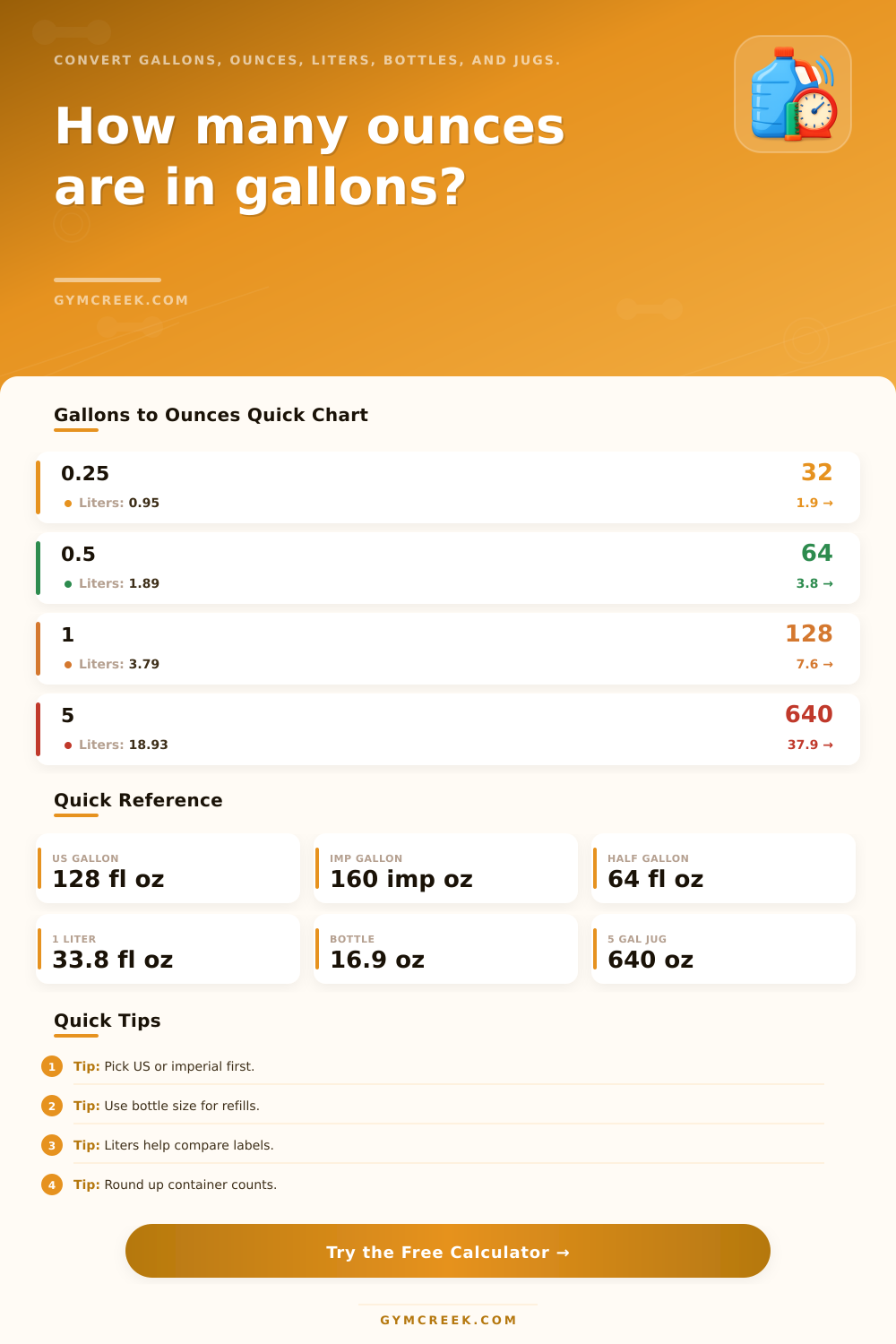
| Volume | US Fluid Ounces | Liters | Common Use |
|---|---|---|---|
| 1 quart | 32 fl oz | 0.946 L | Small bottle refill |
| 0.5 gallon | 64 fl oz | 1.893 L | Half-gallon jug |
| 1 gallon | 128 fl oz | 3.785 L | Daily jug target |
| 5 gallons | 640 fl oz | 18.927 L | Team cooler |
| Standard | Ounces per Gal | Liters per Gal | Use Case |
|---|---|---|---|
| US liquid | 128 US fl oz | 3.785 L | US bottles and jugs |
| Imperial | 160 imp fl oz | 4.546 L | UK and Commonwealth |
| US dry | 148.95 US fl oz | 4.405 L | Dry-volume reference |
| Liter | 33.814 US fl oz | 1.000 L | Metric labels |
| Container | Capacity | Per US Gal | Per 5 Gal |
|---|---|---|---|
| Small bottle | 12 fl oz | 10.67 | 53.33 |
| Water bottle | 16.9 fl oz | 7.57 | 37.87 |
| Shaker | 24 fl oz | 5.33 | 26.67 |
| Large bottle | 32 fl oz | 4.00 | 20.00 |
| Hydration Target | US Gallons | Liters | 16.9 oz Bottles |
|---|---|---|---|
| 64 fl oz | 0.50 gal | 1.89 L | 3.79 bottles |
| 96 fl oz | 0.75 gal | 2.84 L | 5.68 bottles |
| 128 fl oz | 1.00 gal | 3.79 L | 7.57 bottles |
| 256 fl oz | 2.00 gal | 7.57 L | 15.15 bottles |
💡Tips
Look at that intimidatingly large five gallon water jug. It looks large but then you try to imagine its actual size. Here’s the problem, your mind doesn’t automatically make this conversion. We purchase our water by ounce or liter and consume it from shakers that is measured in fluid units; however, we store our bulk amounts in gallons. This disconnect makes it problematic when you’re trying to stock up a team cooler during tournament season or plan out a weekend hike. Before the inventory dries up and you find yourself thirsty with no water in sight, you need a clear picture of what liquid you have on hand.
It all boils down to this: Gallons are only as meaningful as they become useful. In the US, for example, one standard liquid gallon have 128 fluid ounces of water in it. Same amount. Different place. Now let’s go around the world and look at a common imperial (UK/Commonwealth) gallon. This will give you 160 fluid ounces of whatever it is you’re drinking. Big difference, and something you’ll want to account for when checking out labels before filling up your bottles.
Why You Need to Measure Your Water
The calculator above do this work for you after you choose your system, saving you from wondering if that smallish bottle size fits inside the large jug.
Everyone thinks they know how much water they drink but most aren’t close enough to even notice the difference. Sure, you say you want eight glasses per day. That’s fuzzy math, though. Half might come from a glass of tap water here, another from a big bottle of sports drink there, and the rest from some half-empty plastic bottles in the fridge. When you identify a container and measure out how many times you can fill up with a certain volume (like a gallon), then you give yourself something concrete to track. It makes an unclear health goal into something you can physically count. The fifth time you pour your water into the same shaker, it’s full; and not because your phone buzzed at 5pm.
But all of this brings with it additional storage logistics. While converting, you can’t put a full gallon in each of normal sixteen-ounce bottles. It doesn’t work like that. You’d be wasting space, right? Right. How much is a US gallon? It is seven and a half commercial size water bottles, which means there’s a half bottle left over. And then what do you do? When you’re going to an event where supplies will be rationed, or if you’re packing for a trip, that half bottle begins to matter. You can’t give your team mate half a bottle, so you have to round up your container totals. These conversion tables on the page clearly shows that efficiency gap and show you how various sized vessels map back to standard gallon amounts.
Metric labels make things even more complicated because they add liters to the mix along with imperial ounces. Imperial gallons and US gallons aren’t perfectly divisible by a liter so you can’t exactly calculate, just estimate instead. For example, one liter is approximately 33.8 fluid ounces. An odd figure to memorize on-the-fly during quick planning sessions or for international travelers. A device that connects customary cup measurements and metric volume markings make it easier for people who buy imported items or travel internationally. It helps them make purchases without getting bogged down by decimal conversions.
Static charts also fail to include changing variables such as group size and duration of hydration, which is critical too. For example, a 5 gallon cooler might seem like enough for a small group in gym class. However, when spread out over two days for a class of eight athletes requiring almost 2 quarts/day each, it’s easy to see how fast the math add up. By plugging in your own time frame and number of heads, the calculator tells you precisely how much each athlete is getting from their water supply. Before you reach the facility with nothing but empty jugs, it flags when you’re running short.
Second, it’s easy to neglect how much you lose through sweating (and at what rate). A stroll won’t require what a scorching summer run requires, which doesn’t match the sweat lost in a heated yoga class. During the hottest months, upping your intake goal by 10-15% can help prevent dehydrating headaches, but there’s no need for complicated calculations. Just know that your body’s baseline will change seasonal. If you take big numbers and divide them up into smaller more manageable chunks, planning wins out over panic.
This is true for personal goal setting as well as keeping your group fed. Understanding the number of ounces in each gallon puts you in control of the supply chain. When you stare down on a water jug, don’t only view it as a container. View it as all those individual drinks waiting for you when the going gets tough.