Functional Movement Screen Score Calculator
Total the seven FMS movement patterns, apply pain and clearing-test overrides, and see which pattern should be reviewed first.
📌Presets
Presets model common screening snapshots and automatically recalculate the total, side-to-side flags, and pain overrides.
⚙Client Details
📋Seven Pattern Scores
FMS screening snapshot
Enter the seven movement pattern scores to calculate the composite score.
📊Screen Metrics
📑Reference Tables
| Total Score | Band | Screen Meaning | Next Focus |
|---|---|---|---|
| 18-21 | Strong | Few visible limits | Maintain quality |
| 15-17 | Monitor | Some compensation | Clean up lowest pattern |
| 12-14 | Limited | Multiple limitations | Address basics first |
| Any pain | Stop flag | Pain overrides score | Refer or assess further |
| Pattern | Scoring Logic | Asymmetry Check | Override |
|---|---|---|---|
| Deep squat | Single score | None | Pain makes 0 |
| Hurdle step | Lower side counts | Left vs right | Pain makes 0 |
| In-line lunge | Lower side counts | Left vs right | Pain makes 0 |
| Shoulder mobility | Lower side counts | Left vs right | Clearing pain makes 0 |
| Active straight-leg raise | Lower side counts | Left vs right | Pain makes 0 |
| Trunk push-up | Single score | None | Extension pain makes 0 |
| Rotary stability | Lower side counts | Left vs right | Flexion pain makes 0 |
| Score | Practical Meaning | Pattern Quality | Calculator Action |
|---|---|---|---|
| 3 | Completes standard | No major compensation | Adds 3 points |
| 2 | Completes with compensation | Movement needs refining | Adds 2 points |
| 1 | Cannot complete standard | Major limitation seen | Adds 1 point |
| 0 | Pain reported | Do not load pattern | Adds 0 points |
| Preset | Typical Pattern | Common Flag | Use Case |
|---|---|---|---|
| Desk Worker | Squat and hip limits | Low ASLR | Mobility baseline |
| Runner | Side differences | Hurdle asymmetry | Return to volume |
| Field Athlete | High total score | Minor lunge gap | Performance prep |
| Overhead Athlete | Shoulder limits | Clearing pain | Further assessment |
💡Tips
People commonly think of strength in terms of how many pounds they can push off the ground. They picture it as a stack of plates or a heavy barbell. But when you see a guy cave to the ground after failing to squat weight he couldn’t manage, you realize there are two parts of being strong: One is what you do with your body; the second is what it’s made of. Before you load up a bar, you’re measured for functional movement screen… Which is more about ability to function properly with a given structure than it is about moving as far as possible. It preserves bodies, and consequently careers.
Human movement has been broken down into seven categories. Each are not a random exercise. Rather, they’re the basic patterns by which your body moves through space. Overall symmetry and ankle mobility is examined with the deep squat. Single-leg balance and hip stability are addressed via in-line lunge and hurdle step. The push-up checks shoulder mobility and trunk stability. The rotary stability test and the active straight-leg raise address other aspects. A unique set of muscles and joints is targeted for each test.
What Your Score Means and How to Use It
Entering your results into calculator above does the rest of the math for you. You’ll have to figure out what all that means, though. Scoring rules is tight. Three is perfect. It was clean and there was no cheating. Two means you did it but had to cheat a bit (twisted body, lifted feet off floor). One was a no-go for you. And then there’s zero, which I consider the key score in the system. Zero tells me there’s something wrong. Not necessarily that I can’t do it physically, but if it hurts during the screen, even slightly, I get a zero on that pattern. Because pain isn’t a suggestion, it’s a stop sign. And so, it overrides everything else in the calculator. It makes you pay attention to what hurts first and chase those scores later.
Asymmetrical tests don’t get enough credit for their nuance. You have a different score on each side for hurdle step, lunge, straight-leg raise, rotary stability, and shoulder mobility. Then you take whichever is lowest for the overall score. So if you got a 3 on the left and a 1 on the right, you still get a 1. That’s kind of mean, because it’s the weak link that matters functionally. A chain doesn’t break where it’s strong; it breaks where it’s weak. They flag those asymmetries on the calculator because otherwise you might have a good score, look at the sum, and think you’re fine, when you need help with your left hip.
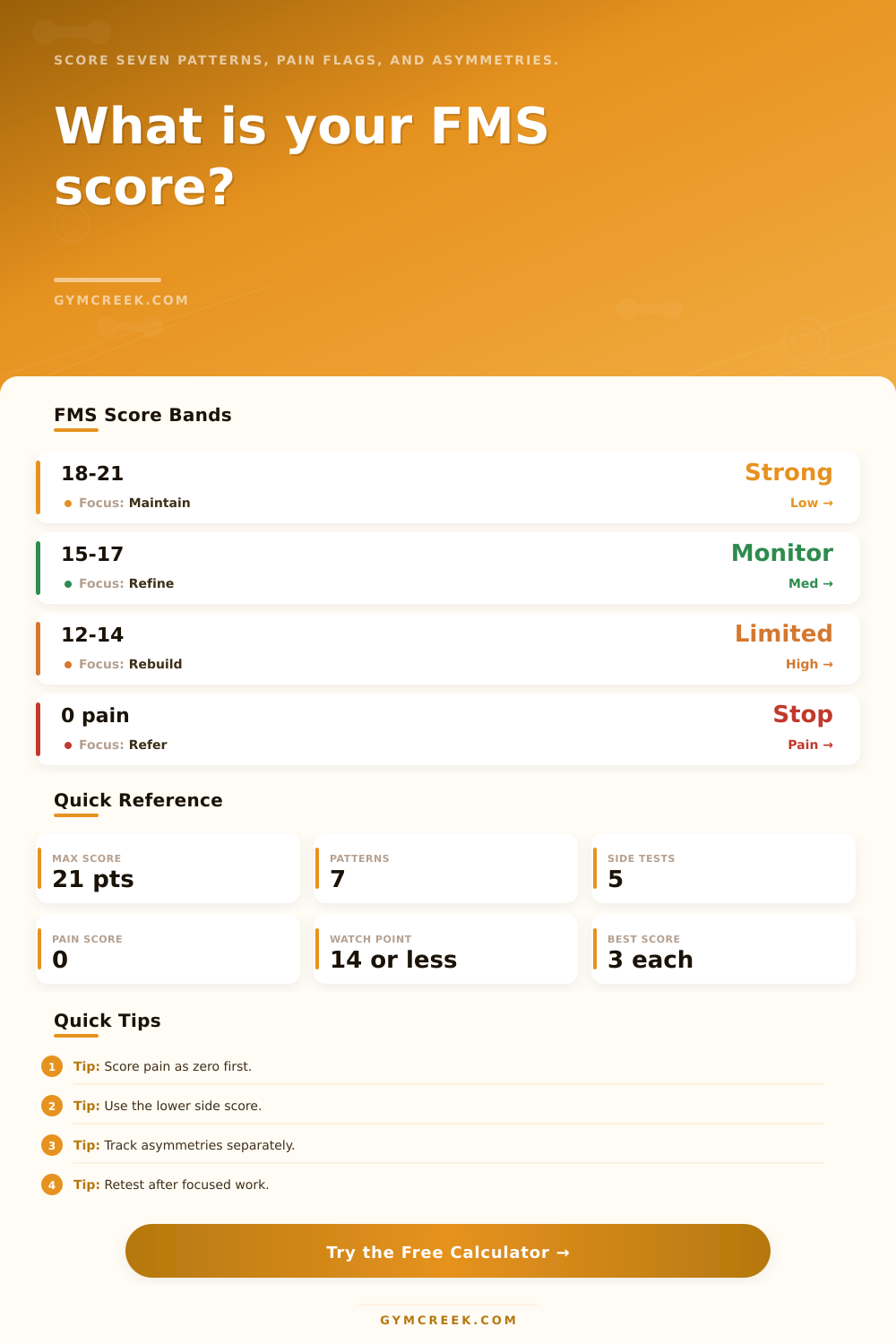
If you’re curious what each of those scores means, they have very detailed reference table at the bottom of the page which breaks it down into risk bands: There are few obvious restrictions for 18-21. You will probably be able to continue as normal with minimal changes. This needs some refinement. It is probably fine, but you could avoid problems later by addressing this. The 12-14 range is a danger zone. Multiple red flags here need to be dealt with before going heavy. For a score of 12 or pain flags, current guidance is to assess or ask for more information. It is time for a referral or deeper investigation.
That’s where the tool comes into play with its presets, which help put those scores into context. If someone sits at a desk all day, they may have a low score on their straight-leg raises because they’re tight through the hamstrings. Someone who runs a lot may find asymmetry in their hurdle steps as a result of years of running on one side. With the tool, you can model that. You’ll be able to see how the baseline should look differently based off lifestyle. And it takes out guesswork around whether your score is typical or not for what you do.
This is where retesting realy comes into play. This isn’t a one-time gaming-of-the-system-and-forgetting-it thing. You’re interested in trends. Did you increase your shoulder mobility score after two weeks of band work? Was the number of trunk stability push-ups increased from one to two? With this tool, you can see how things change over time. And consistency is key. Do all your testing using same setup (clearing checks, scoring rules, etc.) each time. If you compare inconsistent data, what does that tell you?
In conclusion: The Functional Movement Screen is just a lens of diagnosis, no judgment. A poor score doesn’t mean you failed. It’s a map. A guide to precisely where your body needs help fixing, before it breaks under load. Begin with the fundamentals. Eliminate the pain. Correct the imbalance. Now increase the load. When your structure is prepared for the task, it should of borne that burden better.