Frisbee Calorie Calculator
Estimate calories burned from ultimate, pickup, recreational throwing, disc golf, cutting volume, sprint count, throws, wind, field size, rest ratio, and MET-based workload logic.
📌Presets
Each preset loads a real frisbee workload profile and recalculates active time, throwing load, cutting load, wind adjustment, and daily calorie context.
⚙Calculator
Frisbee calorie snapshot
Enter session details to estimate calories burned from frisbee play.
📊Metrics Grid
🧮Formula Cards
Calories per minute = MET x 3.5 x body weight in kg / 200. Active and rest minutes are calculated separately.
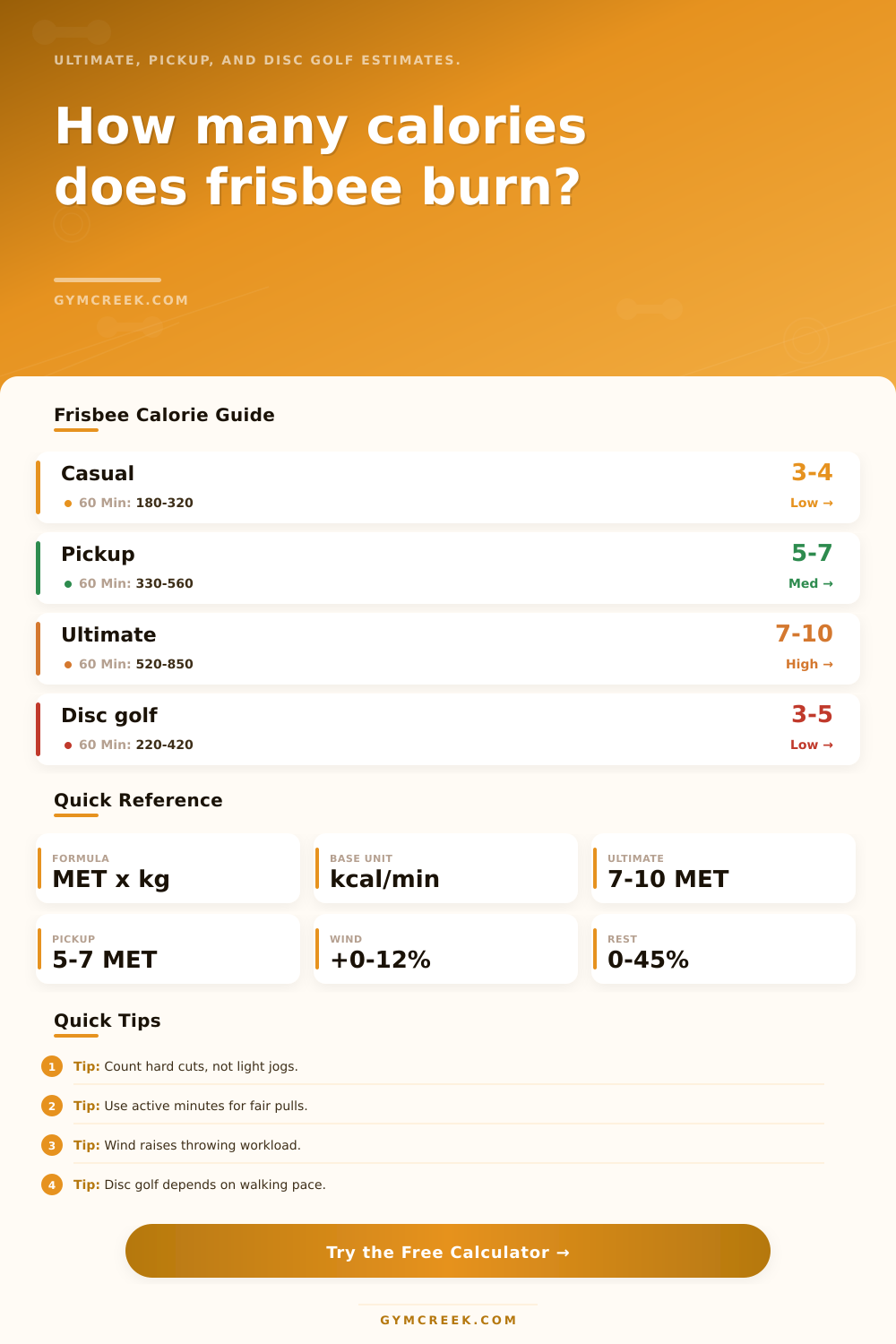
Casual toss starts near 3 MET, pickup and league ultimate sit higher, beach and club play add faster repeated work.
Hard cuts, full sprints, point count, and field length estimate how much stop-start running lifts the active MET.
Throw volume, long throws, drives, and wind raise upper-body and trunk demand before rest ratio lowers total session output.
📑Reference Tables
| Frisbee type | Base MET | Typical work | Best input focus |
|---|---|---|---|
| Casual toss | 3.0 MET | Light movement | Throws and rest |
| Recreational field | 4.2 MET | Jog and catch | Field and throws |
| Pickup ultimate | 6.6 MET | Stop-start runs | Cuts and points |
| League ultimate | 7.8 MET | Match pace | Sprints and rest |
| Club ultimate | 8.8 MET | Repeated efforts | Cuts and sprints |
| Disc golf walking | 3.5 MET | Walking plus throws | Course pace |
| Role | Cut norm | Sprint norm | Throw norm |
|---|---|---|---|
| Handler | 45 per hr | 14 per hr | 90 per hr |
| Cutter | 75 per hr | 28 per hr | 45 per hr |
| Hybrid | 60 per hr | 22 per hr | 65 per hr |
| Defender | 70 per hr | 30 per hr | 30 per hr |
| Casual thrower | 10 per hr | 3 per hr | 80 per hr |
| Disc golfer | 4 per hr | 1 per hr | 36 per hr |
| Field or terrain | Modifier | Why it changes | Use when |
|---|---|---|---|
| Short field | 0.96x | Less top speed | Mini games |
| Full ultimate | 1.00x | Baseline field | 70 by 40 yd |
| Long field | 1.04x | More deep work | Large pickup |
| Beach sand | 1.18x | More resistance | Sand play |
| Hilly course | 1.14x | Climbs and walks | Disc golf |
| Formula | Variables | Output | When used |
|---|---|---|---|
| MET calories | MET, kg, min | Total kcal | Every session |
| Cut factor | Cuts per hr | Run load | Ultimate play |
| Throw factor | Throws, hucks | Disc load | All types |
| Rest split | Rest percent | Active min | Stop-start play |
| Mifflin BMR | kg, cm, age | Daily burn | Context only |
💡Tips
You take the field hoping it’s just another fun game of catch, yet when it’s over, you’re tired. That’s what most people find with frisbee sports. From the outside looking in, the sport seems like it can’t possibly be much work. People walk around, throw and catch. Yet if you’ve ever played, you know that heart rates spikes.
There is a big difference between a league match and a park toss. Knowing this will help guide how you approach your energy use. It will also help guide your nutrition planning so you don’t burn out after the first quarter.
How Many Calories You Burn Playing Frisbee
And that’s what burns calories: The stop-start rhythm. It’s not steady state cardio. It’s explosive acceleration then sudden braking. And when you make a hard cut, you’re not just running forward. You’re using your core and hips to suddenly change direction. That take more energy than jogging in a straight line.
A calculator tool will be able to measure this for you based off how many sprints and how much cut volume you perform. It helps distinguish between high-intensity bursts that deplete glycogen stores and light movement. That distinction is important because most people don’t realize how costly those sharp turns are.
It matters who you are on the field. Handlers tend to throw more but cut less, while cutters does the opposite. In league games, a cutter may be making dozens of deep cuts an hour. That’s a lot of sprints at high speed, pushing your heart rate into the red zone. It’s intense work. Mirroring movement as a defender will also have you burning hard. Think of it like shadow boxing, only with running factored in.
Casual throwers do not has to run fast over and over again. They don’t burn nearly as many calories. Competitive play versus casual play can literally double calorie burn in the same period of time.
There’s an additional tax charged by terrain and weather conditions. The more you play on hills or sand, the more there is resistance with each step. Your body has to work harder as your muscles has to stabilize and then push off more in sand. Add wind, and that’s another layer. If you’re throwing into a stiff breeze, it takes more force from the core and shoulder. And it’s not just about the straight flight of the disc. It’s the physical effort needed to launch it.
Simple fitness trackers don’t account for these environmental factors. A detailed estimation accounts for them by adjusting base metabolic equivalents.
The math is also a little funky with regards to rest periods. Frisbee sports are an intermittent activity, whereas disc golf is different profile that’s largely walking. Perhaps you run for five-seconds, then stand around for forty-five. Now, standing isn’t going to burn many calories. If you assume that you were “active” during the full hour, you’ll overestimate the number of calories burned. You should of deduct time spent waiting for points to be scored or on the bench, or when you’re strolling between disc golf holes. Honesty about what part of the workout was “high-intensity” and what part was low-intensity recovery makes accurate tracking possible.
With disc golf it’s a different profile: mostly walking, occasional throwing. How many calories you burn really comes down to the layout of the course. An 18 hole flat course is going to be a nice stroll around. An 18 hole hilly course with long approach shots will be a legit leg day workout. Here the pace of walking is what it’s about as opposed to how fast you throw. It has a more moddern pace, but it covers more ground. This makes for a consistant workout without being as peaky as ultimate.
It’s one thing to guess at calories burned or rely on simple fitness trackers that often ignore environmental factors like terrain and weather. Using a more structured method allows you to get an idea of how many calories you are burning. This can be a fun curiosity for some or a way to inform how they fuel and recover when training for competition. You can’t manage what you don’t measure. Being able to break down the workout in terms of rests, sprints, throws, and cuts allows you to get a look at what you did and how you should fuel and recover as a result.
But frisbee is surprisingly challenging. It is a mix of anaerobic power and aerobic endurance. The numbers on your screen are estimates, but they serve as reminders of how hard this can be without you realizing it. Listening to your body and tweaking your inputs will extend your time on the field.
You play because it’s fun. You stay because it’s fit. And you’re now aware of what it takes to get there.