Forearm Size Calculator
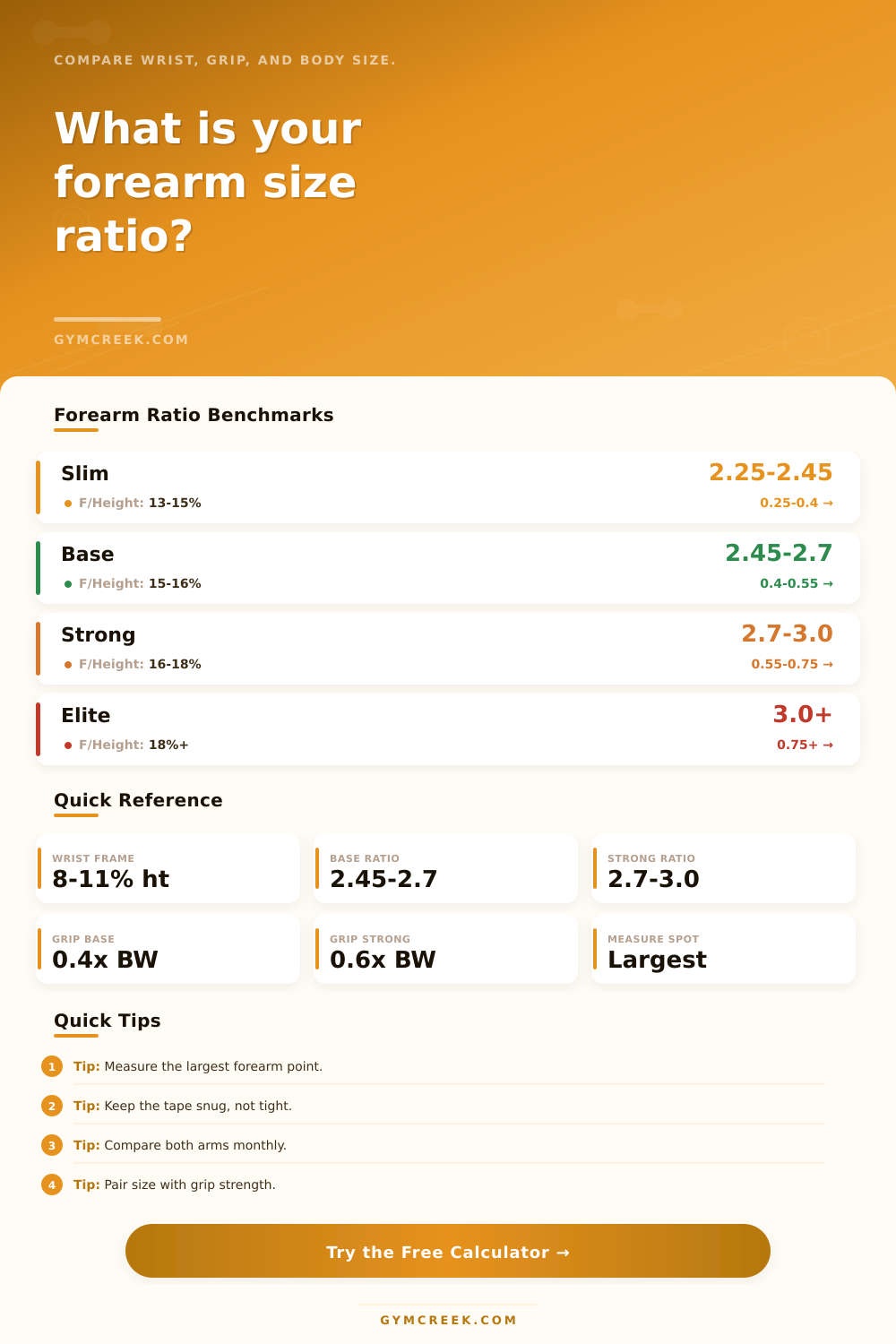
Compare forearm circumference against wrist frame, height, body mass, grip strength, training age, and goal-specific proportion targets.
📌Presets
Presets load realistic body frames and grip profiles, then recalculate the wrist-normalized size target and strength-size balance.
⚙Calculator
Forearm size snapshot
Enter your measurements and calculate wrist-normalized forearm size.
📊Forearm Metrics Grid
📑Reference Tables
| Forearm Level | Forearm/Wrist | Forearm/Height | Typical Read |
|---|---|---|---|
| Small relative size | Under 2.35 | Under 14.5% | Lean or undertrained |
| Average base | 2.35-2.65 | 14.5-16.2% | Normal frame match |
| Strong proportion | 2.65-2.95 | 16.2-17.8% | Trained size |
| Very large | 2.95+ | 17.8%+ | High muscularity |
| Profile | Wrist Frame | Grip Pattern | Ratio Target |
|---|---|---|---|
| Small-frame lifter | Narrow | Moderate | 2.55-2.80 |
| Balanced trainee | Medium | Steady | 2.60-2.90 |
| Climber or grappler | Varied | High | 2.70-3.00 |
| Bodybuilder | Any | Medium-high | 2.85-3.15 |
| Large-frame athlete | Wide | High | 2.65-2.95 |
| Grip Zone | Grip/BW | Size Meaning | Planning Note |
|---|---|---|---|
| Low | Under 0.35 | Size may lead strength | Retest technique |
| Base | 0.35-0.50 | General capacity | Build consistency |
| Strong | 0.50-0.70 | Good force output | Track side gap |
| Elite | 0.70+ | Very high grip | Manage recovery |
| Formula Piece | Variables | Output | Use |
|---|---|---|---|
| Forearm ratio | Forearm, wrist | F/W score | Frame match |
| Height ratio | Forearm, height | % height | Body scale |
| Grip ratio | Grip, body mass | Grip/BW | Strength context |
| Target size | Wrist, height, goal | Circumference | Progress target |
💡Tips
The first time you put on a new pair of gloves, if they feel to tight around the wrist but just right at the palm, you probably first notice how big or small your forearms is. If this difference sparks your curiosity in how big your forearms really are, it’s about proportion and structural reality, though aesthetics certainly play a role for people who lift weights or climb rocks. But the calculator do the work for you after you input your numbers. You don’t have to guess which formula to use. You also don’t need to worry about converting between units, which baffles most folks attempting to self-assess.
Mostly, most individuals look at the number on the end of a tape measure and assume the number is the complete picture. Rarely ever is it true. Thirteen inches may be large, but on a six-foot bodybuilder it appears different than on a five-four rock climber with thin wrists. The context change the meaning of data entirely.
Why Forearm Size Depends on Your Body Frame
Why it asks: Bone structure determines your visual frame, as well as the limitations of your leverage. No amount of exercise will modify the width of your ulna/radius or the density of your bones. All exercise can do is increase the muscle surrounding these fixed anchors. Your wrist circumference represent your “frame.” By asking you to enter this value, we normalize your forearm size against your wrist width. This removes genetic luck from the equation so we can assess your true muscular development in relation to your skeletal frame. When you have small wrists, for instance, a modest gain in forearm circumference creates a much more dramatic visual change then it would for someone with naturaly thick bones.
This is how it works: The page includes a reference table showing how ratios change based off different body types. It allows you to see if your existing measurements are on par with your frame, or if you’ve got some extra space to grow into something that fits your natural build.
But there’s one more wrinkle: The circumference measurement doesn’t account for grip strength. Sometimes a big forearm is due to excessive lifting, which causes swelling. Or high blood pressure. Sometimes a big forearm have nothing to do with functional power or even strong tendons. Enter the grip reading from the dynamometer. The reason this was added as its own box in the calculator is because it makes you think about what exactly the muscle is capable of doing versus the amount of space it takes up. Are you lagging on grip strength compared to your body weight ratio? Then you may be dealing with an imbalance between your size and how much force you can produce. That’s the piece many people overlook when they go after mirror muscles without working toward function.
And then there’s the issue of training age. Depending upon how long you’ve been lifting weights, your muscles grows differently. If you’re new to regular resistance training, you can expect a newbie bump-up during your first year or two. But if you already have a decade or so under your belt, you’ll know that it takes more patience and precision to make significant progress. With that in mind, the calculator will adjust its goal recommendations to match. It knows that where you begin affects how you continue. You’re not starting from scratch each time you walk through those gym doors. All that work you did previously has primed your muscle fibers and nervous system to be more efficient.
And then there’s body composition. Because nobody is made the same, they need to make sure that comparison is apples-to-apples (or forearms-to-forearms). Someone could have the same circumference as someone else, but because they happen to be carrying more lean tissue and the other person is carrying more subcutaneous fat, it doesn’t tell the whole story. They account for that here. You don’t want to see day-to-day fluctuations due to glycogen storage levels or hydration levels misleading you. It is small stuff, but it is relevant if you’re looking to measure long term trends versus short term noise.
But, in the end, forearm measurement isn’t really about reaching any particular number. It is more about learning how your body adapt to what you ask of it. For example, do you need stronger arms? Are you trying to improve your clothing fit? Are you climbing big faces? The numbers provide a roadmap. You are driving the car, though. Let them inform where you focus but don’t use them as a way to measure yourself. Having balanced proportions and a strong grip will help you out a lot farther in life than having a big number ever could.
So measure regularly, train smartly, and let the context of your frame determine your goals… Not some arbitrary ideal that you find somewhere on the internet.