Football Calorie Calculator
Estimate American football calories from position, practice minutes, game minutes, plays, sprint intensity, contact intensity, equipment load, rest ratio, and adjusted MET logic.
📌Presets
Each preset loads a realistic football workload and recalculates session burn from plays, live reps, rest, position demand, pads, sprints, and contact.
⚙Calculator
Football calorie snapshot
Enter position, minutes, plays, sprint load, contact, equipment, and rest to estimate football calories.
📊Football Metrics
🧮Formula Cards
Calories per minute = MET x 3.5 x body weight in kg / 200. The calculator applies separate MET values to football work, conditioning, and rest.
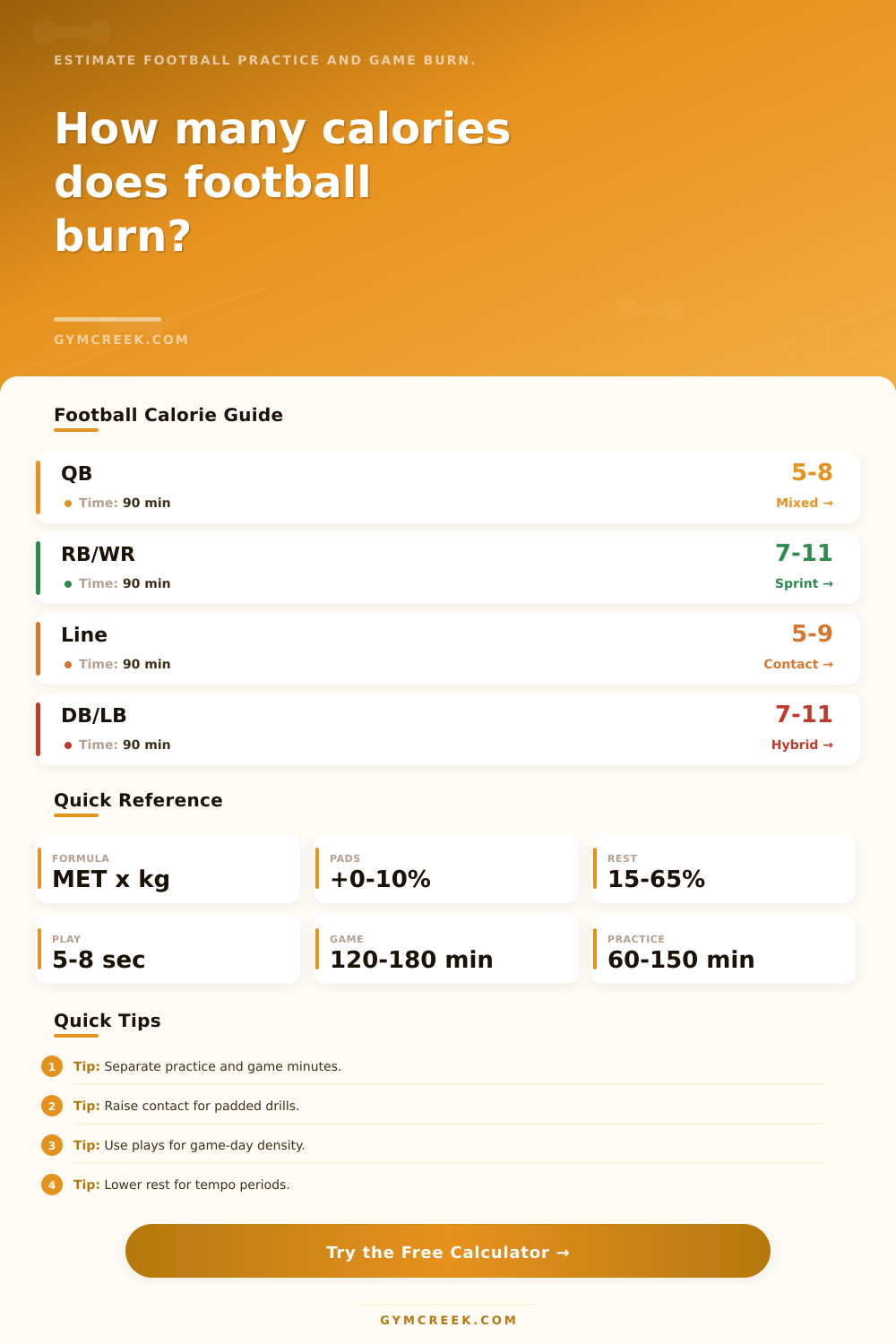
Each position starts with a football MET band. Skill players get more sprint influence, linemen get more contact influence, and hybrid roles blend both.
Plays estimate live football density. Rest ratio lowers total session MET, while equipment load raises work cost for helmets, shells, and full pads.
Mifflin-St Jeor estimates BMR from age, size, and gender, then the activity multiplier gives TDEE so football burn can be compared to a day.
📑Reference Tables
| Position | Base MET | Sprint Bias | Contact Bias |
|---|---|---|---|
| Quarterback | 5.4 to 7.8 | Moderate | Low to mid |
| Running back | 7.2 to 10.8 | High | High |
| Wide receiver | 7.0 to 10.6 | Very high | Moderate |
| Offensive line | 5.8 to 9.4 | Low | Very high |
| Linebacker | 7.0 to 10.8 | High | Very high |
| Session | Minutes | Rest Ratio | Best Input |
|---|---|---|---|
| Walkthrough | 30 to 75 | 45 to 70% | Live share |
| Practice | 75 to 150 | 25 to 50% | Period plan |
| Scrimmage | 60 to 120 | 25 to 45% | Live reps |
| Game day | 120 to 180 | 45 to 70% | Snap count |
| Load Factor | Low | Medium | High |
|---|---|---|---|
| Sprint intensity | 0.90x | 1.10x | 1.30x |
| Contact intensity | 0.88x | 1.06x | 1.26x |
| Equipment load | 1.00x | 1.06x | 1.13x |
| Tempo factor | 0.94x | 1.07x | 1.22x |
| Formula | Variables | Output | When Used |
|---|---|---|---|
| MET kcal | MET, kg, min | Calories | Main burn |
| Live density | plays, min | Percent | Rep demand |
| Rest kcal | Rest MET, min | Break burn | Sideline |
| TDEE share | kcal, TDEE | Percent | Daily context |
💡Tips
Tight games involve a lot of contact, like those in August or when time drags in the fourth quarter. In these moments, it’s easy to understand why there is such a gap between amount of work done and calories required. You’re so burned out, you can barely hold onto anything and your hands is shaking (but you’re still fatigued and sluggish). That’s why knowing the math behind your metabolism is more important than just chowing down on more grub.
When you enter your session information and position into calculator above, it will do all the complicated math for you. This saves you from having to guess how things like a sprint drill or wearing a helmet affect your daily calorie needs.
Why Football Calories Are Different
“Most athletes think: calories in = calories out. Understanding the math of your metabolism matters more then simply eating more. But football isn’t a consistent activity. It’s stop-and-go. You’re not burning fuel the way a runner burns fuel on track. A wide receiver burns it while standing around in the huddle between bursts of speed. That’s why estimating can be difficult.
The tool accounts for that by splitting game minutes from practice minutes and letting you edit your live rep share. If you have a two-hour practice, and listen to a play call for 45 minutes, your metabolism will drop dramatic when you’re sitting there doing nothing. If you don’t factor in that rest period, you’ll overeat and blow up your caloric intake. It is a subtle tweak, but a significant change to your baseline.
It’s not just about time; it’s also about position. Sure, that quarterback may have covered less yardage than a linebacker, but he was moving in short bursts with high cognitive load, which results in different metabolic profile. As you can see by glancing at the reference table on the page, certain roles has a higher contact-intensity, while others are skewed toward the sprint side of things. Receivers and running backs, skill positions, have a high sprint bias, which means they has a higher jump in base energy use upon the sound of the whistle. On the other hand, linemen have a contact bias. Instead of relying on vertical speed, their job is to absorb collisions and generate heat through constant muscle tension.
That’s important. It tells us what to fuel them with. Players who are sprint-heavy require carbs that quickly provides an instant boost for burst power. Because linemen are grinding it out, a combination of sustained energy sources tends to work better (and they don’t crash).
And then there’s the gear. I know, it sounds small. But putting on 20 pounds worth of pads alters the mechanics of how we move around. Walking in pads takes more effort than walking in shorts. There’s also an equipment load factor built into calculator to account for the additional resistance. Toggle between full pads and flag gear and you’ll see the output scale change. It’s not just about comfort… it’s also accounting for what your muscles are actualy doing to carry that extra weight.
That’s why summer camp seems more exhausting than games in the fall. You’re still wearing the same amount, but the heat and lack of acclimatization increase the energy expenditure.
The last part of the puzzle that most folks overlook is rest ratio. If you’re playing in a high school game, for example, you could be sitting on bench for forty minutes with just twelve minutes of action on field. Sure, your body is still burning calories on the sideline, but not as fast as it would during the play itself. Enter a rest percentage into the tool, which smooths out those peaks and valleys. The higher your rest ratio, the lower the average energy needed for the workout. This gives you a more realistic picture of how much energy you really used compared to what you would of burned if you had played without stopping.
So knowing those variables makes you not guess. It allows you to sync what you are putting into your system to what that day’s work requires. Not all meals after practice should be the exact same. A full pad scrimmage require more than a light walkthrough with little contact time. The data tells one story and the way your body feels is another. When you connect that is when real performance management starts to take place. You no longer treat each day equally. Now you are feeding yourself for actual work at hand.