Foot Position Deadlift Calculator
Estimate a deadlift stance from hip width, stance type, toe angle, shin angle, arm length, bar path, mobility, and pull style.
📌Deadlift Position Presets
Presets model common deadlift setups, then calculate how foot width, toe angle, shin angle, and bar path should be nudged.
⚙Calculator Inputs
Deadlift foot setup snapshot
Enter your measurements and current pull pattern to estimate a stance worth testing.
📊Position Metrics Grid
📑Reference Tables
| Stance Type | Width From Hip | Toe Range | Best Fit |
|---|---|---|---|
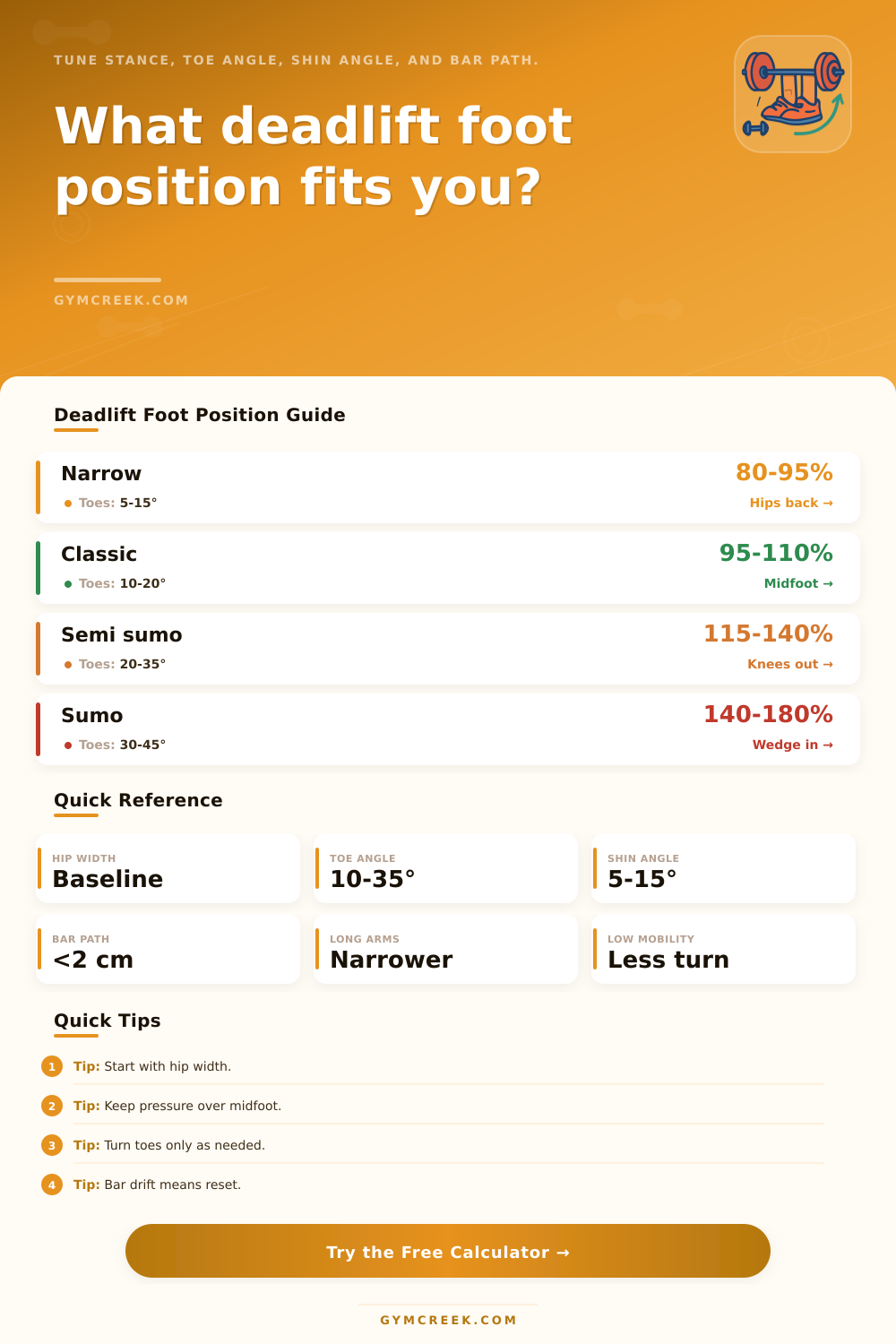
| Narrow conventional | 80-95% | 5-15° | Long arms, strong hinge, close bar path |
| Classic conventional | 95-110% | 10-20° | Balanced hips, average arms, steady floor speed |
| Semi sumo | 115-140% | 20-35° | Moderate hip turnout with shorter pull distance |
| Full sumo | 140-180% | 30-45° | Mobile hips, upright torso, patient wedge |
| Signal | Too Narrow | Too Wide | Useful Adjustment |
|---|---|---|---|
| Bar leaves forward | Often hips too far back | Sometimes knees block bar | Shift stance 1-2 in and reset midfoot |
| Knees cave in | Less common | Common with poor turnout | Narrow slightly or increase toe angle |
| Slow floor break | Can lack quad drive | Can lose wedge tension | Find width that keeps shins near vertical |
| Low-back load | Torso may be too horizontal | May improve if hips tolerate it | Try semi sumo before full sumo |
| Body Lever | Width Bias | Toe Bias | Setup Note |
|---|---|---|---|
| Short arms | Wider | Slightly more | Use more knee bend or semi sumo |
| Average arms | Neutral | Moderate | Start near hip width and test |
| Long arms | Narrower | Less | Take advantage of easier bar reach |
| Very long arms | Narrowest | Minimal | Keep the bar close and hinge hard |
| Pull Style | Priority | Stance Bias | Watch For |
|---|---|---|---|
| Max strength wedge | Total tension | Best score, not widest | Hips rising before the bar |
| Speed from floor | Fast break | Slightly narrower | Bar swinging away from shins |
| Posterior-chain tension | Hinge feel | Narrow or classic | Knees crowding the bar |
| Low-back friendly | Torso angle | Classic to semi sumo | Forcing range you do not own |
💡Deadlift Setup Tips
When you’re trying to find the proper foot position in a deadlift, it can feel more of a guessing game.
Your stance width change the bar’s path and how your hips load. This affects how much your low back is carrying. The majority of lifter attempt a handful of stances, feel that one “feels” better, and continue without ever understanding why. Understand how everything works together. Understand what’s happening with every component in your setup.
How to Find Your Best Deadlift Stance
Shin angle indicate whether your knees remain back in hinge or if they come forward too soon. Stance width affect both how much your hips need to rotate and how vertical your shins can stay. Your toe angle affects how much external rotation your hips has to perform. How does your bar path relate to staying close to your center of mass? How do these factors work together?
Once measured relative to yourself, these variables can be understood in terms of how they work together. Arm length is surprising important. The longer your arms, the less torso lean you need to reach the bar. That typically pairs best with a narrower stance since you don’t have to bend your knees so far down. With shorter arms, you’ll tend to favor a wider stance (or more out-toeing) that brings the bar closer but doesn’t require such extreme hip positioning. Other mobility will limit this equation from the opposite end. Even if math says going wide shortens your pull length, there are issues if your hips won’t rotate comfortabley outward into that position.
When you enter your measurements into calculator, it compares your hip width to your current heel spacing to give you a target stance width, along with a recommendation of a toe angle to try and a cue as to what to look for. It doesn’t tell you the answer. It gives you a target width. It suggests a toe angle to try. It also gives you a cue as to what to look at.
Then it’s up to you to film the lift, to determine if your knees are tracking and whether or not the bar is staying overhead of midfoot.
What’s wrong: Most lifters alter multiple variables simultaneous. In one workout they’ll spread their feet apart, splay their toes outward, and attempt to sit further back in their heels. How will they ever be able to identify which adjustment made an impact? To fix it, select one variable to change and do so slightly. On moderate repetitions, observe how the bar travels and track your knees. Does it stray too far forward? Likely, your stance is too broad different than your hip mobility. Do your knees collapse inward? Perhaps you require a narrower base or more toe-out.
Consistency with reps is what matters most. You’ll find something that fits, allows you to generate tension and keeps the bar close even if it’s not “optimal” (on good days). That’ll outperform an “optimal” position that works well on some days but not others. The calculator provides a starting place for you to test. Your body and the bar provide feedback based off the platform. You should of used this more often.