Foot Contacts Per Session Calculator
Count plyometric landings, weight them by intensity, and compare the session against practical jump-volume ranges.
📌Presets
Presets load common plyometric sessions, including bilateral jumps, bounds, depth jumps, and return-to-run contacts.
⚙Calculator
Plyometric contact snapshot
Enter your plyometric block and calculate session contacts.
📊Session Metrics
📑Reference Tables
| Athlete Level | Low Session | Moderate Session | High Session |
|---|---|---|---|
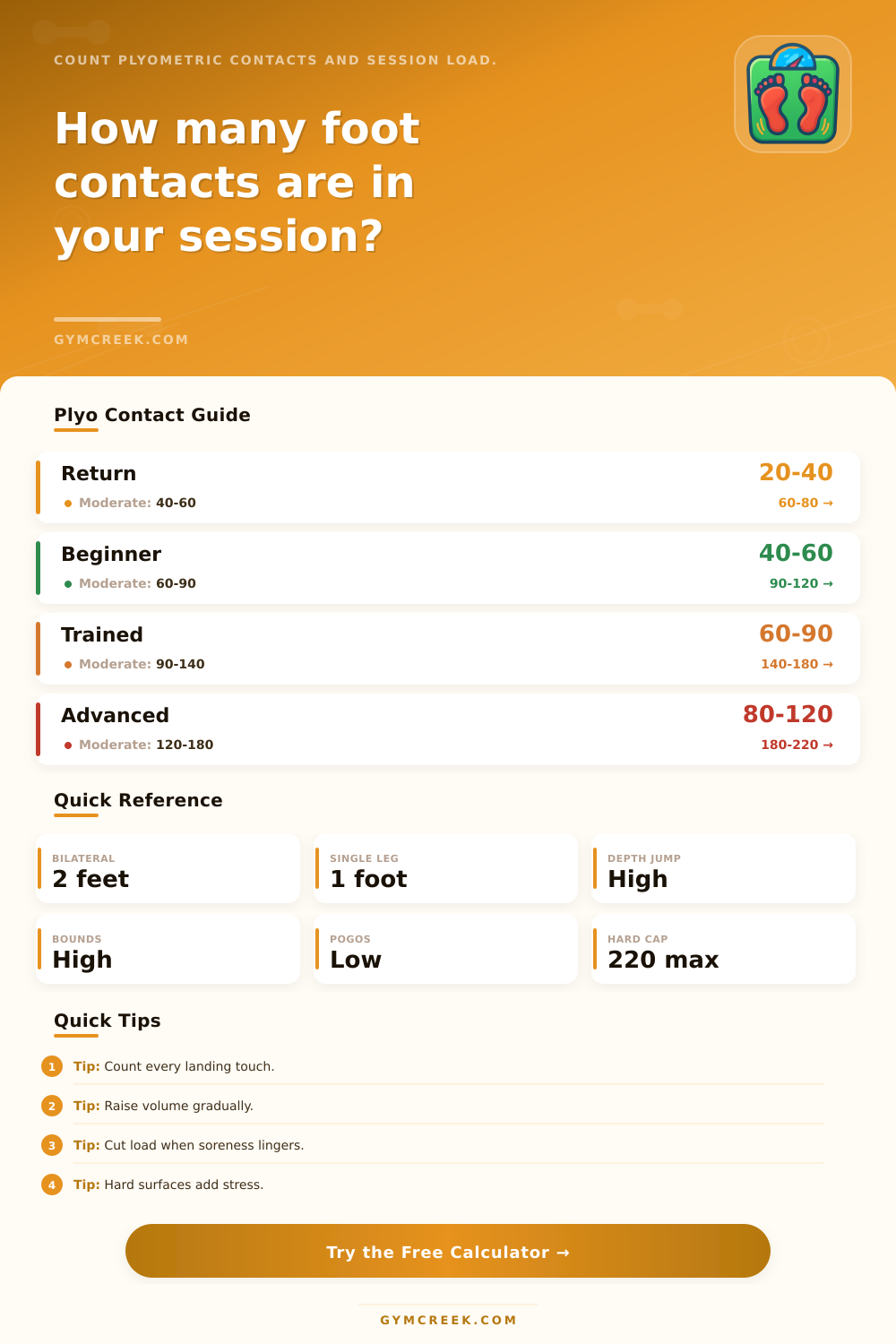
| Return to plyometrics | 20-40 | 40-60 | 60-80 |
| Beginner | 40-60 | 60-90 | 90-120 |
| Trained | 60-90 | 90-140 | 140-180 |
| Advanced | 80-120 | 120-180 | 180-220 |
| Movement | Intensity | Typical Count | Notes |
|---|---|---|---|
| Pogo hops | Low | 20-80 | Fast ankle contacts |
| Box jumps | Moderate | 20-60 | Step down when possible |
| Bounds | High | 20-80 | Horizontal force |
| Depth jumps | Very high | 10-40 | Use sparingly |
| Surface | Load Factor | Best Use | Adjustment |
|---|---|---|---|
| Turf or grass | 0.90 | Return blocks | More forgiving |
| Track or court | 1.00 | General plyos | Baseline |
| Rubber floor | 1.05 | Gym sessions | Watch rebound |
| Concrete | 1.25 | Rare use | Reduce contacts |
| Input | Formula Role | Raises Load When | Planning Note |
|---|---|---|---|
| Landing pattern | Foot factor | Both feet count | Track each contact |
| Jump height | Height factor | Higher drops | Limit depth work |
| Weekly sessions | Exposure | Frequency rises | Spread hard days |
| Rest days | Readiness | Less than 2 days | Trim volume |
💡Tips
When most coaches design a plyometric routine, they think in terms of sets and reps. Four sets of ten box jumps is written down, and the job’s done. This ignores the variable that cause fatigue. And the factor that increases tendon injury risk. Foot contacts per session are the key metric.
This means counting each landing. Sounds tedious? Yep. But it’s the sole method for determining whether you’re jumping at a sustainable volume. This eliminates guesswork for you. It turns what exercise you’re doing into how many contacts there is. There’s no math involved either. Just pick your athlete’s level, select the exercise type, and input the rep/set range.
Count Your Landings to Stay Safe
Then, the program will adjust based off surface hardness (multiplier), landing pattern, and jump height. A pogo hop on turf is very different than a single-leg bound on concrete. One is significantly more difficult than the other. If you don’t account for that one difference in your plan, you’ll be sore later.
The level of athlete matters. How do I know? A novice will handle anywhere from 40, 60 comfortabley contacts. An advanced jumper would likely require more than 100 before they could adjust. The reference table spells it out nicely. When coming back after some time off, begin at a lower number. Your nervous system adjust faster then tendon tissue. It’s possible you could be feeling fresh on day 1. But that doesn’t mean you didn’t build up micro-damage which show up in 3 days. This is why we ask about rest days since your last high-impact activity. Stacking jump days without recovery will cause a spike in the weighted load score. This tell you to immediately reduce your volume.
One variable that’s often overlooked by most folks is surface selection. Concrete has a much higher impact level than a rubber or even a track floor; jump on either of those and the tool compensate. If you’re limited in terms of facilities, lower your number of contacts because it’s a hard surface. It’s a tradeoff. Soften the landing and you can maintain high volume, decrease your volume and you can maintain high intensity. Rarely do you get to have both.
Neural fatigue is expensive; it takes lots of reps for depth jumps to reach full fatigue. In just milliseconds they create huge ground reaction forces. The calculator treats those as high-intensity inputs. Even ten will get a newbie’s session up towards moderate or even high. Low intensity pogo hops let you add more landings (contacts) due to tiny force per landing.
Why does this matter? It lets you balance out your training week. Maybe do sixty pogos one day then do twenty depth jumps the next. Total contacts will vary greatly, yet the fatigue profile could of been the same if done right. The safety net is that it tracks weekly totals. Four sessions a week at 200 contacts each, you’re probably pushing your limits of recovery. As most athletes develop their toughness, they’ll thrive within the moderate to low ranges. Going into high zone on a regular basis brings Achilles and shin splint issues.
You don’t want to push your limits as much as possible. You want to improve it to get performance gains while avoiding breakdowns. If you’re not sure where to begin, use the presets. They’ll load some common scenarios such as volleyball approaches or youth box jumps. From there, tweak the variables based on your specific environment. And let the calculator do the math for you. Focus on movement quality instead.
At first, counting each touch of your landings sounds tedious. Once you understand how it separates the pain from the progress, though, it becomes second nature. You begin seeing training as a cumulative load on the body. That shift in perspective will change the way you recover. It will also change the way you coach.