Floor Press Load Calculator
Estimate floor press 1RM, training max, suggested working load, weekly pressing volume, and relative strength from reps, RPE, grip, and goal.
📌Presets
Each preset loads a realistic floor press scenario and recalculates the estimate using the selected unit system, grip, goal, and set effort.
⚙Calculator
Floor press load snapshot
Enter a completed floor press set to estimate max strength and target loading.
📊Fitness Metrics Comparison
📑Reference Tables
| Goal | Common Reps | Target Percent | Usual RPE |
|---|---|---|---|
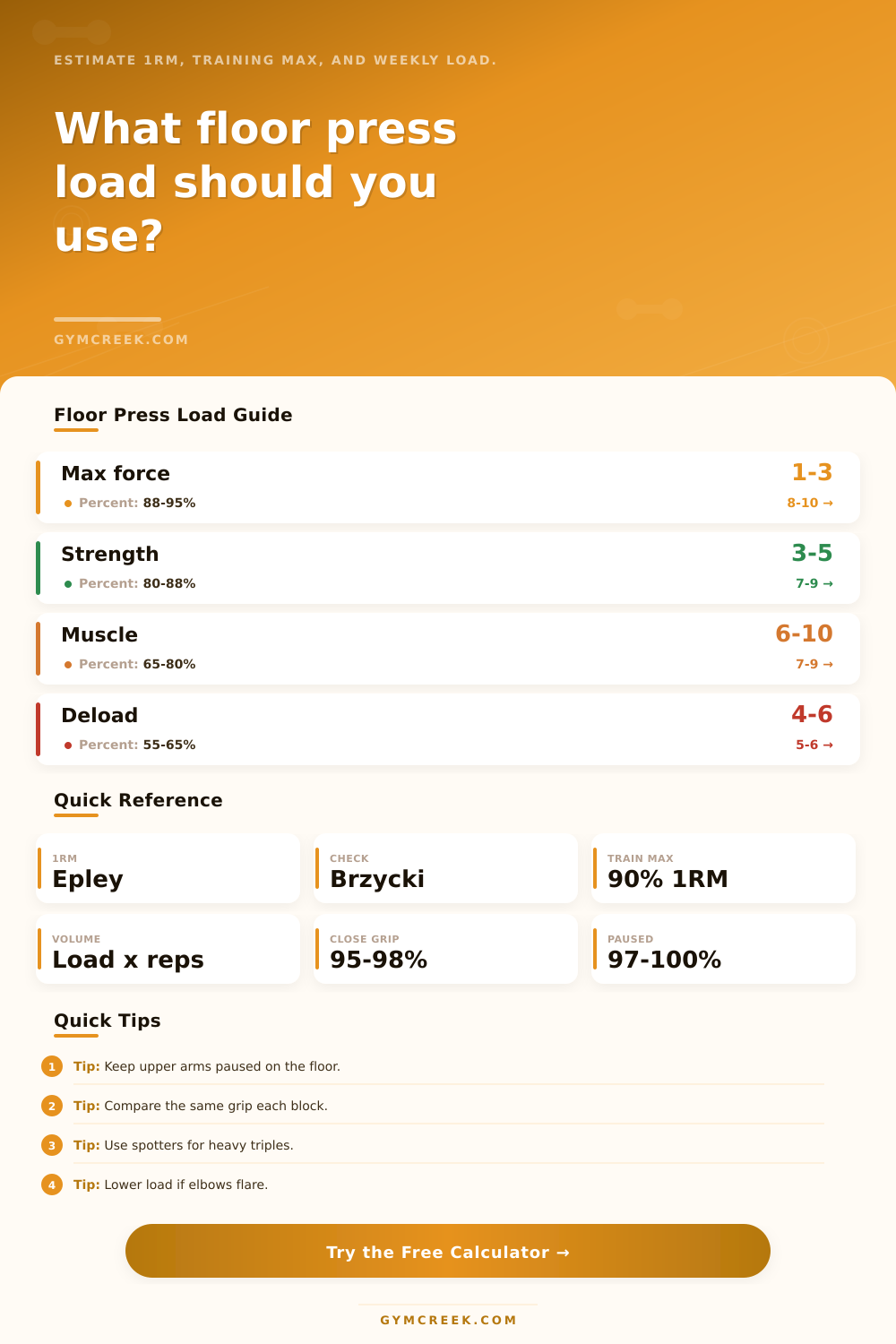
| Max force practice | 1-3 reps | 88-95% of training max | 8-10 |
| Strength building | 3-5 reps | 80-88% of training max | 7-9 |
| Hypertrophy press work | 6-10 reps | 65-80% of training max | 7-9 |
| Deload or return week | 4-6 reps | 55-65% of training max | 5-6 |
| Floor Press Style | Load Note | Carryover Estimate | Best Use |
|---|---|---|---|
| Standard barbell | Baseline | 100% floor press | General strength |
| Close-grip barbell | Often 2-5% lower | Triceps focus | Lockout work |
| Dumbbell floor press | Total pair load | Lower stability | Shoulder-friendly work |
| Paused stop | Usually strict | High control | Bottom-end pause |
| Relative 1RM | Male Category | Female Category | Open Note |
|---|---|---|---|
| Under 0.75x BW | Beginner | Novice range | Technique priority |
| 0.75-1.10x BW | Novice | Intermediate | Good base |
| 1.10-1.45x BW | Intermediate | Advanced | Strong press |
| 1.45x+ BW | Advanced | High advanced | Specialized strength |
| Formula | Variables | Output | When Useful |
|---|---|---|---|
| Epley 1RM | Load x (1 + reps / 30) | Max estimate | 1-10 reps |
| Brzycki check | Load x 36 / (37 - reps) | Max cross-check | 1-10 reps |
| Training max | Estimated 1RM x 0.90 | Planning max | Repeatable loading |
| Volume load | Load x reps x sets x weekly frequency | Weekly work | Fatigue tracking |
💡Tips
When you’re laying down on the floor pressing weight, there’s something about having your back on the ground that give you quiet confidence. Because the floor press takes off bottom half of bench press range, it changes physics of the lift as well as muscles that drive it upwards. You take away stretch reflex at bottom, so now you can’t use elastic energy to “bounce” the bar out of a hole. Now, you have to produce pure force from a dead stop.
This transition make the movement a test of your front shoulder and triceps strength. That’s why athletes and powerlifters uses it for building lockout power. But knowing it works is different than knowing how much weight to put on the bar.
How To Use The Floor Press Calculator
That’s how most lifter go about it: they’ll take their bench max, remove some arbitrary number for reduced ROM, and cross their fingers. That won’t always work, though; floor press doesn’t always change at same rate than bench. Depending on your technique, i.e., how much you rely on momentum during the negative, some athletes will carry over almost pound-for-pound, whereas others will drop off dramaticly.
Here’s where a structured approach realy shines. The calculator use the sets you input above to estimate your one-rep max and assign sensible percentages based on your current training goal. No more guessing around with the load, you’ll be not only heavier, but strategically so.
But half the battle come down to understanding the inputs. By entering your rate of perceived exertion and number of reps, you open up a window into how fatigued you actualy were. Did you have two rep left in the tank? If so, an RPE of eight imply that weight was hard, but doable. That’s important, continually pushing yourself to failure builds systemic fatigue that can throw off your progress for weeks.
Based off that info, the tool will work out a training max, typically ninety percent of your estimated true one-rep max. So why not 100 percent? Because this gives you some breathing room to train often while avoiding burning out your central nervous system. It’s a tiny mathematical tweak, but a huge difference in the long run.
Finally, how do you interpret the numbers? That depends on both variation and the grip. For example, if you’re performing close-grip floor press, you’ll exert enormous tricep demand and may see lower absolute loads than normal (i.e., a “normal”-grip variation). Using dumbbells? Your estimated max will probably be lower than that of barbell, but not because of raw strength; instead, you must consider stability.
Again, it’s all laid out nicely on the page: different variations corresponds to specific ranges of reps/sets/percentages. Don’t mix ‘em up. Unless you adjust your expectations of what’s possible under each variation. If your expectations don’t match, you will get frustrated when the numbers don’t align.
Another common place intuition goes wrong is volume management. Intuitively, we think that more sets = more gains, yet floor pressing is extremely hard on connective tissue and joint health. By including frequency in its calculations, the calculator tell you how much volume you’re putting through your upper body every week… I.e., total load. If it’s spiking too high, take a hint from Mr. The calculator shows it is time to back off or deload before your shoulder forces you to do so. Lots of lifters wait until they have a sore shoulder to bother checking this metric. Track this data quietly to prevent those loud moments of failure.
And lastly, understand that your numbers are a tool used for planning, not a trophy earned for winning. Aiming to get the maximum number you can guess at on a spreadsheet isn’t the goal. The goal is move weight consistently and under control over time (months & years). Take the recommended load as a starting point, make adjustments depending on how your body feels in practice, and trust the process. There’s no shortcutting this lift; you’re forced to own each inch of it. That same sense of discipline should of be applied when managing your loads. Respect the pause and you’ll respect the progress.