Flip Turn Time Calculator
Estimate how pool length, race distance, turn count, split time, wall time, push-off distance, breakout strokes, stroke style, and fatigue change your swimming race time.
📌Named Flip Turn Presets
Each preset loads a complete race profile with its own pool length, race distance, split time, wall speed, underwater distance, breakout count, and stroke demand.
⚙Flip Turn Inputs
Turn impact snapshot
Enter race distance, split time, pool length, wall time, push-off distance, and breakout strokes to calculate turn impact.
📊Turn Metrics Grid
📑Flip Turn Reference Tables
| Measure | Raw Value | Per Turn | Use |
|---|---|---|---|
| Turn time | --- | --- | Enter values above. |
| Event | 25 Pool Turns | 50 Pool Turns | Turn Emphasis |
|---|---|---|---|
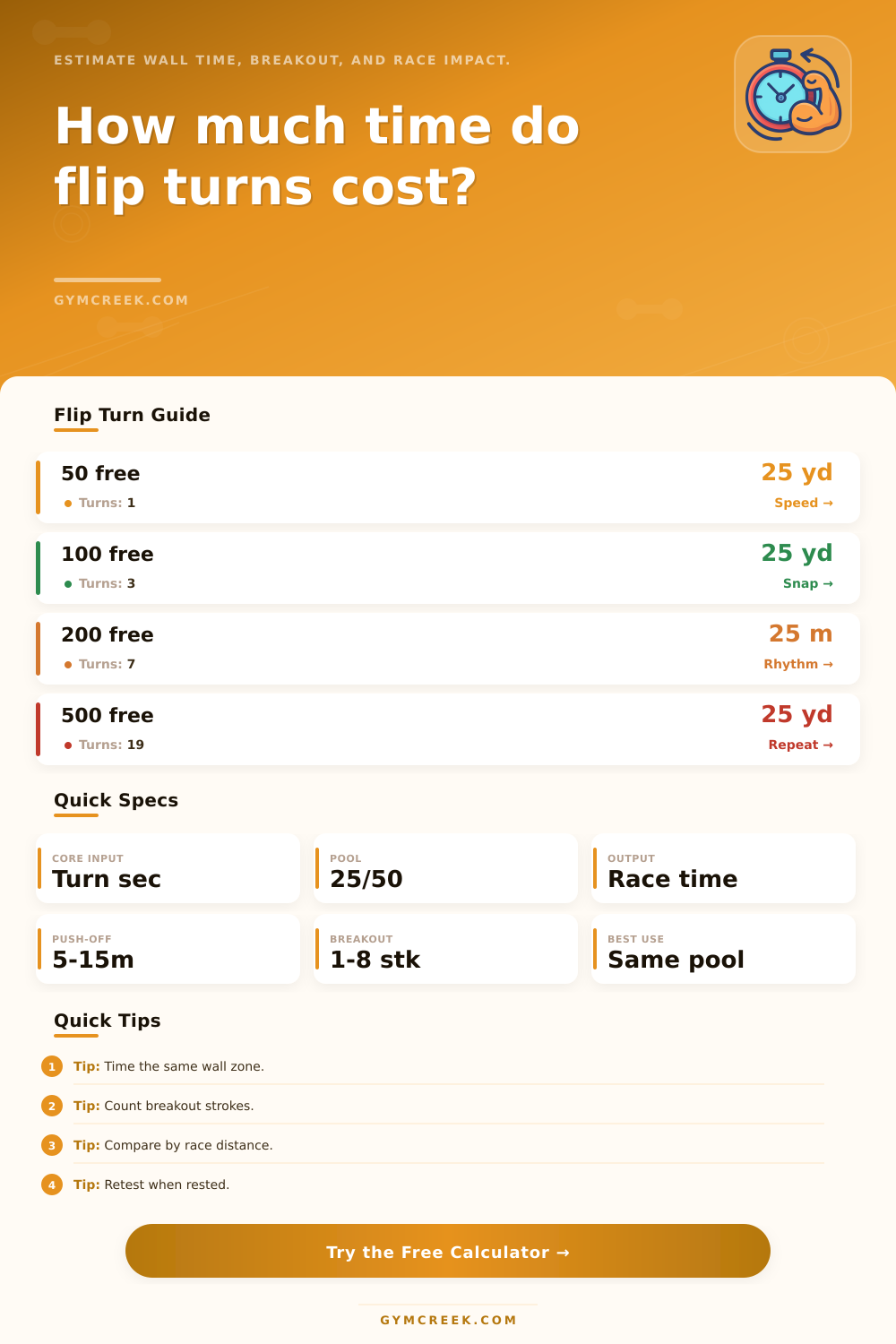
| 50 freestyle | 1 in short course | 0 in long course | Start and one wall can decide the race. |
| 100 freestyle | 3 in short course | 1 in long course | Each wall should repeat under pressure. |
| 200 freestyle | 7 in short course | 3 in long course | Rhythm matters more than one fast wall. |
| 500 or 400 free | Many repeated walls | Fewer long-course walls | Small per-turn gains compound quickly. |
| Profile | Turn Time | Push-Off Range | Breakout Cue |
|---|---|---|---|
| Developing swimmer | 1.8-2.6 seconds | 3-5 pool units | Find the wall without gliding in. |
| Fitness or masters | 1.3-2.0 seconds | 4-7 pool units | Hold speed through rotation. |
| Club swimmer | 0.95-1.45 seconds | 5-10 pool units | Break out before speed falls away. |
| Elite short course | 0.70-1.10 seconds | 8-15 pool units | Connect wall speed to surface rhythm. |
| Pattern | Likely Meaning | Main Cause | Next Check |
|---|---|---|---|
| Turn share | --- | --- | --- |
💡Flip Turn Tips
In all races, flip turns take away time. As you approach wall, you feel yourself speed up as you rotate. Then, clock either rewards you for making that flip or it punishes you for it. That slight change from a sluggish flip to a clean push can be the difference in your final time. Swimmers don’t really understand that unless they race at end of their race. Knowing what each flip actualy costs is more important then many realize.
All you have to do is input information. You need to enter race distance, length of pool, your split time for one lap, and the type of turn you make. Then calculator does the rest.
How to Use the Flip Turn Calculator
You should of know why those variables alter the result. How many walls you get to swim depends on the length of pool. You get seven if it’s a 25-meter pool, which means seven chances at gaining or losing time during a 200-meter event. Cut that down the middle with a 50-meter pool and every single wall become exponentially more important.
The total distance of race tells the tool how much pattern repeats. Events like short course meters favors explosive speed out of wall. Longer races penalize any lack of consistency late in the race.
Turn time is average amount of time between your final hand entry and your initial breakout stroke. That one number represent your rotation speed, how hard you push off the wall, and when you decide to break the water’s surface. How far do you go before resuming propulsion? The further you go, the more likely you are to slow down before you hit the surface. The shorter the distance, the less power you have generated.
Breakout strokes represent number of strokes until returning to an even pace. Each additional stroke past wall brings added drag, something remainder of length must compensate for. Every repeat is affected by fatigue and approach speed. When they push less hard, a tired swimmer will rotate later. Aggressively approaching can save time early but risk jamming the turn if approach slips.
These is factors folded into expected time gain by calculator. It shows what happens when you improve each wall by small, realistic margin. That’s possible because inputs represent the real sequence of decisions a swimmer makes on each length.
If you look at reference table on page you can see that different events do better and worse off of each turn. A 50 free rises and falls with single wall. Because 500-meter freestyle sees walls repeated so many times, small improvements each turn add up. This will be important if you choose to train at certain locations. Every race benefit from improved wall speed, but some benefit faster than others. Short course races has walls more frequently which pays off quicker.
One error is measuring an incorrect zone. A 5-meter start results in one number. A hand touch to feet off the wall results in another number. Each measurement has value but cannot be compared apples-to-apples.
A second error is shortening push-off to pursue faster rotation. On film, that looks faster, but speed are lost before initial stroke is attempted. But that’s where true value comes to light when you try this same section of wall under other scenarios. Try it fresh vs. Tired. Controlled vs. Aggressive. See what the numbers does differently. See how much it costs for whole race, because calculator tells us that.
The little things like whether you rotate a hair sooner or later; break out a hair more or less; they add up because they’re all repeated on every single length. Treated as a repeatable skill instead of an interruption along the way, that swimmer have fewer surprises at end and cleaner splits. And that makes difference between a good turn and a race winning turn.