Fitness Level Calculator
Estimate your overall fitness level from aerobic capacity, strength, body composition, mobility, and weekly activity.
📌Presets
Each preset loads a different training profile and recalculates the score immediately.
⚙Calculator
Fitness level snapshot
Enter your tests to calculate an overall fitness score.
📊Fitness Metrics
📑Reference Tables
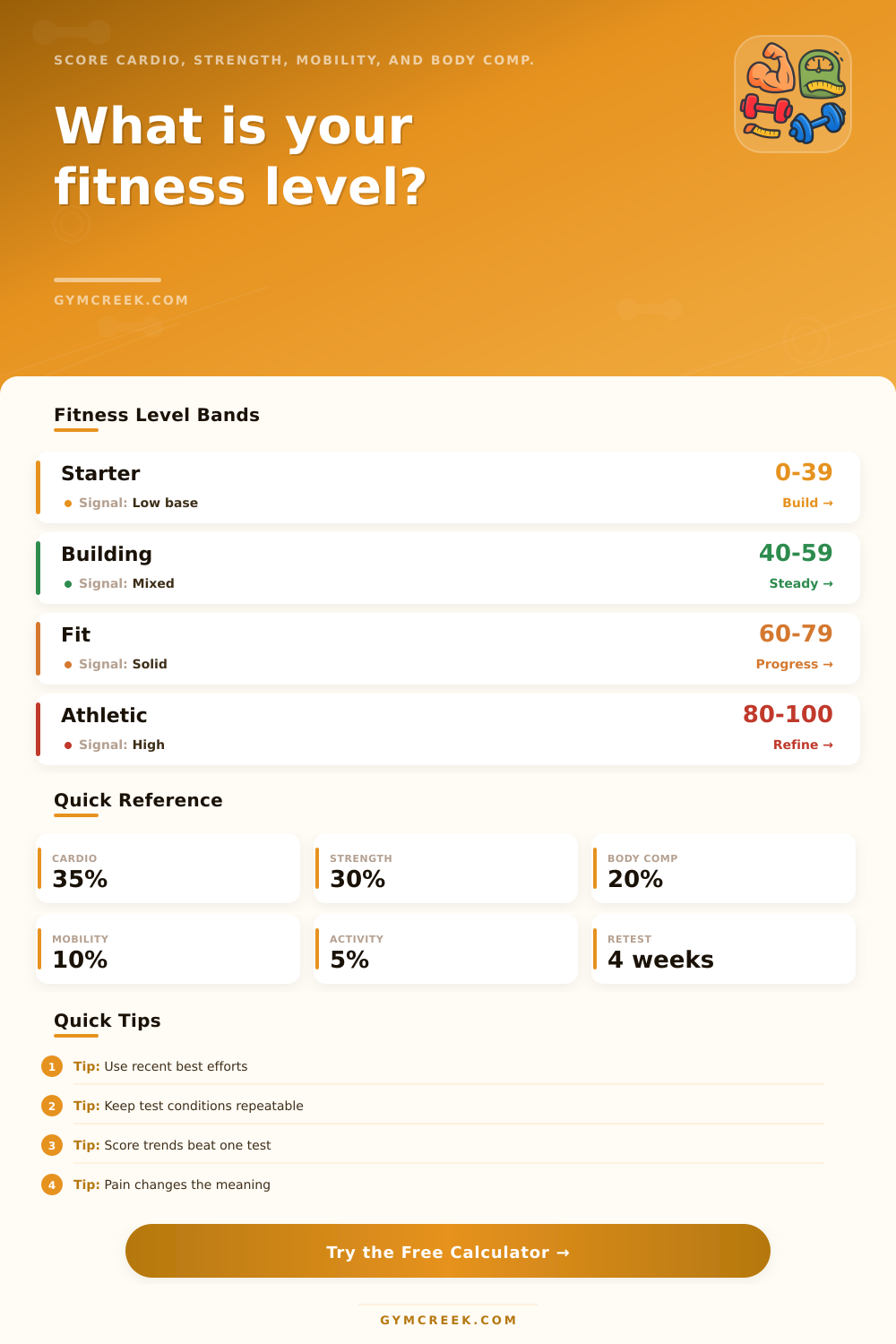
| Score band | Level | Common signal | Next focus |
|---|---|---|---|
| 0-39 | Starter | Low base or returning | Consistency and easy capacity |
| 40-59 | Building | Some qualities developed | Raise the lowest subscore |
| 60-79 | Fit | Solid all-around profile | Progress specific goals |
| 80-100 | Athletic | High capacity across areas | Refine weak links |
| VO2 band | General meaning | Cardio score | Notes |
|---|---|---|---|
| Under 30 | Low aerobic base | 0-35 | Build easy volume first |
| 30-39 | Developing endurance | 35-60 | Consistent weekly work helps |
| 40-49 | Good aerobic fitness | 60-80 | Mix easy and harder work |
| 50+ | High aerobic fitness | 80-100 | Progress carefully |
| Component | Weight | Formula source | What it reflects |
|---|---|---|---|
| Cardio | 35% | Cooper or run estimate | Aerobic capacity |
| Strength | 30% | Epley e1RM ratios | Relative force output |
| Body comp | 20% | BMI, waist, body fat | Size and composition context |
| Mobility/activity | 15% | Self-score and minutes | Readiness and consistency |
| Measure | Good target | Watch point | Use |
|---|---|---|---|
| Resting HR | 50-65 bpm | 75+ bpm | Recovery context |
| Weekly minutes | 150-300 | Under 90 | Activity consistency |
| Strength ratio | 1.0x+ average | Under 0.5x | Relative strength |
| Retest span | 4-8 weeks | Daily swings | Trend tracking |
💡Tips
Fitness levels is determined by the choices individuals make each week, not solely by the number on a fitness scale or in a mirror. Many people have a sense of their energy levels and how difficult it feels to perform certain movement compared to previous attempts. However, it is difficult for individuals to associate those sensations with their fitness levels.
No single fitness test can provide the complete measurement of an individual’s fitness level. Therefore, several measurements must be combined to provide an accurate view of an individual fitness level. The calculator perform the mathematical calculations once an individual input their fitness results.
How to Measure Your Fitness Level
The measurement of cardio capacity is weighted most heavily because cardio performance impact an individual’s daily energy and recovery speeds from physical activity. The second measurement within the fitness calculator is strength, as an individual’s strength impact their ability to perform physical activity, as well as their body composition. Other measurement of fitness that are included in the calculator include mobility and the number of weekly physical activity sessions that an individual perform.
While performing cardio tests, individuals may feel intimidated. However, an individual’s performance on these tests is a snapshot of their fitness level. For instance, the 12-minute distance option for cardio tests reward individuals who maintain even pacing during the test and provides an estimate of the body’s use of oxygen during physical exertion.
For those who enjoy running, the 1.5-mile test is an option for those who complete the test in the shortest time. Finally, resting heart rate measurement require little effort from individuals and are an appropriate test if the physical activity is an impossibility for some individuals. Each test will provide an individual with a comparable score for their cardio fitness.
For instance, an individual’s resting heart rate will decline with the number of physical activity sessions that they completes during the week. Therefore, an individual should ensure that the tests are performed under the same variable to ensure even comparisons of their fitness levels. For example, the sleep cycles and nutritional needs of an individual should be evened out for each test.
For the strength measurements, individuals need to utilize relative numbers for their strength. For instance, an individual should divide their one-rep max values by their body weight to account for the fact that an individual with a higher body weight will require the use of more force to move their relative load. Additionally, push-up and plank measurements account for body-weighted exercises and determine the individual’s endurance in these exercise.
Many individuals undervalue these exercises relative to other form of exercise. If the results of an individual’s strength measurement are lower than their cardio measurement, they should add one more session each week to increase their strength. Body composition utilize a number of measurements to determine an individual’s body composition.
These measurements include body mass index (BMI), waist measurement, and body-fat estimation. These attributes all play a crucial role in determining an individual’s body composition. For instance, an individual’s BMI may classify them as overweight despite having a low amount of body fat.
However, an individual’s waist-to-height ratio may show that their body fat is distributed in a way that does not pose health risk. Additionally, the body-fat estimation will provide a more accurate measurement of body composition, even if the individual estimates their body fat as an approximation. While individuals should not pursue any arbitrary target for body composition, it is essential for individuals to note if their body composition affects their other fitness qualities.
For instance, if an individual has extra body weight, their mobility scores may drop as a result of the extra body weight that makes it difficult for their joint to express their full range of motion. Although body composition levels are weighted less heavily within the fitness score calculation, they play a crucial role in determining whether the other fitness qualities calculated can improve. An individual’s limited mobility in their shoulder or hips can significantly impact their ability to perform strength exercises well and may pose a risk of injury when performing cardio exercises.
Additionally, the number of physical activity session that an individual completes each week will affect their adaptation capabilities in their body. An individual’s body will adapt to the amount of physical activity that they perform, just as their other measurement will adapt to the relative strength within their body. Common mistake include performing the physical fitness tests while sleeping poorly or when the individual is in a calorie deficit for the week.
Additionally, performing the tests if the individual is nursing an ache in their body will result in shifted number on the fitness test and the individual’s score will drop. While an individual may feel discouraged by their score, they should take note of these condition and retest their physical fitness at a later date. An individual’s score will improve if the physical activity and fitness score is tracked appropriately.
Individuals may also make a mistake by treating the fitness score that is provided as a permanent value. However, an individual’s fitness can change due to their training age, injury that affect their physical activity, or the number of stressful life events that they experience. A result within the reference table indicates to the individual the level of fitness that they possess.
For instance, if an individual scores within the lower band for their fitness qualities, they may need to focus on increasing the volume of their physical activities before focusing on the intensity. An individual with a score within the mid-range indicates that they have a workable foundation that can be used to improve their weakest fitness qualities. An individual with high scores have the potential to focus on refining their fitness rather than building it up.
These bands dont have a moral weight to them, as they simply indicate the individual’s current state of fitness. The fitness calculator is unable to account for various constraint on an individual’s physical fitness routine. For instance, an individual who has previously suffered from knee issues may struggle to exhibit elite performances in squat exercise.
However, they may score well in other fitness category. An individual must use their personal context within the fitness test to interpret the reference tables to determine their fitness level. Additionally, the test output includes a top-limiter callout for each fitness test to provide an individual with insight into their weakest fitness quality.
To properly track the individual’s fitness, the individual should perform each fitness test every four to eight week. An improvement in the lowest scoring fitness test will exhibit the highest improvement for the individual’s overall fitness score. For instance, an improvement in an individual’s mobility score will provide more improvement within the overall fitness score than adding to the individual’s cardio score.
Additionally, the fitness score’s impact on each fitness attribute is based on the physiology of the individual’s body. The value of the fitness score is in the decision that an individual makes with the information that is provided within the fitness test. For instance, if an individual scores low on the number of physical activity minute that they perform each week, they may require an improvement in consistency of their physical activity routine rather than the type or intensity of their physical activity routine.
Additionally, if an individual scores well on their strength score but have poor body composition measurement, an individual should focus more on their nutritional intake and recovery from physical activity. While the fitness score does not indicate an individual’s level of motivation for physical activity, an individual’s score will provide a more accurate map of their physical abilities than they could intuitively understand by themselves. By determining their fitness level and by appropriately adjusting the individual’s fitness routine according to the recommendations from the fitness calculator, an individual can exhibit the highest potential in their physical fitness abilities.