Finger Strength Calculator
Estimate max hang strength, bodyweight-relative grip capacity, edge-adjusted load, and practical hangboard training targets.
📌Presets
Presets fill realistic climbing profiles and calculate immediately. Use the same edge and grip shape when comparing sessions.
⚙Calculator
Finger strength snapshot
Enter a recent hang test to estimate training targets.
📊Metrics Grid
📑Reference Tables
| Relative Strength | Typical Range | Benchmark Edge | Training Note |
|---|---|---|---|
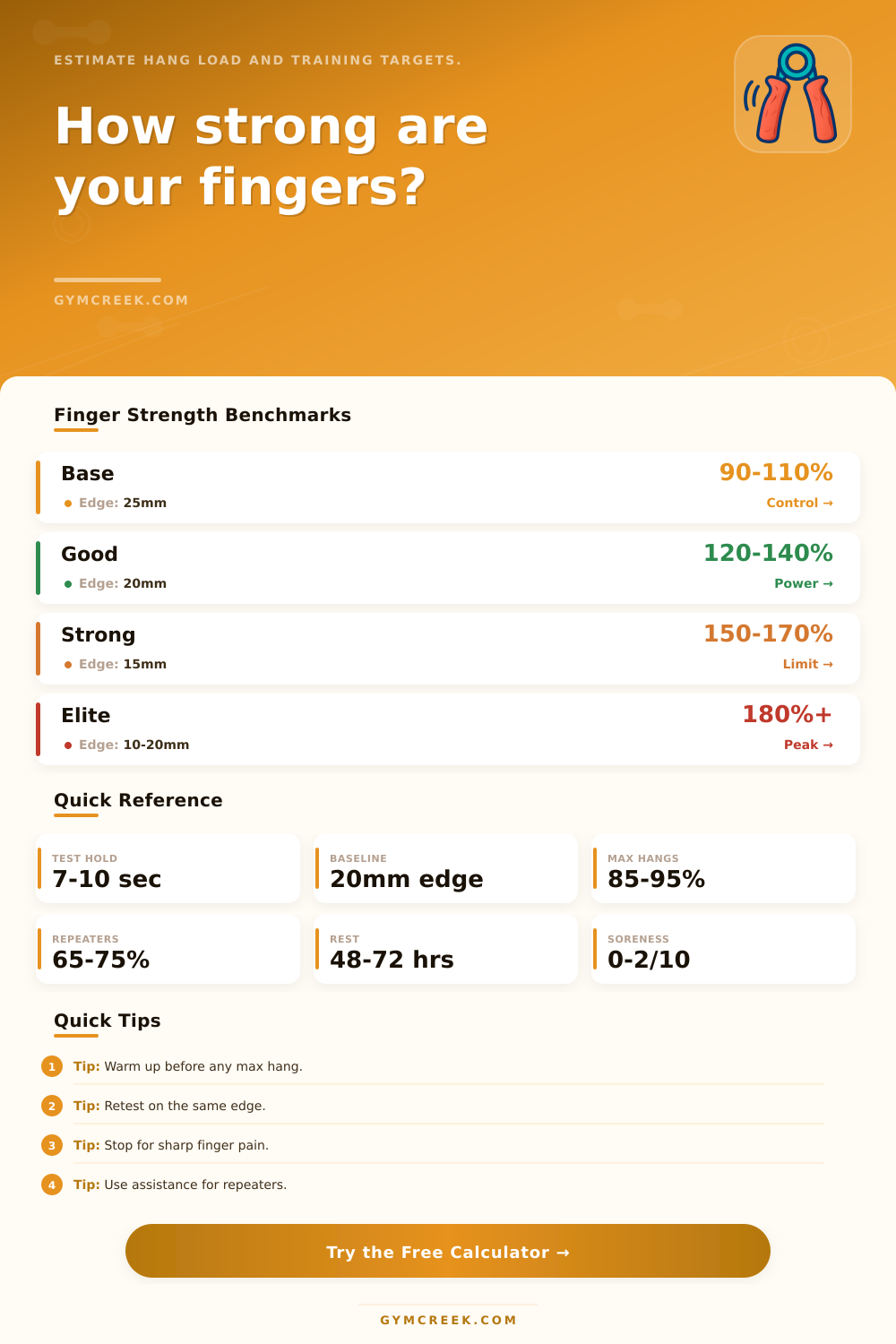
| Foundation | 90-110% | 25 mm | Build positions |
| Intermediate | 115-140% | 20 mm | Add structure |
| Advanced | 145-170% | 15-20 mm | Use careful loading |
| Elite | 180%+ | 10-20 mm | Manage fatigue |
| Goal | Intensity | Hold Style | Primary Output |
|---|---|---|---|
| Max hang | 85-95% | 5-10 sec | Peak force |
| Repeaters | 65-75% | 7 on 3 off | Capacity |
| Density | 55-65% | 20-40 sec | Tissue tolerance |
| Maintenance | 75-85% | Short sets | Keep strength |
| Grip | Use Case | Multiplier | Caution |
|---|---|---|---|
| Half crimp | Benchmark | 1.00 | Keep wrist neutral |
| Open hand | Pockets, edges | 0.92 | Avoid sagging |
| Full crimp | Limit testing | 1.05 | Use sparingly |
| Pinch | Thumb strength | 0.72 | Track separately |
| Input | Formula Role | Higher Value Means | Retest Rule |
|---|---|---|---|
| Body weight | Relative base | More total load | Measure weekly |
| Added load | External load | More max force | Same harness |
| Edge depth | Difficulty factor | Easier hold | Same edge |
| Duration | Time correction | Better capacity | Same timer |
💡Tips
Finger strength on the rock climbing scale is important because finger strength influence almost every movement that an individual makes while rock climbing. Finger strength calculations are based upon the small tendons that are within an individual’s hand. When an individual performs a crimp or a reach for an overhang route, these tendons are subjected to loads placed upon them.
Furthermore, because most climber cannot feel the loads that are placed upon these tendons, many climbers have to train by feel alone. However, training by feel alone will lead to either stalled progress or the development of injuries. A finger strength calculator is a tool that can help an individual to convert there raw hang test to a series of number that help to indicate the type of training that they should be performing.
How to Use a Finger Strength Calculator
The inputs that are used within the calculator have significant effect upon the output that the calculator produces. Each of the inputs for the calculator can be manipulated in order to produce a specific desired result. For instance, body weight is one of the primary input for the calculator.
Other examples of the other variables that may be manipulated within the calculator include the load that is added to the individual during their test, the duration of their hang, their edge depth, the position in which they grip the hold, and the size of their hand. The output of the calculator is a relative strength value. The relative strength value indicate the percentage of how strong an individual is compared to the average rock climber.
Furthermore, relative strength values has different bands that can be used to describe an individual’s strength as either a foundation strength (beginner) climber, intermediate climber, advanced climber, or elite climber. In relation to these bands, if an individual’s relative strength value is low, they may need to train with more volume. If their relative strength value is high, they can handle more added load before there training become risky for their tendons.
The goal of an individual’s training will alter the target load for the calculator. For instance, individuals performing max hang work will have a target load of approximately 90% of their relative strength. Individuals performing repeater training will have a target load of approximately 70% of their relative strength.
Density hangs will have an even lower target load. Additionally, different setting for maintenance and return-from-break will alter the target load. Furthermore, the readiness of an individual’s tendons will produce a readiness score that indicates whether the individual should be performing more intense training or lighter training within that day.
Most climbers will use a 20-millimeter edge with the calculator. The reason for this is that climbers test a 20-millimeter edge as one of the most common edges. Thus, all other edge measurement can be compared to the 20-millimeter edge.
Furthermore, the calculator accounts for the increased stress placed upon the tendons of an individual when using small edges, such as when using a full crimp with an edge that is smaller than 15 millimeters in depth. Although the calculator produce valuable information for climbers, there are still a few things that the calculator cant account for. For instance, the calculator cannot account for an individual’s sleep habits, nutritional habits, or how many training session they performed in the past week.
Furthermore, the calculator cannot account for the ability of the individual to feel the difference between sharp pain and normal fatigue. Thus, an individual should use the calculator to plan their training, but should adjust the suggested load based off how their fingers feel during their first set on the hold. If it feels too heavy, they should drop the load.
If it feels too light after a warm-up, they may need to increase the load that they will perform. An individual may also make some mistake with the calculator. For instance, they may change too many variables at once.
If an individual changes the depth of the hold, the grip that they use, and the duration that they hang on the hold, they will not be able to recognize whether their strength has increased. Thus, they should ensure that these variables are held constant during each test of their strength. Furthermore, they should not aim for a high relative strength value as a goal for their strength.
For instance, attaining a relative strength value of 90% with a one-rep max on a tiny edge is not the same as being able to sustain 90% of one’s strength over many hold on a moddern edge. The reference tables within the calculator have the value for each strength band and what type of grip is required for that level of strength. Additionally, the tables indicate what type of training will best develop an individual’s strength.
Thus, these tables provide context for the information output by the calculator. Finger strength improve slowly with time and training. Furthermore, because finger strength develops slowly, it is beneficial to force an individual to be patient and not to aim for to rapid of gains in strength.
Instead, an individual will find that their relative strength will increase in how long they can tolerate certain load, rather than their relative strength percentage. Thus, over many training months, an individual’s relative strength will develop into a record of the loads that their fingers can stand up to over time. They should of practiced more to see results.