Finger Board Max Hang Calculator
Estimate your fingerboard max hang load, bodyweight percentage, training target, and per-finger loading from edge size, grip type, hang duration, and effort.
📌Presets
Each preset fills a complete fingerboard scenario and recalculates the suggested training load.
⚙Calculator
Fingerboard max hang snapshot
Enter a strict test hang to estimate training load and finger stress.
📊Finger Strength Metrics
📑Reference Tables
| Training Aim | Hang Time | Intensity | Rest |
|---|---|---|---|
| Limit test | 5-7 sec | 95-100% | 4-5 min |
| Max strength | 7-10 sec | 85-92% | 3-5 min |
| Strength base | 8-12 sec | 75-85% | 2-3 min |
| Return week | 8-10 sec | 55-70% | 2-4 min |
| Edge Depth | Stress | Best Use | Adjustment |
|---|---|---|---|
| 25-30 mm | Low | Warm-up | +5% |
| 20 mm | Base | Testing | 0% |
| 15-18 mm | High | Advanced | -5% |
| 8-14 mm | Very high | Specialist | -12% |
| Grip | Load Effect | Risk Note | Use Case |
|---|---|---|---|
| Open hand | -4% | Lower | Volume |
| Half crimp | Base | Moderate | Standard |
| Full crimp | +6% | Higher | Rare tests |
| Sloper | -12% | Skin limit | Contact |
| Formula | Variables | Output | When Used |
|---|---|---|---|
| System load | BW +/- load | Total hang | Every calc |
| Duration scale | Time ratio | 7-sec max | Non-7 sec test |
| Training target | Max x goal | Work load | Sets |
| Finger load | Total / digits | Per finger | Stress check |
💡Tips
⚠Safety Disclaimer
Your body’s ability to create leverage and your tendon strength is measured by the fingerboard. Too often climbers sees it as a punishment device and this hardly ever develops true strength.
You must load up in very precise ways during specific time windows to get maximum strength hangs. You see, there is a specific math to determining your safe training load. And that math has nothing to do with your body weight alone. To determine this, you need to know how many finger are in play (how deep is your edge?) and how much additional weight you’re wearing. Then, the math works out based off your body weight plus the additional weight. The calculator does all of this for you.
How to Train Finger Strength Safely
So now what? Knowing why these inputs matter will keep you from getting hurt. When we put your body weight and amount of additional load in the equation, we get a number that represents the overall system stress. That’s different than looking at the number on the scale. We’re talking about the actual force that travels through your fingertips.
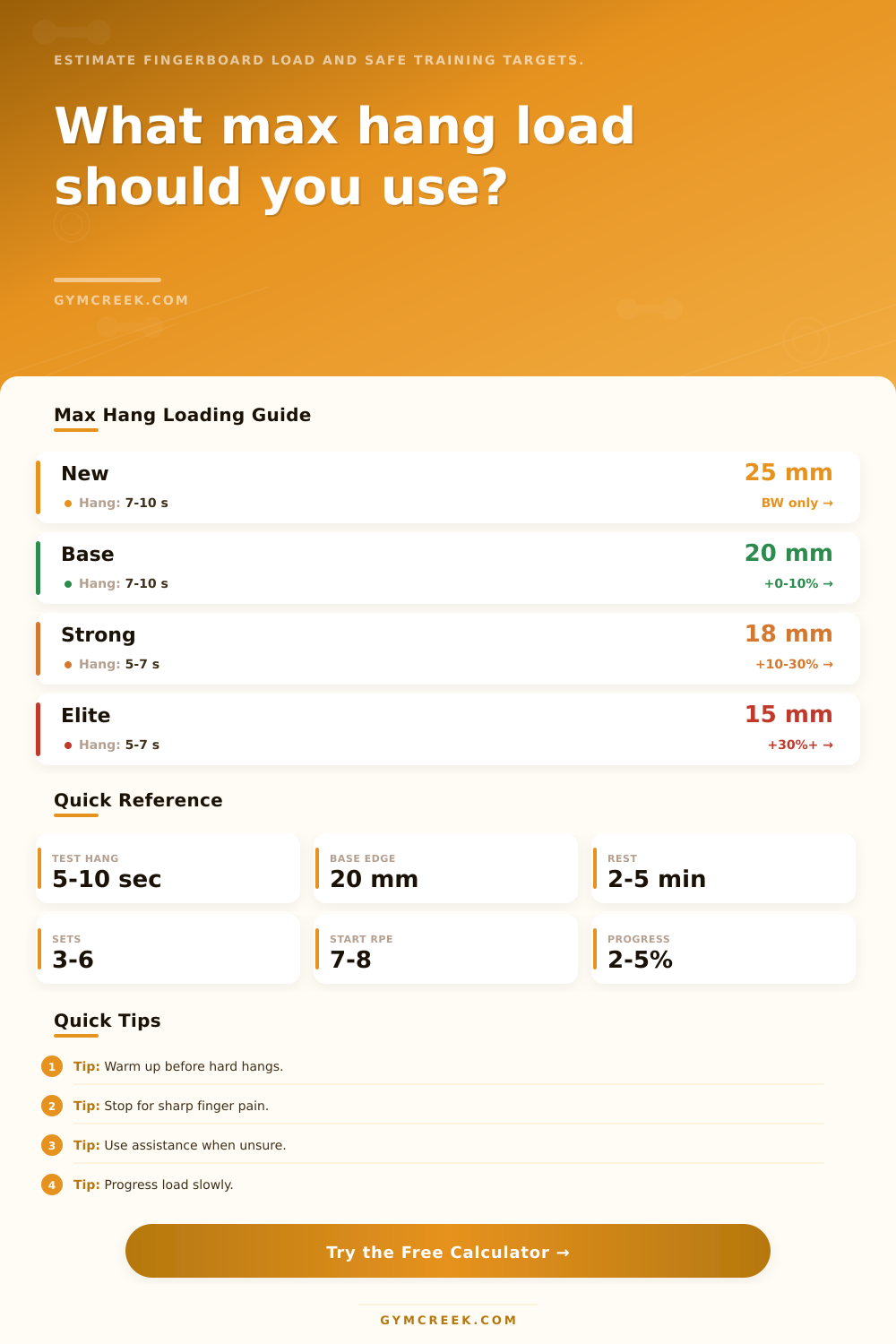
One other significant variable that folks tend to overlook is edge depth. For our testing, we used a baseline of a twenty-millimeter edge. This is deep enough to be considered “safe” for most intermediate climber and shallow enough that you need some real grip strength. As the edge becomes smaller, the amount of stress on your finger joints go up exponentially. Since a fifteen-millimeter edge force your fingers to perform more work per square millimeter of contact area, the tool will adjust the load to match. In other words, your body needs to use less force and a lighter load to do the same amount of work. This is compared to using a heavier load to do that same work on a deeper edge. So the calculator recommends a lower load percentage. It’s a safety measure to prevent you from putting the same weight down on all edges.
The other key consideration is time. The maximum duration is short; seven or ten second hangs are the limit. Anything longer then ten seconds shifts the effect from pure strength to endurance. Fifteen second holds don’t make your muscles stronger, they acclimate them to fatigue resistance. This is all spelled out nicely in reference table on the page. Strength building stays within the moderate zone of intensities and has very specific timing rules. It’s got to be at that level but not push too far into endurance. To test your limits, you will need longer rests between sets and more intensity.
Hand placement makes a difference. The tendons is stronger when gripping with an open hand, so you can get away with a little bit more and it’s generally safer. Although it looks like a hard move while climbing, a full crimp puts great strain on the pulley system. That’s why we factor a risk adjustment into the calculation; injuries occur most frequently here. If you choose a full crimp, the tool will probably recommend a more conservative load. Go with that recommendation, your fingers are delicate things that require a long time to heal. Go slow.
Adding weight too soon (or reducing size of the edge) can lead to tendonitis. Instead, maintain the grip and edge, and slowly increase the load a couple/five percent at a time. Your tendons will have time to adapt to the new stresses. Because tendons has poor blood supply, they take much longer to heal and strengthen compared with muscle tissue. The most difficult aspect of finger training is patience.
Using the tool’s presets also helps create reasonable expectations based off where you’re currently starting. Bodyweight on a wide edge is the beginning place for a novice; an advanced climber could add meaningful outside load on narrow edges. Bottom line: Begin where you are, not where you wish to be.
When the calculator tells you something seems too easy, don’t give in to temptation to override. One hero move is not better than consistent progress with a tolerable load. You’ll thank your fingers later.
Building strength is incremental. Finger strength develops one cautious hang after another. It is not about how hard you hang, but how smartly you hang repeatedly.