Field Hockey Calorie Calculator
Estimate calories burned in field hockey from position, match minutes, practice minutes, sprint count, stick-skill drills, substitution rest, turf condition, and adjusted MET logic.
📌Presets
Each preset loads a realistic field hockey workload and recalculates calories from position demand, match and practice minutes, sprint count, drill time, substitutions, turf drag, and rest.
⚙Calculator
Field hockey calorie snapshot
Enter position, minutes, sprint count, stick-skill drills, rest, and turf condition to estimate field hockey calories.
📊Field Hockey Metrics
🧮Formula Cards
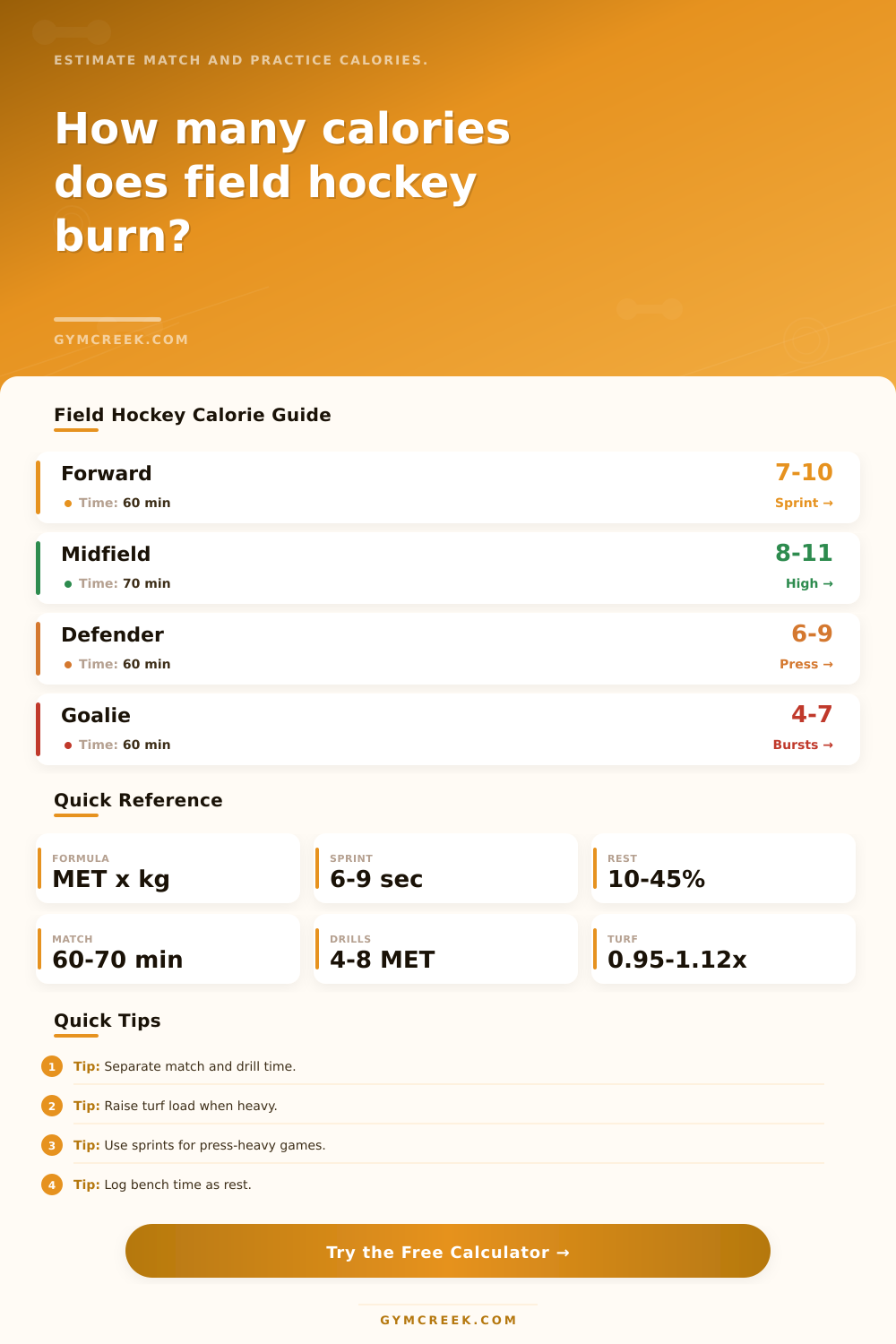
Calories per minute = MET x 3.5 x body weight in kg / 200. This is applied to field play, stick-skill drills, sprint work, and rest separately.
Forwards, midfielders, defenders, goalkeepers, and utility players start with different MET bands, then match, practice, scrimmage, and tournament settings adjust the base.
Sprint count adds a high-intensity bucket, while stick-skill drill minutes use a separate drill MET that rises with moving patterns, elimination reps, and small-group tempo.
Turf condition, pressing load, and rotation pattern raise or lower active MET. Substitution and rest ratio moves part of the session to low-MET standing recovery.
📑Reference Tables
| Position | Match MET | Practice MET | Demand Cue |
|---|---|---|---|
| Forward or striker | 7.4 to 10.4 | 6.2 to 8.4 | Leads and press |
| Midfielder | 8.0 to 11.2 | 6.6 to 9.0 | Full-field work |
| Defender or fullback | 6.4 to 9.2 | 5.6 to 7.8 | Recovery runs |
| Goalkeeper | 4.0 to 6.8 | 4.8 to 7.4 | Short bursts |
| Utility rotation | 6.8 to 9.8 | 6.0 to 8.4 | Mixed shifts |
| Session | Minutes | Rest Ratio | Best Input |
|---|---|---|---|
| Outdoor match | 60 to 70 | 10 to 35% | Shift time |
| Team practice | 60 to 120 | 15 to 35% | Drill blocks |
| Live scrimmage | 30 to 90 | 10 to 30% | Sprint count |
| Tournament day | 120 to 240 | 25 to 55% | Rotations |
| Turf Condition | Modifier | Feel | Use When |
|---|---|---|---|
| Fast watered turf | 0.95x | Quick ball | Low drag |
| Normal synthetic | 1.00x | Neutral | Most games |
| Dry grippy turf | 1.05x | Hard turns | Hot days |
| Grass or slow surface | 1.12x | Heavy legs | Slow ball |
| Formula | Variables | Output | When Used |
|---|---|---|---|
| MET kcal | MET, kg, min | Calories | Main burn |
| Sprint kcal | Count, sec | High burn | Press load |
| Drill kcal | Drill MET | Skill burn | Stick work |
| TDEE share | kcal, TDEE | Percent | Daily view |
💡Tips
Playing field hockey is a very demanding sport that require a lot from your body. That moment of fatigue are the result of a complex energy equation. Knowing how many calories you expend while playing can not only improve your performance but also support your ability to survive. Without knowing what your body expends, you won’t be able to replenish what it needs.
An accurate calorie calculator is there to help you keep tabs on your expenditure. It is not out of vanity, but for performance and recovery. Typical fitness trackers are general-purpose devices for athletes; they don’t distinguish between different type of running. For example, field hockey is not simply steady-state running. It is a combination of moving into position at a low intensity, technical stick work, sudden starts and stops, and short bursts of intense activity.
How to Count Calories in Field Hockey
All that gets processed in the magic black box we call “the calculator.” You input what you do during your session, and which role you play, and it figures out if you’ve just done a sprint session or more like a marathon. Your basic metabolism cost depends on your position. Your average speed might be lower as a forward compared to a midfielder, but the explosiveness of your attacking make the overall caloric demand higher. Metabolic equivalent values gets changed to reflect your chosen position. It takes into account the real world chaos of the sport.
Energy expended is also influenced by the surface on which you play. It is a seemingly small detail, but the physics of each and every stride change based off turf condition. It is harder to accelerate when playing on heavy, wet turf different than a watered-in, fast surface. There is a modifier for this situation in the calculator. When your legs has to work harder to push off a slow, dry, grippy surface, there is extra drag and more fuel burn even if the time on the scoreboard stay the same. Getting the turf condition correct prevents underestimating the energy cost of a heavier training day. This is especially true if you’re looking to fine tune your nutrition for a tournament weekend.
Total burn is also influenced by sprints. Goalkeepers’ shifts aren’t as long as midfield matches but that doesn’t mean they cover less distance; their efforts are more intense. To account for this high-intensity energy use, the tool requests a sprint count. Short, sharp bursts of speed gets your heart rate spiking while burning through glycogen stores rapidly. You’ll probably underestimate your overall burn if you only log the number of minutes during your match but don’t note the frequency with which you sprinted.
Different session types impact metabolic load different, and the page’s reference tables demonstrates this. An hour-long skills clinic might look very different than a high-pressing match of the same length when it comes to caloric burn.
The other side of the equation is recovery. When you spend fuel, you should of know how much fuel you replaced with what. Running on fumes doesn’t work, both in terms of performance and injury avoidance. Breaking out rest time from action time gives you a better understanding of how hard you worked. It allows you to determine if half-time means a quick carb hit or if the post-game needs a full meal. It turns fuzzy tiredness into something you can act on. It honors your effort.
Field Hockey is tough but graceful. Understanding what your body need when it’s tired puts you back at the wheel. It means no more guesswork. It means you’re prepared. Next time your feet weigh a ton during those last few minutes…you’ll have a number to explain why. And you’ll be ready for the fight because you have enough fuel in the tank to give yourself one more go.