Fencing Calorie Calculator
Estimate calories burned from foil, epee, sabre, drills, bouts, tournament pacing, body weight, rest time, footwork load, and fencing intensity.
📌Presets
Each preset fills a realistic fencing session profile and recalculates the calorie estimate.
⚙Calculator
Fencing calorie snapshot
Enter session time, weapon, body weight, and intensity to estimate fencing calories.
📊Fitness Metrics
🧮Formula Cards
Calories per minute = MET x 3.5 x body weight in kg / 200. The calculator applies it separately to fencing, footwork, and rest.
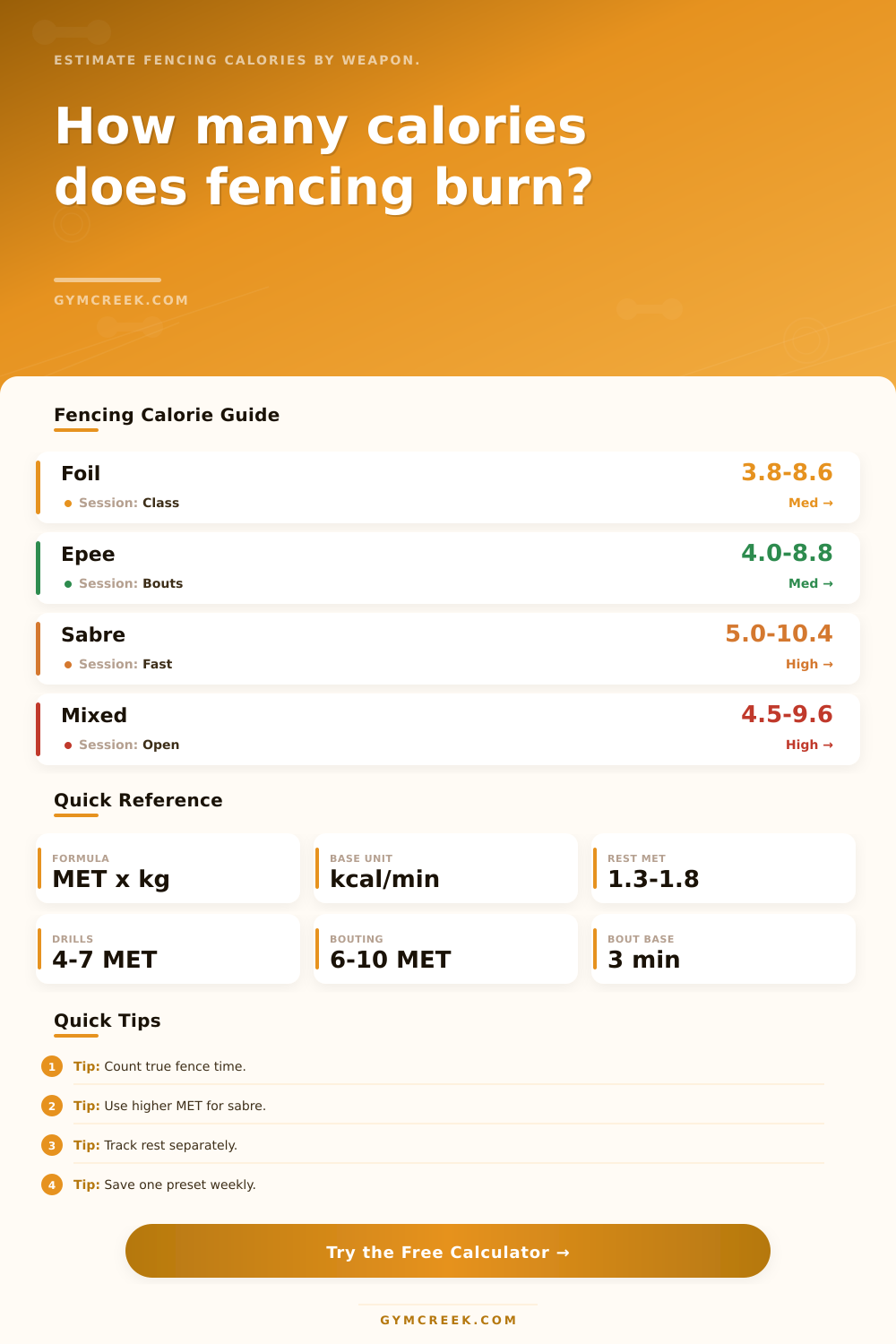
Foil and epee start lower, while sabre and competition pacing receive higher base MET values for frequent accelerations and changes of direction.
The average MET is total MET-minutes divided by total session minutes, so long rest periods lower the complete-session intensity.
Mifflin-St Jeor estimates BMR from weight, height, age, and gender, then the selected activity multiplier estimates TDEE for comparison.
📑Reference Tables
| Weapon | Light | Moderate | Hard |
|---|---|---|---|
| Foil | 3.8 MET | 5.8 MET | 7.8 MET |
| Epee | 4.0 MET | 6.0 MET | 8.0 MET |
| Sabre | 5.0 MET | 7.2 MET | 9.3 MET |
| Mixed weapons | 4.5 MET | 6.6 MET | 8.7 MET |
| Session Type | MET Shift | Best For | Notes |
|---|---|---|---|
| Private lesson | 0.95x | Skills | Coached reps |
| Technical drills | 1.00x | Practice | Repeat work |
| Footwork | 1.08x | Fitness | Leg demand |
| Club bouting | 1.12x | Open fencing | Variable rest |
| Tournament | 1.18x | Events | High stress |
| Profile | Time Split | Typical Load | Use Case |
|---|---|---|---|
| New fencer | 30/15/20 | Light | Class |
| Club fencer | 45/15/20 | Moderate | Practice |
| Sabre night | 50/20/15 | Hard | Intervals |
| Tournament | 75/10/60 | Comp | Event day |
| Formula | Variables | Output | When Used |
|---|---|---|---|
| MET kcal | MET, kg, min | Calories | Main burn |
| Footwork MET | Weapon, load | Drill kcal | Footwork |
| Mifflin BMR | kg, cm, age | Baseline | Daily burn |
| TDEE share | kcal, TDEE | Percent | Context |
💡Tips
So you’re on the strip, wearing your mask and blade, all fired up for an intense athletic duel. And then referee stops it because your partner shifted her equipment. Or you made a mistake in footwork. Next thing you know, that furious cardio rush fades into nothing as you stand still.
That stop-and-go pace makes it difficult to count calories burned while fencing. When you’re fencing, it isn’t only a matter of how intensely you fence. It’s also a question of how much you actualy fence compared to how much time you spend standing around while someone tells you what to fix.
How to Count Calories in Fencing
We tend to overestimate our burn rate as fencers because we recall the heart-racing lunges, but not the subsequent 10 minutes spent listening to coach tell us to take off our masks. When we can identify these different phases and remove them from the equation, the math becomes simple, thanks to this handy-dandy calculator. (And it’ll save you from common error of overinflating your active time.)
Beyond the obvious fact that you’ll know which weapon is being used, it’s important to understand that there’s more variation between weapons then you’d expect. Because of nature of the weapon, sabre fencers tend to use more oxygen and burn more calories per minute compared to their peers who fence with foils or epees. In many cases, there’s no sitting back and waiting for the other guy to make a mistake. You’re moving forward or backward, and standing still carries heavy consequences. So in essence, there’s a greater energy cost during the workout.
Even when fencing at what feels like same effort level, switching from one weapon to another will alter number of calories burned. That table below on the page explain it all by giving sabres a higher starting value to account for just how much acceleration is needed. It is a subtle mechanical detail that becomes a large caloric gap after a couple hours of training.
Add a separate line item for footwork drills. A lot of fencers lumped these kinds of drill, lunge, advance retreat, etc… Into their overall bouting time. That dilutes the accuracy of the results. Footwork is pure anaerobic conditioning. It clears away mental work required by strategy and scoring, so it spikes heart rate fast while burning fuel efficientally. Isolating those minutes provides a clearer picture of your progress in terms of fitness.
The tool distinguishes between footwork only drills and blade-in-hand fencing. How much of your energy are you putting into raw physical output versus technical skill? That’s helpful in balancing your training. Are you fencing hard but not doing the foundational fitness work? Your footwork fatigue may be low, but your sparring fatigue is high.
But there’s no such thing as a free ride when it comes to resting. Calorie expenditure is still happening during rests, even if at a dramatically reduced rate compared to striking. That’s why I included ability to enter rest length and activity type into the calorie calculator. Resting seated uses fewer calories than standing, and walking between strips or refereeing uses more calories than standing. If you ignore that rest time, you’ll end up with overestimated daily caloric expenditures.
For example, perhaps you thought you worked hard for an hour and burned off five hundred calories. But maybe forty minutes of that hour were spent sitting on a bench. In that case, you’re probably looking at about three-hundred calories. When you track rest individually, it makes you realize how skewed your sense of effort is. This happens after a day of tournaments where you spend hours waiting between fights. You’re exhausted, yes, but not necessarily because you’ve been running.
The last figure comes directly from body weight. Because you have to move all your mass around, heavier fencers will expend more calories doing the same movements. The calculator takes this into account when scaling its results for your weight, but also provides some context. It compares the calories you burned during your session to your total daily energy expenditure. This allows you to gauge whether your fencing session is a significant contribution to your day’s deficit, or a small bump on the road to fullness. A practice may make up fifteen percent of a light foil fencers need for the day, while a tournament may double that for a heavy sabre fencer. That way it can put the abstract calorie count into a concrete nutritional framework.
Long story short: it’s all about intervals, not endurance running. The heart rate goes up, down, up, down, up. To capture that jagged line instead of a flat calorie count, you need to split the session into those individual intervals. Break it down further into time spent actively fencing, doing footwork, and resting. Now you have a number which approximates to what really happened on the strip. This turns vague feelings of fatigue into solid data points you can use for the next bout.
Mainly it just comes down to knowing what it is you’re measuring. You walk off the strip feeling wrung out, but did that wringing come after sixty minutes standing around? Or did it follow ten minutes of sprinting?