Ideal Thigh Size Calculator Female
Estimate a realistic female thigh size range from height, hip, waist, frame, current thigh measurements, training goal, and left-right symmetry.
📌Presets
Presets load different female body types and goals so the calculator can compare current thighs against a personal range, not a universal ideal.
⚙Calculator
Female thigh size range
Enter height, hip, waist, and thigh measurements to compare your current size with a personal range.
📊Fit Metrics Grid
📑Reference Tables
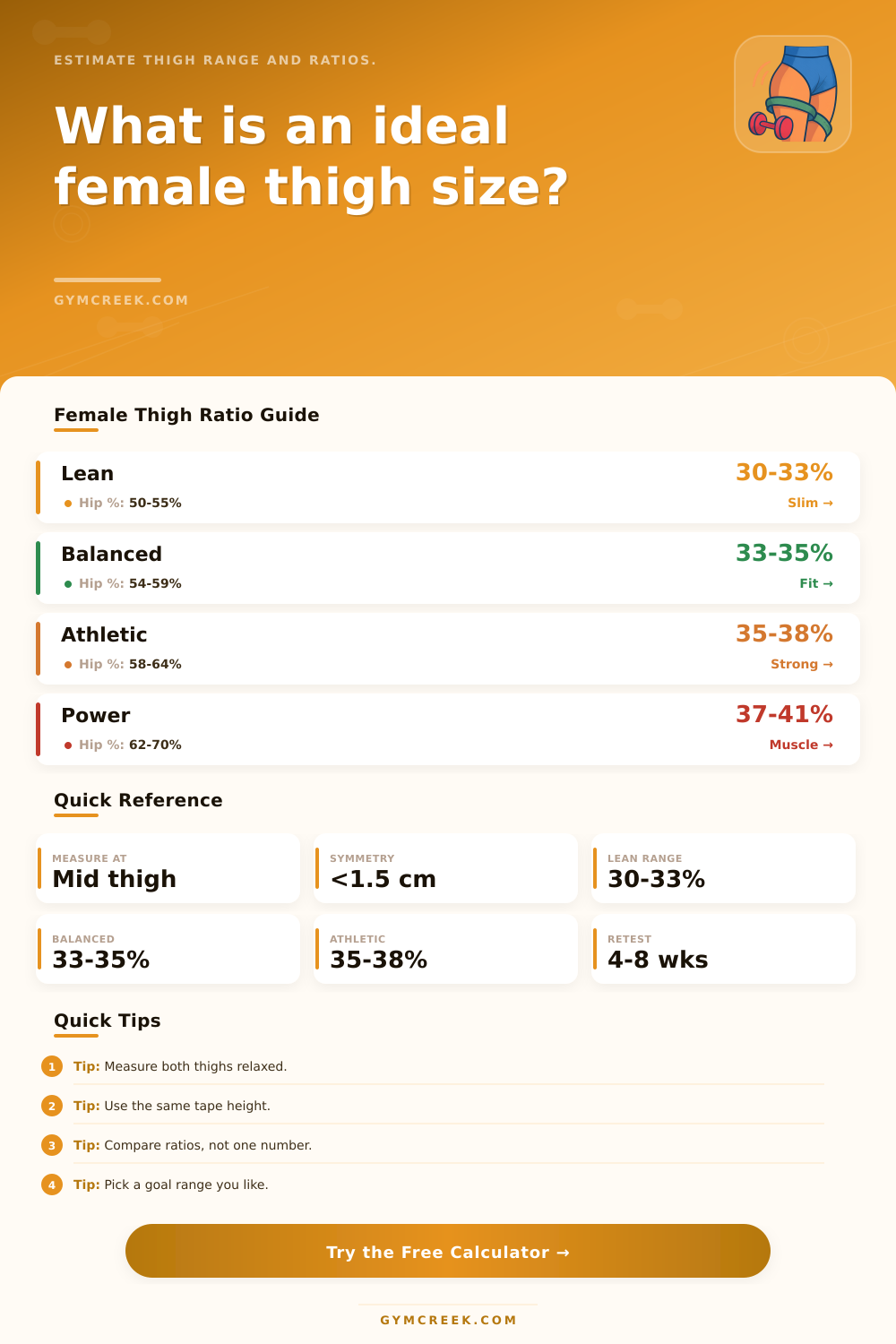
| Goal lane | Thigh / height | Example at 5 ft 5 in | Typical read |
|---|---|---|---|
| Lean athletic | 30-33% | 19.5-21.5 in | Slim leg line |
| Balanced fit | 33-35% | 21.5-22.8 in | Proportional |
| Athletic strong | 35-38% | 22.8-24.7 in | Strong quads |
| Power or curvy | 37-41% | 24.1-26.7 in | Muscle focus |
| Metric | Formula | Useful range | Interpretation |
|---|---|---|---|
| Thigh to hip | Thigh / hip | 54-64% | Lower-body balance |
| Waist to thigh | Waist / thigh | 1.15-1.45 | Shape context |
| Waist to hip | Waist / hip | Personal | Body-size context |
| Symmetry | Side gap | 0-1.5 cm | Training balance |
| Goal | Base ratio | Training nudge | Best use |
|---|---|---|---|
| Lean | 30.5-32.8% | Small | Running, slim fit |
| Balanced | 32.8-35.2% | Moderate | General fitness |
| Athletic | 35.0-38.0% | Moderate | Sport or lifting |
| Power | 37.5-41.0% | Larger | Muscle focus |
| Step | Method | Record | Why it matters |
|---|---|---|---|
| Tape height | Mid-thigh | Distance | Prevents drift |
| State | Relaxed | Time | Pump changes size |
| Sides | Both legs | Left/right | Shows symmetry |
| Cycle | 4-8 weeks | Trend | Reduces noise |
💡Tips
Many women look into the mirror and notice that they either have too slim of leg or they have too muscularly legs for their bodies. Many women searches for the perfect thigh circumference measurement to find the best balance between fitness and femininity. However, there is no such thing as an perfect thigh circumference for every woman due to the fact that thigh circumference should depend upon the height of the individual with whom those measurement are taken.
For instance, a woman with a thigh circumference of twenty inches may have a much differently appearance with a woman who stands five feet in comparison to a woman who stands six feet in height. Additionally, the thigh circumference may appear different with a woman whose thighs contains more lean muscle than soft tissue, or with a woman whose thighs contain more soft tissue than lean muscle. The composition of the body is inherently connected to the skeleton.
Find the Right Thigh Size for Your Body
The calculator tool ask for the height of the individual as well as their hip measurements. The proportion of the thickness of the thighs relative to the circumference of the hips will create a visual representation of the individual’s legs. If the thighs are too lean in comparison to the hips, the legs may appear skeletal to the individual.
Conversely, if the thighs contains too much soft tissue relative to the hips, those legs may appear too soft to the owner of those legs. The use of mathematics within the body proportion tool allow for the individual to find a middle ground to their thigh and hip measurements. Individuals often make the mistake of taking the measurement of their thighs only once.
Thigh muscles is dynamic and exhibit change in size according to muscular strength and activity. For instance, measuring thigh circumference after perform heavy squat exercises will exhibit the muscle pump in those thighs. A muscle pump is a temporary increase in blood and fluid in the muscles.
Therefore, the best time to take thigh measurements is when the individual is in a relaxed state, such as in the mornings before beginning the day. Because there are different goal for individuals who run versus those who lift heavy weights with weights like barbells, the tool also asks for the individual’s training goal. Individuals who wish to exhibit the leanest, most athletic body ratios should have a different goal than those who wish to exhibit muscle in their thighs.
The ratio bands exhibit different percentages of thigh circumference compared to the height of the individual for those who are classified as balanced to those who are classified as athletic. Thus, the size of the thighs of an individual is not the focus of the tool, but rather the reason for the thighs’ size. An additional factor to consider is the symmetry of the thighs.
Few individual have perfectly symmetrical thighs, with one thigh being the same size as the other. For most individuals, one thigh will be larger than the other due to the bodys dominant side or the tilt of the pelvis. A gap of a few millimeter between the legs is normal, but if the gap between legs is close to a centimeter in size, this is a signal to review the individual’s training program.
A large gap between the thighs may be a result of the individual’s use of only one leg when performing lunges or other exercises, or a shift in the body’s form when performing exercises with heavy weight. Using the symmetry scale allow the individual to focus upon the balance of the thigh muscles. The frame size of the individual also play a major role in the body measurements.
Women who have small frames has narrow shoulders and hips. Thus, a woman with a small frame will exhibit a balanced body with a thigh circumference that is lower than a woman with a larger frame. Any attempt to force a woman with a small frame to exhibit the same measurement as a powerlifter will result in a body whose proportions appear disjointed.
Thus, the calculator tool utilizes frame size to allow the body proportions tool to account for the bone structure of the body. The goal of using these measurement tools is to exhibit a trend in the body over time. If an individual is focused upon developing larger glutes and quadriceps muscle, it will take some time to exhibit the change.
Therefore, every four to eight week, individuals should utilize the tool to measure the changes in their thighs. Using the tool every four to eight weeks will allow individuals to focus upon the changes in their thighs rather than guess at the changes in those muscles. The score that is given to individuals when they enter their measurements is a representation of the alignment of their legs with their goal for their body.
A low score does not indicate that an individual’s legs appear bad to themselves or others, only that their thigh measurements are outside of the mathematical goal that is created with their desired body type. Thus, individuals can either adjust their goal to their current body measurements, or use the score to create a plan to achieve their desired body type. Rather than searching for a goal or ideal thigh size for themselves, each individual should focus upon finding the balance that best expresses their vision for their legs and thighs.
Whether an individual desires the look of a distance runner with lean, thin legs, or an individual that desires the size and strength of a powerlifter, the goal should be to slowly and intentional adjust their body to achieve their goal. Furthermore, they should maintain the symmetry and balance of their thighs to ensure that their muscles is equally developed. While the mirror will tell them how they look to others and to themselves, these ratios will allow them to understand the reasons behind the way that their legs appear to the rest of the world.