Featherstone Carb Load Calculator
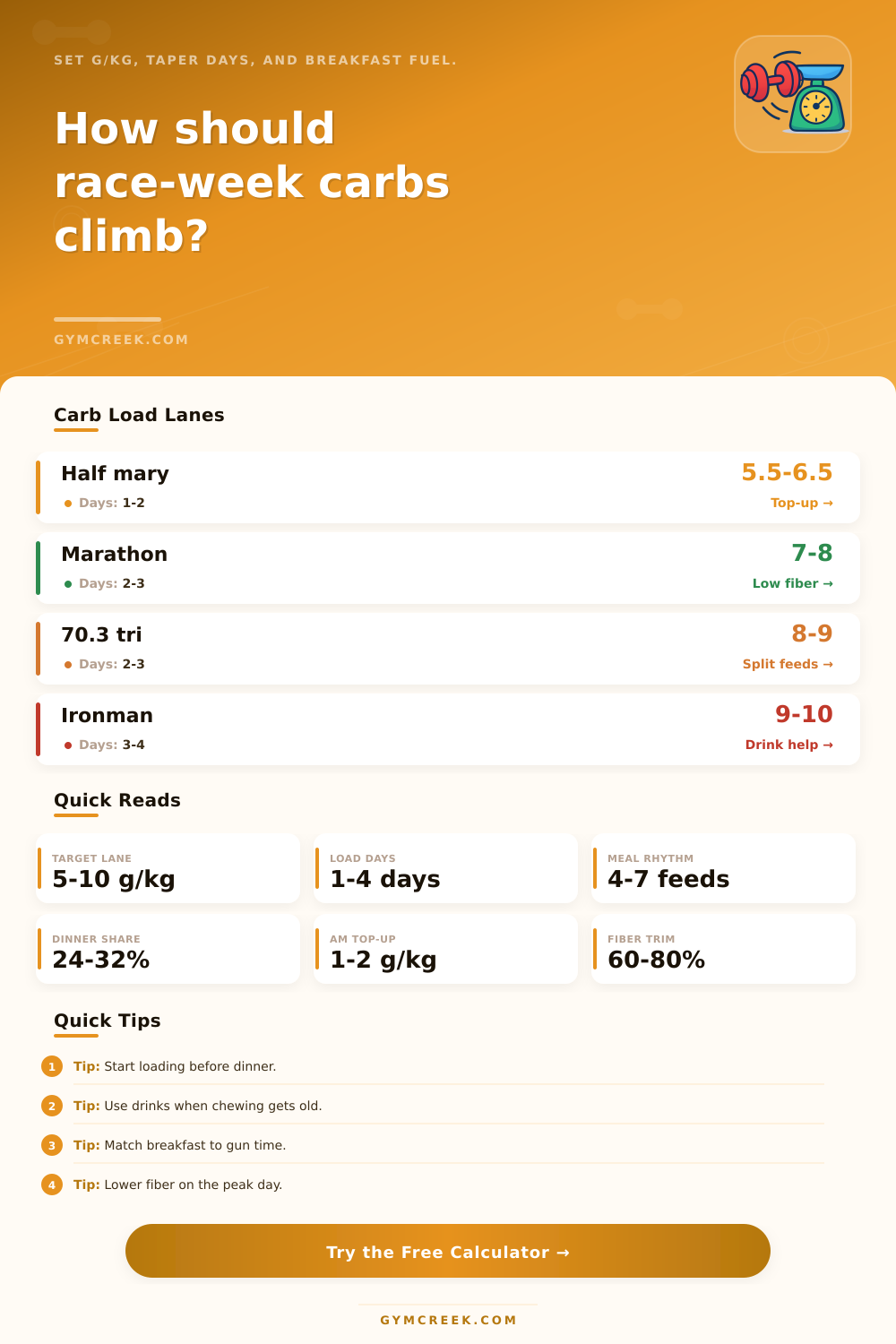
Build a Featherstone-style race-week carb plan from body size, event demands, taper structure, and breakfast timing so the load is spread across the week instead of dumped into one giant dinner.
📌Preset Race Setups
Each preset loads a believable endurance profile with body size, taper width, meal rhythm, and gut strategy so the calculator behaves like an actual race-week planning tool instead of generic carb math.
⚙Carb Load Inputs
Build your carb load
Enter race details to turn body weight, taper length, and breakfast timing into a practical loading plan.
📊Race Fuel Metrics
📑Reference Tables
| Duration | Target lane | Load days | Read |
|---|---|---|---|
| 1 to 1.5 hr | 4.5 to 5 g/kg | 1 | Breakfast top-up matters more than a classic full load. |
| 1.5 to 2.5 hr | 5.5 to 6.5 g/kg | 1 to 2 | Compact loads fit hard half-marathon and shorter triathlon plans. |
| 2.5 to 4 hr | 6.5 to 7.5 g/kg | 2 | Classic marathon and long sportive lane. |
| 4 to 8 hr | 8 to 9 g/kg | 2 to 3 | Needs visible starches at every meal and often a drink assist. |
| 8+ hr | 9 to 10 g/kg | 3 to 4 | Dense choices work better than trying to chew huge food volume. |
| Event | Default days | Adjustment | Why |
|---|---|---|---|
| Road half | 1 to 2 | -0.2 g/kg | Breakfast and in-race fueling still matter more than a huge load. |
| Marathon | 2 to 3 | Base lane | The standard reference point for most classic loading plans. |
| 70.3 tri | 2 to 3 | +0.4 g/kg | Bike plus run duration usually rewards a denser load. |
| Ironman | 3 to 4 | +0.8 g/kg | Long race day and calm-gut choices both matter more. |
| Trail 50K | 3 | +0.5 g/kg | Long uphill time often makes dense carbs useful late in the taper. |
| Food block | Typical serving | Carbs | Why it helps |
|---|---|---|---|
| Cooked white rice | 2 cups | 88 to 90 g | High return with low chewing stress and modest fiber. |
| Bagel plus jam | 1 bagel plus 2 tbsp | 65 to 70 g | Easy breakfast or snack anchor when appetite is limited. |
| Sports drink | 24 fl oz | 35 to 40 g | Useful when late-taper chewing starts to feel like work. |
| Rice cereal bowl | 2 bowls plus banana | 80 to 85 g | Fast-digesting option for race eve or race morning. |
| Potatoes and toast | 400 g plus 2 slices | 75 to 80 g | Savory choice when sweet foods start to get old. |
| Schedule row | Carb target | Meal split | Session note |
|---|---|---|---|
| Day -4 | --- | --- | Calculate to build your taper script. |
| Day -3 | --- | --- | Earlier meals should carry part of the load. |
| Day -2 | --- | --- | Late taper carbs often get easier with a drink assist. |
| Day -1 | --- | --- | Race-eve dinner is important, but not the whole plan. |
| Event morning | --- | --- | Breakfast changes with start time. |
💡Coach Notes
Carbohydrate loading is a process used to increase the amount of glycogen stored in the muscle and the liver. Glycogen is the stored fuel that the body need in order to perform during races. Many athlete will try to load carbohydrates the night before the race.
However, loading carbohydrates the night before the race can cause digestive discomfort. A better method of loading carbohydrates are to continue to load carbohydrates over several days leading up to the race. The amount of carbohydrates that an athlete should consume during the loading phase is dependent upon the athlete’s weight and the length of the race that they is to compete in.
How to Load Carbohydrates for a Race
For instance, an athlete that is competing in a half-marathon that will last for approximately 90 minutes will need to load carbohydrates at a rate of 5.5 gram of carbohydrates per kilogram of body weight. An athlete that is competing in a marathon that will last for four hour will need to load carbohydrates at a rate of 7 or 8 grams of carbohydrates per kilogram of body weight over a period of two to three days. If an athlete is competing in an event that will last longer than eight hours, they should load carbohydrates for three to four days leading up to the event.
In these longer events, athletes may use carbohydrate drink to ensure that they are consuming the amount of carbohydrates that their body need. To calculate the number of grams of carbohydrates that an athlete needs to consume during the loading phase, the athlete should multiply the grams of carbohydrates per kilogram of body weight by the athlete’s total body weight. For instance, if an athlete weigh 70 kilograms and consumes 7 grams of carbohydrates per kilogram of body weight, the athlete will need to consume 490 grams of carbohydrates.
Because it is not possible for an athlete to consume that amount of carbohydrates in one meal, the athlete should divide the amount into meals. For instance, the athlete could load carbohydrates into six separate meal throughout the day. This even spread of carbohydrates will allow an athlete to avoid feeling too full and to maintain there digestion.
The type of food that an athlete consumes during the loading phase is also important. The carbohydrates that are loaded should contain a low amount of fiber. Many athletes prefer foods like white rice, pretzels, or sports drinks that contains a low amount of fiber.
If an athlete consumes too many foods that contain a high amount of fiber during the loading phase, they may experience bloating. Savory food like boiled potatoes or toast athletes may consume that are becoming tired of consuming sweet carbohydrate. Another important aspect of the loading phase is the timing of the meal containing the loaded carbohydrates on the day of the race.
If the race is to start early in the morning, the athlete should consume a small amount of carbohydrates approximately two hour prior to the start of the race. For instance, the athlete could consume 1 gram of carbohydrates per kilogram of body weight. If the race is to take place in the middle of the day, the athlete can consume carbohydrates at a more higher rate.
For instance, the athlete could consume 1.4 to 2 grams of carbohydrates per kilogram of body weight. By consuming carbohydrates at the appropriate time, an athlete will ensure that their blood glucose level are stable during the race. The process of loading carbohydrates is mathematical in nature.
By loading carbohydrates over several days, the body can store the glycogen that is necessary. If the muscles and the liver contains glycogen, the body will have the fuel necessary to sustain its physical activities during the race. By using a plan to load carbohydrates over several days, athletes can avoid making the mistake of consuming too much carbohydrate or not enough at all.