Fatigue Management Calculator
Estimate today’s training readiness from sleep, soreness, HRV/readiness, session RPE, volume spike, performance trend, life stress, recovery gap, and planned load.
📌Fatigue Presets
Presets load complete readiness scenarios. Change any field to match the athlete, lift, or training block.
⚙Calculator Inputs
Fatigue management snapshot
Enter readiness, stress, workload, and planned-load details to estimate today’s adjustment.
📊Fatigue Metrics Grid
📑Reference Tables
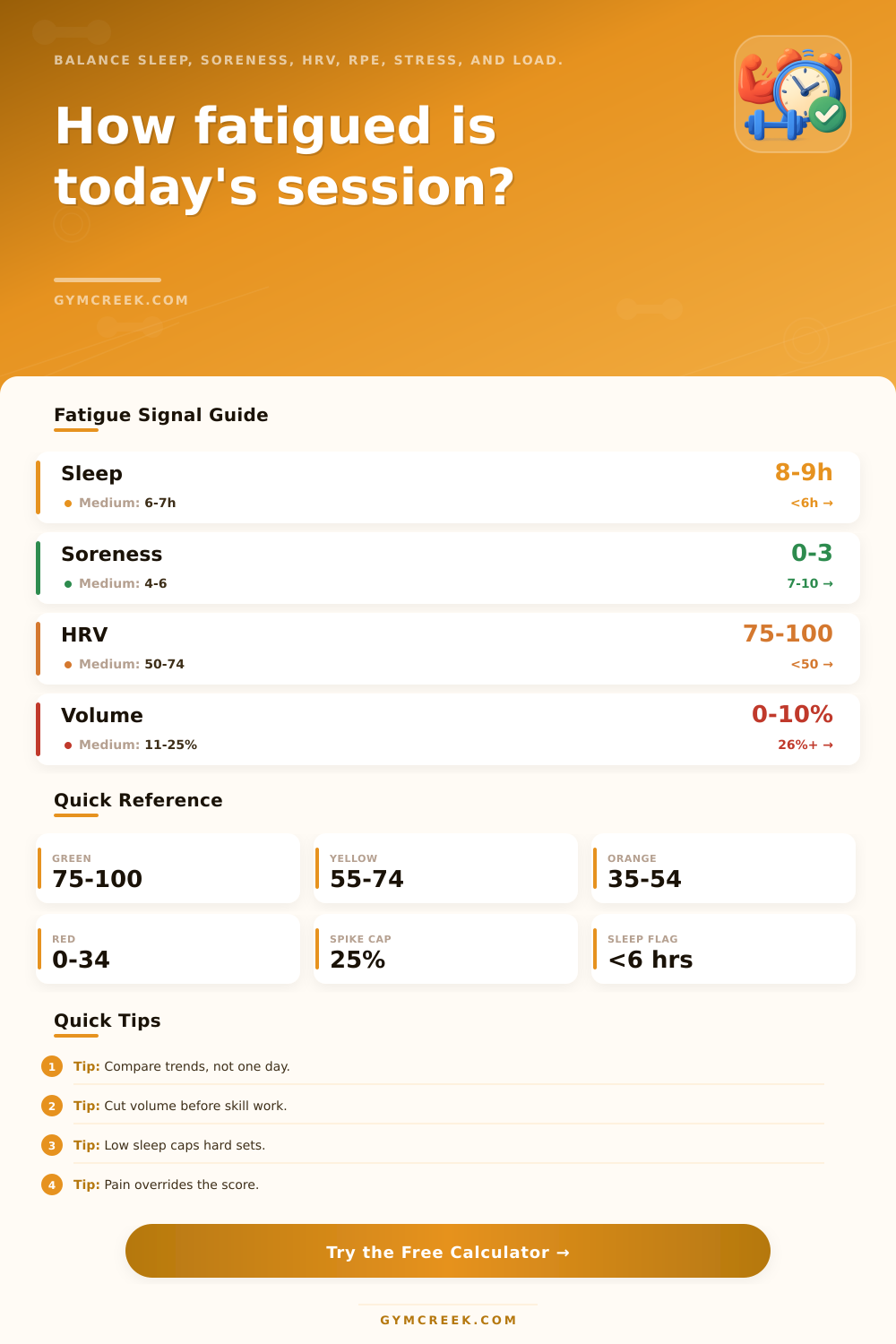
| Readiness Band | Score | Load Choice | Volume Choice |
|---|---|---|---|
| Green | 75-100 | Hold or small add | Run planned sets |
| Yellow | 55-74 | Hold or trim 2-5% | Cut one set if needed |
| Orange | 35-54 | Trim 5-10% | Reduce hard sets |
| Red | 0-34 | Technique load | Deload or stop early |
| Signal | Low Fatigue | Caution | High Fatigue |
|---|---|---|---|
| Sleep | 7.5-9 hours | 6-7 hours | Under 6 hours |
| Soreness | 0-3 out of 10 | 4-6 out of 10 | 7+ out of 10 |
| HRV/readiness | 75-100 | 50-74 | Under 50 |
| Life stress | 0-3 out of 10 | 4-6 out of 10 | 7+ out of 10 |
| Volume Spike | Meaning | Adjustment Bias | Watch Point |
|---|---|---|---|
| Below 0% | Less than normal | Neutral to add | Do not force intensity |
| 0-10% | Normal build | Mostly neutral | Track RPE drift |
| 11-25% | Moderate spike | Cap increases | Cut accessory sets first |
| 26%+ | Large spike | Reduce load or sets | Protect next session |
| Session Type | Best Fatigue Move | Preserve | Trim First |
|---|---|---|---|
| Heavy strength | Small load cut | Clean top set | Backoff sets |
| Hypertrophy volume | Set reduction | Target muscle work | Junk volume |
| Power or speed | Speed cutoff | Fast reps | Slow reps |
| Technique practice | Lower strain | Position quality | Grinders |
💡Fatigue Management Tips
It takes in the wear and tear of previous workouts. It also accounts for the toll that yesterday’s stress took on your body. Finally, it consider the impact last night’s sleep had on waking up.
You feed all those cues into a fatigue management calculator that considers your heart rate variability, how sore you are, how much sleep you got, what your performance has looked like lately, if you’ve recently increased or decreased your workout volume, then tells you whether to go heavy as planned, back off by trimming some weight, or just go for it with confidence.
How to Use a Tool to Manage Your Fatigue
Athletes should of been tracking some of this info already. If you pay attention, you know when your legs is extra heavy during training. Maybe today’s warm-up isn’t feeling right if you usually have a strong one. A well-designed tool puts all that data in one place where nothing is missed or given too much weight.
Recovery capacity are far more affected by sleep than most people realize. Even if you’re feeling great for motivation and your soreness level is low, two bad nights in a row can increase fatigue levels. The calculator just puts that link on display rather than relying on your memory.
The same applies to soreness. A sore seven out of ten in the muscles you intend to exercise are not the same thing as a sore seven out of ten in muscles that you hardly use. One impacts your ability to produce force; the other is mostly about comfort. Similarly, life stress has an impact. Travel with lousy sleep or high work demand doesn’t necessarily show up as muscle soreness, but it will decrease the body’s capacity for training without tipping into overreaching.
Special note for volume spikes: Those come dressed up as progress but are usualy too much for your given sleep-stress profile to recover from. A 25 percent boost in workload during one week appears productive on paper, but it exceeds recovery capacity. It shows this by comparing the current week’s load to previous week norms. If the spike’s significant, it advise protecting tomorrow’s session instead of eking out each additional set today.
Add in performance trends. Even when sleep and soreness appear OK, your bar speed might drop or your technique might break down. That is a signal from the body of something the subjective ratings didn’t pick up on. That is why we include a suggested adjustment range as well as a readiness score in the output. The former is where you are; the latter is what to do about it.
This is where the trick comes in. Accept that number for what it is: the beginning, not the end. Use the number to set your expectations before the warm-up. Pay extra close attention to the feeling of those initial working sets if the score indicates caution. Often you’ll be able to maintain much of the intended volume if the quality of movement remain intact. A rapid decline? The tweak likely proved helpful; cut the rest of the volume with no shame.
It’s a learning process over time that teaches you things you wouldn’t have learned from one session alone. For instance, you begin to realize that certain combinations… Like high life stress and low sleep… Always lead to lower readiness scores, even if the individual numbers look moderate. Knowing that helps you plan ahead rather than react after the fact.
It’s not about predicting perfectly. It’s just making better decisions based off clearer information different than you’re ever going to get from mood and memory alone.