Fat To Carb Ratio Calculator
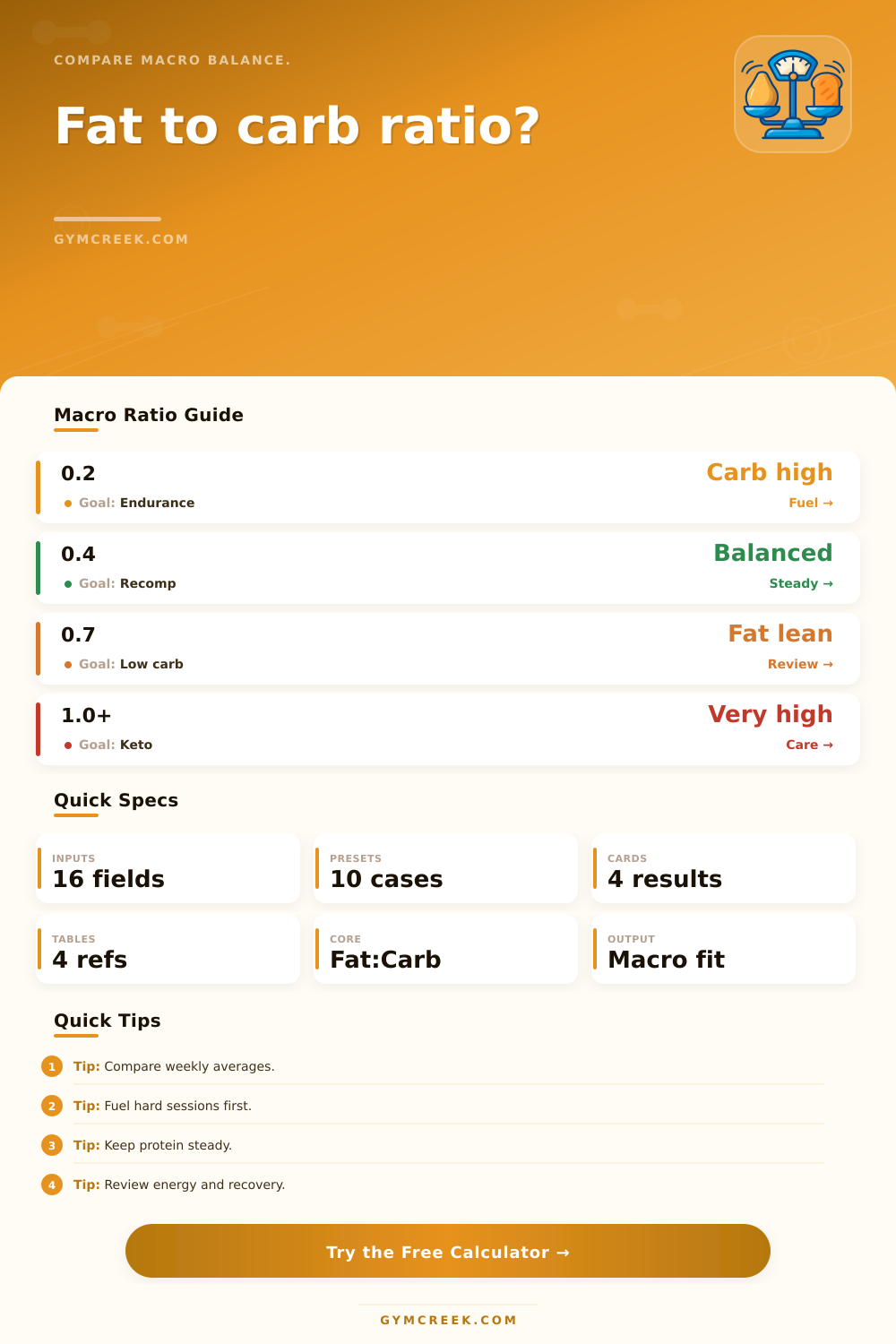
Compare fat grams to carbohydrate grams, calorie shares, training fuel bias, and goal fit from body stats, daily macros, and activity context.
📌Macro Presets
Presets load complete macro scenarios with demographics, goal, activity, protein factor, fat, carbs, fiber, training days, and tracking confidence.
⚙Macro Inputs
Fat to carb ratio snapshot
Enter your macros and calculate the balance.
📊Fitness Metrics
📑Reference Tables
| Ratio | Fuel bias | Common use | Review cue |
|---|---|---|---|
| Under 0.25 | High carb | Endurance, high volume, lean bulk | Check fat floor |
| 0.25 to 0.50 | Balanced carb | Recomp, maintenance, mixed training | Good start point |
| 0.50 to 0.85 | Fat leaning | Lower carb cuts or rest days | Watch performance |
| 0.85+ | Very fat heavy | Keto style or strict low carb | Review fiber and training fuel |
| Goal | Fat:carb | Carbs | Fat note |
|---|---|---|---|
| Fat loss | 0.30 to 0.75 | 1.5 to 4 g/kg | Do not crash fats |
| Recomp | 0.25 to 0.55 | 2 to 5 g/kg | Keep protein high |
| Performance | 0.15 to 0.40 | 4 to 8 g/kg | Fuel hard work |
| Low carb | 0.70+ | 0.2 to 2 g/kg | Check adherence |
| Output | Formula | Inputs | Purpose |
|---|---|---|---|
| Fat:carb | Fat g / carb g | Fat, carbs | Main ratio |
| Calorie share | Macro kcal / total | P, F, C | Macro balance |
| BMR | Mifflin-St Jeor | kg, cm, age | Calorie context |
| Fuel score | Goal + training | Ratio, days | Planning fit |
| Measure | Value | Reference | Signal |
|---|---|---|---|
| Fat:carb | --- | 0.25 to 0.55 | Enter values above. |
💡Ratio Tips
Most of us view carbohydrates and fats as competitors for space on our plates. As though you need carbs to build muscle, fat to lose weight, etc. Etc. In reality, it’s far less dramatic and much more mechanistic. Give your body the fuel and it will use it. It doesn’t care if you look good or bad, only if you give it the right inputs for its metabolism to function correctly. This is where the ratio comes into play. Do not choose sides with macronutrient antagonists, but rather dial in the optimal blend for the work you perform.
Carbs should be thought of as high-octane gas for heavy lifters and sprinters. Stored in both your liver and your muscles they’re prepared to light up quickly and burn hot. Dietary fat is more akin to wood pellets or diesel. It take longer to burn (requiring more oxygen) but it also offers a consistent low-level thrum of fuel. Attempting to run long distances or crush a high-volume leg day fueled primarily by dietary fat? You’ll feel flat. Yes, you may have the calories, but not the instantaneous kick.
How to Mix Carbs and Fat for Your Body
This is where that calculator up top does such an excellent job of translating this dynamic. By knowing what you want to do with yourself and how intensely you train, it paints a picture of whether your split will support that effort or work against it. A lot of trainees go all-in on protein and don’t give a thought to the carb to fat ratio. Yes, protein matters for repair. Absolutely. However, protein doesn’t fuel your activity. So if you want more fat, then you need to take away equal carbs. And this alters “fuel” for your workout.
A carb-heavy ratio tends to be better for performance days. A high fat ratio will tend to help you stay fuller when eating less (rest day / cut). Maybe you’re hitting your daily protein target, but you’re noticing your strength isn’t where it should of be. Guess what? You might have a carb deficiency. Your body’s glycogen stores gets depleted fast when training hard. If you’re eating a high-fat diet, they won’t be replaced. And you’ll feel sluggish as a result.
On the other hand, if you’re eating low fat/high carbs while attempting to shed some pounds, you may find yourself battling your hunger hormones. Carbs can’t always control those signals; adding fat helps provide that buffer and prevent spikes and subsequent crashes that lead to midnight snacking. This sensitivity comes out in the use of presets. For example, the best numbers are vastly different when you shift from a strength-focus to an endurance-focus preset. Fueling up for a big bench press set isn’t the same as fueling up for a five-kilometer run. The former requires sustained power output while the latter need rapid energy release.
To account for such small details, the tool adjusts based off both intensity level and number of training days. In doing so, it makes you think about your entire weekly schedule, not just that one workout. Most people base their nutritional intake around their most difficult day without taking into account everything else they do during the week. This leads to being overfed on hard days and underfueled on easy days.
When accounting for carbohydrates, don’t neglect importance of fiber. Technically, it’s still in the same column, but it acts different in the body. If you’re eating lots of fiber, your digestion slows and your blood sugar stays stable. This allows you to experience a higher-carb day in a way you might not otherwise. Without considering that factor, you’ll see some unwanted energy dips and stomach distress.
On the page are some reference tables that illustrate why certain goals require varying levels of carbohydrate floors. Unless there’s a clear metabolic rationale for cutting carbs to zero, don’t do it. Most people need at least some carbs in their diet to retain muscle while on a deficit. In the end, the ratio is a way of getting feedback. How do you feel? Do you bounce back quickly or drag through the day? Are you constantly hungry or tired? Those are clues into whether your balance is right or wrong.
Take the numbers as a guide but not the last word. Your body tells you the truth quicker then any spreadsheet can. What you’re looking for is the sweet spot where you operate with good results while still not feeling like you’re depriving yourself. That meeting of function and fuel is the difference between short-lived diets and lasting habits. It’s creating a system in sync with your body rather than one at odds with it. Get to know how carbs and fat play together in your own situation and then everything else falls into place more easy. Take some data, tweak based off how things feel, and let consistency carry the load.