Fat Max Heart Rate Calculator
Estimate a practical Fatmax heart rate zone from maximum heart rate, resting heart rate, threshold heart rate, training status, modality, body-composition goal, and preferred zone width.
📌Fatmax Presets
Each preset fills a complete scenario. Edit the heart-rate anchors, training status, modality, body-composition context, threshold, and zone width to match the athlete.
⚙Calculator Inputs
Fatmax heart rate snapshot
Your target zone, HR reserve anchor, threshold cap, and session guidance update as inputs change.
| Zone | Lower HR | Upper HR | Use |
|---|---|---|---|
| --- | --- | --- | --- |
📊Metrics Grid
📑Fatmax Reference Tables
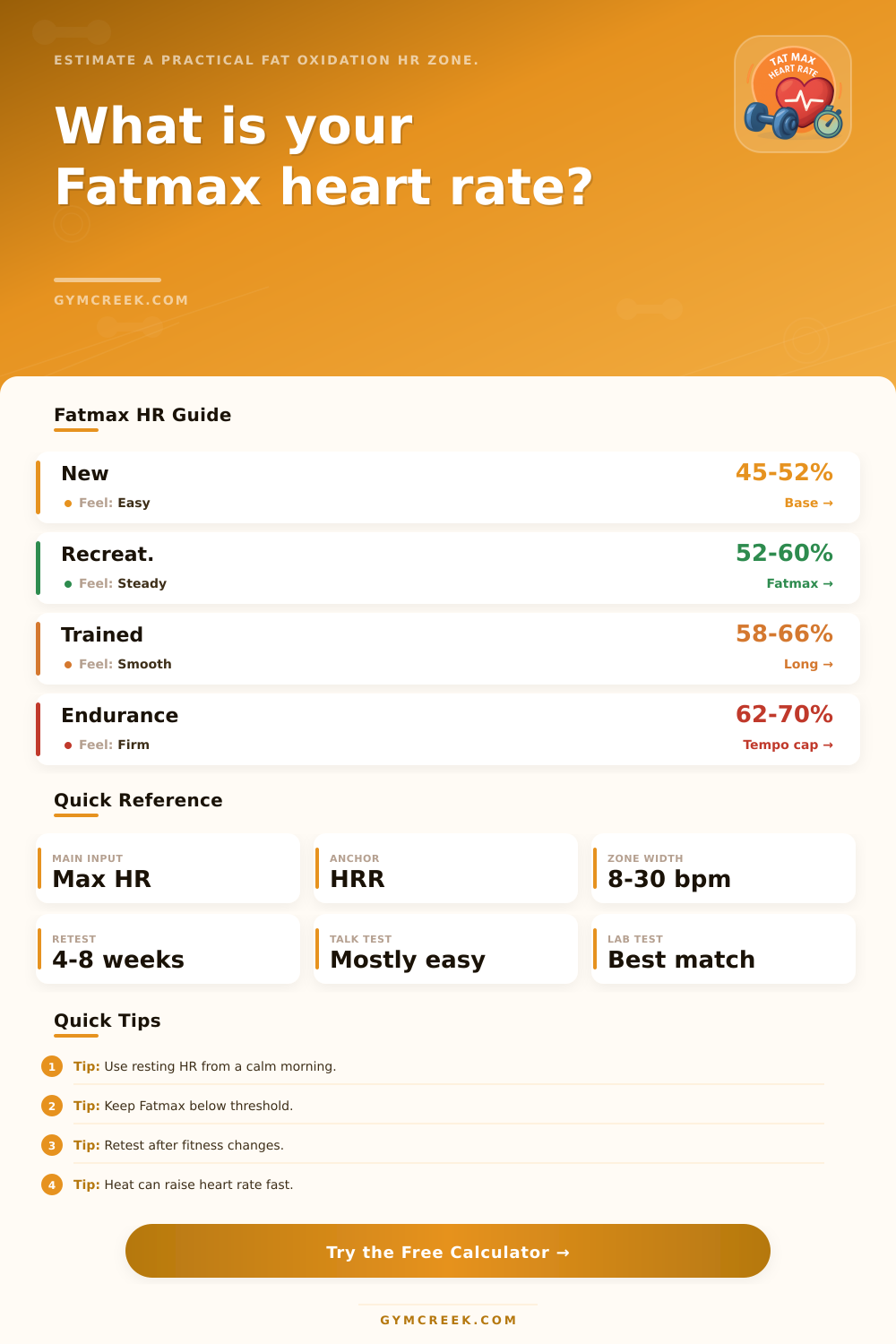
| Status | Starting HRR target | How it should feel | Common use |
|---|---|---|---|
| Deconditioned or returning | 44% to 50% HRR | Very easy, full sentences | Restart aerobic work and reduce soreness risk. |
| New aerobic base | 48% to 55% HRR | Easy and controlled | Build consistency before chasing higher zones. |
| Recreationally trained | 53% to 61% HRR | Steady, mostly conversational | General Fatmax estimate for most gym users. |
| Trained endurance athlete | 58% to 66% HRR | Smooth, durable, not breathless | Long aerobic work with stable heart rate. |
| Advanced endurance athlete | 62% to 70% HRR | Firm but sustainable | Upper Fatmax estimate when threshold is high. |
| Modality | Adjustment | Why it changes | Practical cue |
|---|---|---|---|
| Outdoor running | +2% HRR | Running often elicits higher HR than cycling at similar aerobic demand. | Keep breathing calm and strides relaxed. |
| Brisk walking / incline walk | -3% HRR | Lower skill and impact demands make a conservative cap useful. | Nasal or easy mouth breathing should work. |
| Road or gravel cycling | -3% HRR | Cycling HR may sit lower because body mass is supported. | Prefer power if available on hills or wind. |
| Indoor bike / trainer | -4% HRR | Heat buildup indoors can raise HR for the same output. | Use fan cooling and watch HR drift. |
| Elliptical | -1% HRR | Supported movement varies by machine and technique. | Use perceived effort as a cross-check. |
| Rowing / ski erg | 0% HRR | Large muscle mass raises HR, but rhythm limits intensity spikes. | Stay below breathless intervals. |
| Uphill hike / trail | -2% HRR | Terrain and grade make pace noisy and HR lag important. | Power hike before HR creeps upward. |
| Input | Rule | Reason | When to override |
|---|---|---|---|
| Threshold HR known | Fatmax center is capped near 80% to 87% of threshold HR. | Fatmax should remain comfortably below sustained threshold work. | Only override with lab gas-exchange data. |
| Fat loss or recomposition | Moves target slightly lower and favors repeatable duration. | Total weekly adherence matters more than a tiny intensity bump. | Raise only if HR is stable and talk test is easy. |
| Metabolic health | Uses a middle aerobic target with lower heat penalties. | Consistency and low strain are usually the priority. | Progress duration before intensity. |
| Performance support | Allows a slightly higher center if threshold margin is adequate. | Trained athletes may oxidize fat at higher outputs. | Back off if drift exceeds about 5%. |
| Already lean | Uses a small reduction and shows fueling caution. | Low energy availability can turn easy work into stress. | Fuel longer sessions appropriately. |
| Step | Formula or rule | Inputs used | Output |
|---|---|---|---|
| Max HR | Known max HR, or 208 - 0.7 x age when max HR is zero. | Age, max HR | Max HR used for the estimate. |
| Heart-rate reserve | Max HR minus resting HR. | Max HR, resting HR | Reserve available for intensity targeting. |
| Initial Fatmax anchor | Resting HR + HRR x adjusted Fatmax percent. | Status, modality, goal, heat context | Uncapped center HR. |
| Threshold cap | Known threshold HR x status cap ratio. | Threshold HR, training status | Upper safety anchor for Fatmax center. |
| Zone range | Center HR plus and minus half the chosen width. | Center HR, zone width, max HR | Lower and upper Fatmax HR targets. |
| Session cap | Upper zone edge reduced when heat, fatigue, or long duration are entered. | Heat context, duration | Practical cap for today's workout. |
💡Tips
The fat max heart rate calculator is used to find the specific rate at which a person should train to aid in the oxidation of body fats. Many individuals use the fat max heart rate calculator because most individuals dont have access to the means of measuring there fat oxidation rates in an laboratory. A person can use the fat max heart rate calculator to determine the target heart rate zones that they should aim to train their body to reach.
The fat max heart rate calculator use several different data points to calculate the target rate for fat oxidation. These data points includes an individual’s maximum heart rate, resting heart rate, training status, the type of sport that they are to perform, their goal for their training, and the environmental factors that may impact their ability to reach their target heart rate. The maximum heart rate for an individual is the highest rate at which their heart can beat in a minute.
How to Use the Fat Max Heart Rate Calculator
As with other calculations of the body, an individual’s tested maximum heart rate can be used in the equation. If the individual does not have a tested maximum heart rate, an estimate of that parameter based off the age of the individual is use instead. The resting heart rate for an individual is the rate at which their heart normally beat when they are at rest.
The resting heart rate for each individual may differ from each other even if they are of the same age. Each individual have a heart rate reserve, which is the difference between their resting and maximum heart rates. The more higher the heart rate reserve, the more individual capacity there is for establishing a zone for fat oxidation.
The training status of an individual indicates how physically active the individual is. This impacts the fuel that their body use when performing physical activity. An individual who is just returning to physical activity after a period of inactivity will have a lower training status than an endurance athlete.
As a result of this difference in training status, the fat max heart rate calculator will calculate an easier rate for the individual who is just returning to exercise compared to the endurance athlete. The calculator automatically adjusted these percentages for the individual. The fat max heart rate calculator is a beneficial tool for individuals who may train too hardely during their easy days or who may train too conservatively when they are improving their fitness.
The type of sport that an individual is to perform is also consider in the calculation of the fat oxidation zone. The modality, or type of sport of exercise will impact the rate at which an individual’s heart pump. For instance, running may result in a higher calculated heart rate than cycling.
Indoor sports sessions may also result in higher calculated heart rates due to the heat that is often present within indoor areas. The fat max heart rate calculator makes these adjustments to the calculated heart rate for different sports. An individual’s body composition and environmental factors such as heat can also impact their fat oxidation zone.
For example, if an individual desires to lose body fat, they may wish for their fat oxidation zone to be sustainable for longer periods of time. Environmental factors such as heat and humidity will increase the rate at which the individual’s heart pump for the same amount of physical work. The same is true of physical fatigue.
Since these factors increase the rate at which the individual’s heart pump, the fat oxidation zone will be automatically adjusted to lower the upper edge of the rate at which the individual should train with the fat max heart rate calculator. The reference tables can provide examples of the various factor that may impact the fat oxidation zone calculated by the fat max heart rate calculator. However, it is not necessary for an individual to memorize these tables.
The tables can be used to understand how the training status or the type of sport that an individual performs can alter the fat oxidation zone. For instance, if an individual find that their heart rate is increasing without a change in the rate at which they are performing their exercise, they are experiencing heart rate drift. Heart rate drift indicates that their heart rate has moved beyond their fat oxidation zone.
In this case, the top of their training zone with the fat max heart rate calculator could be adjusted to lower their heart rate, or the length of their exercise can be shortened. The talk test is another strategy for confirming an individual’s fat oxidation zone. For the talk test, an individual should try to speak in full sentences without gasping for air.
The most important component of the fat oxidation zone calculated with the fat max heart rate calculator is the consistency with which the calculator is utilized. The inputs for the calculator should be updated every four to eight week. An update to the calculator should occur if an individual feels that their fitness, sleep patterns, or environment have change.
By updating these variables with the fat max heart rate calculator, individuals can ensure that the calculated fat oxidation zone remain accurate. Furthermore, the fat max heart rate calculator simplifies the mathematical components of the calculation so that individuals can make decision about the difficulty of their training sessions.