Face Pull Load Calculator
Convert cable stack readings or band tension into true hand load, then adjust the target for rope path, external rotation, scapular control, reps, RPE, and posture goal.
📌Presets
Use a preset as a fast starting point, then match the ratio printed on your cable station or the band tension you measured at the start and finish of the rep.
⚙Calculator
Face pull load snapshot
Enter a stack or band tension to estimate true hand load and the next useful target.
📊Metrics Grid
📑Reference Tables
| Cable Ratio | Stack Reading | Hand Load | Common Station |
|---|---|---|---|
| 1:1 | 40 lb | 40 lb | Single pulley |
| 2:1 | 40 lb | 20 lb | Functional trainer |
| 3:1 | 45 lb | 15 lb | Light trainer arm |
| 4:1 | 60 lb | 15 lb | Assisted pulley |
| Rope Path | Load Effect | Rotation Target | Best Use |
|---|---|---|---|
| Forehead | Slight lighter | 75-90 deg | External rotation |
| Eye line | Neutral | 60-85 deg | Balanced reps |
| Nose bridge | Neutral plus | 55-80 deg | Rear delt focus |
| Low neck | Heavier feel | 35-60 deg | Only if strict |
| Goal | Rep Zone | RPE Zone | Load Advice |
|---|---|---|---|
| Warm-up | 12-20 | 5-6 | Move easily |
| Posture reset | 12-18 | 6-7 | No shrugging |
| Hypertrophy | 10-20 | 7-9 | Controlled burn |
| Prehab | 15-25 | 5-7 | Own the finish |
| Observation | Likely Cause | Load Change | Technique Cue |
|---|---|---|---|
| Neck tension | Too heavy | Drop 10-20% | Long neck |
| Elbows low | Wrong path | Drop 5-10% | Pull wide |
| Arching ribs | Lost brace | Drop 10% | Ribs down |
| No rear delt | Too fast | Keep load | Pause finish |
💡Tips
There’s something about standing in front of a cable machine that makes you stare at the weight stack. Forty pounds. So you grab the rope, bring it up to your face and it feels as light as a feather. Then you glance in the mirror and notice your rear delts is taking a nap while your traps do all the work. Sound familiar?
That’s because the number on the stack isn’t necessarily the number your shoulders feel. Most failed face pull sessions stem from this disconnect… What the machine says it is versus what your body feels. You’re not pulling feebly. You’re reading resistance incorrecty.
Why Face Pulls Feel Lighter Than They Look
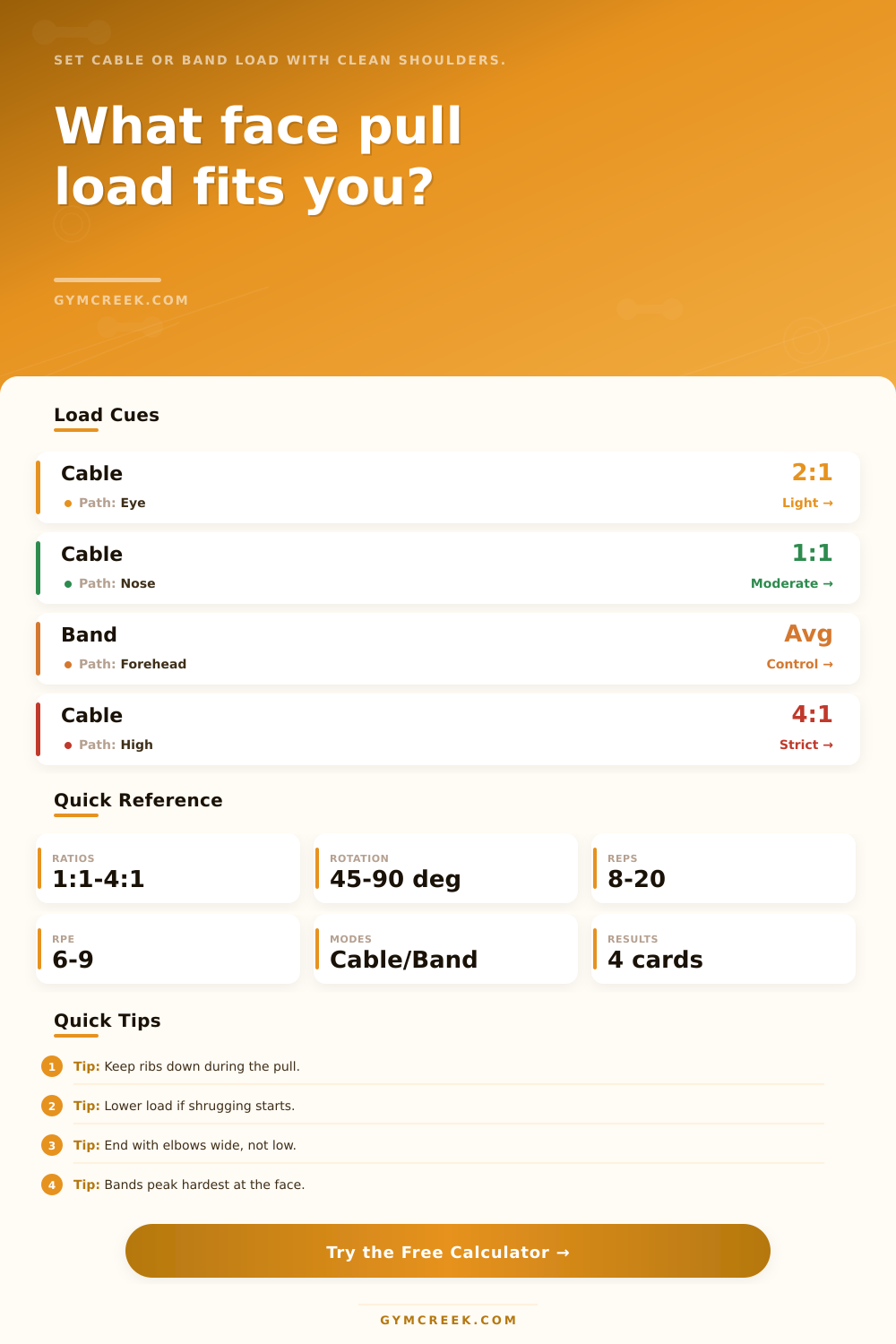
First it has to do with the pulley system. A good pulley system will have a 2 to one ratio, so for example, when you pull down on the weight stack, what feels like 40 pounds on the stack is realy only applying twenty pounds of tension in your hands. With a heavier assisted pulley, say a 4 to one ratio, that 40 pound setting would be pulling with only ten pounds of resistance. You can stretch yourself warm while thinking you’re working out hard. Once you plug in your stations’ specific ratio into the calculator above, it’ll run the numbers for you and show you why those high rep sets don’t seem to require much work.
The mechanics of the system are the first step in understanding how to actualy hit the target muscle. How you hold the rope and move it around will drastically change the leverage. When pulling back towards your head (forehead), you encourage arms to turn outward, which will be great for your shoulders but slightly decrease load on the rear delts. Holding the rope lower toward your mouth or nose will increase the demand for pulling your arms across your chest but also invite traps to shrug inward and assist. So there’s a bit of a trade-off here; do you want more intensity or do you want better control?
Letting your elbows drop too far will transform a face pull into bent-over row, defeating the entire purpose of this exercise. You want to keep the ribs down and limit movement to the angle of your shoulder blades.
The magic occurs in external rotation. And it’s here that most folks will cheat on the exercise. At the end of the pull, you’re looking for your forearm to rotate outward (and ideally land in the sixty- to ninety-degree range). This activates the rotator cuff and requires the rear delts to stabilize the joint. Finishing with thumbs pointed downward robs you of the main benefit of this move.
More times than not, the ability to control that rotation decides how much weight you’ll be able to lift. The effort needed for that rotation often matter more then your pure muscle strength. Proper rotation with a lighter weight is infinitely better than sloppy mechanics with a heavier one.
The last filter is scapular control. Are you shrugging your shoulders or arching your back to complete the rep? If so, it’s too much weight. Because this is a volume exercise, not a max effort lift, the calculator will adjust its recommendation downward to match if you’re losing control of form during the workout.
Why does this matter? You want face pulls to be about accumulating quality work for shoulder health and posture, not about producing maximal amounts of force. Maintaining a slow tempo with moderate intensity allows the smaller, rear delt and lower trap muscles to do the job instead of the bigger upper trap and chest muscle taking over.
Using a resistance band changes the curve entirely. Resistance bands give you variable tension, they offer more resistance when stretched out further. The end (or “finish”) of the move tends to be most difficult. That matches the shoulder muscle strength curve well. But it does mean you’re responsible for guessing how much tension should of been on the band from the beginning through the end of the rep. It is less accurate than the cable stack but frequently feels more natural during at-home sessions. Just remember that you want the band slightly tight initially rather than having to struggle against slack throughout the rep.
In conclusion, the face pull is a tool for longevity. It corrects our hunched postures from sitting at computers all day and primes the shoulders for more heavy pressing exercises. Don’t ego lift with this one. Go to a reasonable weight where you can perform the movement with strict form and reach high rep ranges. Feel the posterior deltoids burn and have faith it’ll pay off when practiced consistantly.
That figure on the stack means nothing. What you feel in your upper back is what matters.