Explosive Strength Calculator
Estimate peak power, watts per kilogram, RFD, and repeat-power quality from jump height, bar speed, bodyweight, load, and contact time.
📌Power Presets
Each preset loads a specific explosive-strength test with realistic bodyweight, load, jump, velocity, reps, and contact-time values.
⚙Calculator
Explosive strength snapshot
Enter jump height or bar speed to estimate power output.
📊Power Metrics
📑Reference Tables
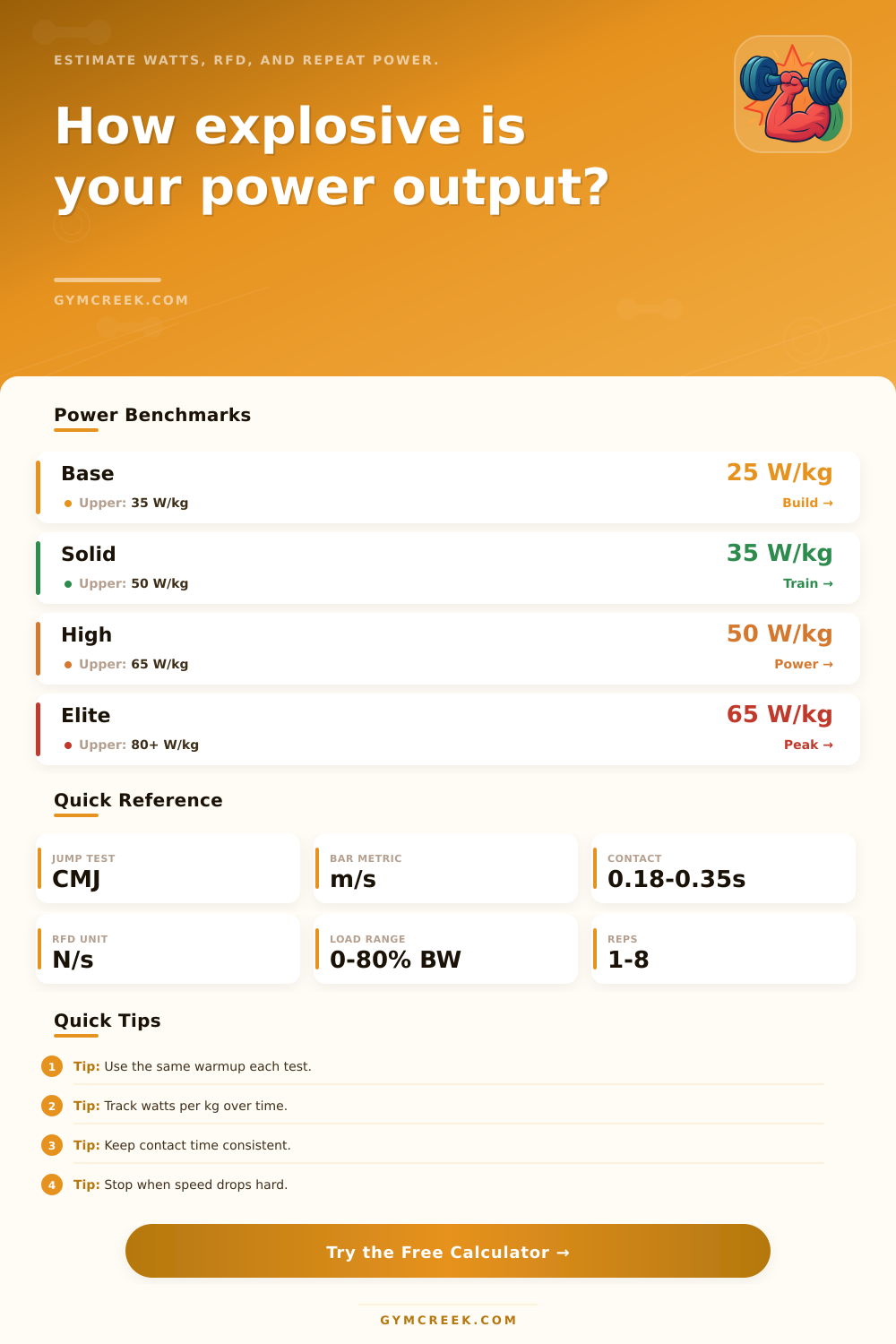
| Relative power | Lower body | Upper body | Training signal |
|---|---|---|---|
| Developing | 25-35 W/kg | 5-8 W/kg | Build force base |
| Solid | 35-50 W/kg | 8-11 W/kg | Progress power |
| High | 50-65 W/kg | 11-14 W/kg | Refine speed |
| Elite | 65+ W/kg | 14+ W/kg | Peak carefully |
| Exercise | Moving mass model | Best input | Use case |
|---|---|---|---|
| CMJ | Body mass | Jump height | Readiness check |
| Loaded jump | Body + load | Both inputs | Power loading |
| Bench throw | Load + upper mass | Bar speed | Upper-body power |
| Clean pull | Load + trunk share | Bar speed | Speed strength |
| Goal | Load cue | Contact target | Primary output |
|---|---|---|---|
| Peak power | Light-moderate | 0.20-0.45 sec | Watts |
| Speed strength | Light | Fast intent | Velocity |
| Fast RFD | Body-light | Shortest clean | N/s proxy |
| Repeat power | Stable | Same rhythm | Drop score |
| Formula | Inputs | Output | When useful |
|---|---|---|---|
| Sayers-style jump | Jump, body mass | Peak watts | Vertical jumps |
| Force x velocity | Mass, speed | Bar watts | Loaded lifts |
| Force / time | Mass, contact | RFD proxy | Start speed |
| Drop adjusted | Reps, fatigue | Repeat score | Power endurance |
💡Tips
From a dead stop, moving quickly and forcefully seem to be explosive. Whether changing directions in a game, driving off the floor in a jump or leaving the blocks in a sprint, you’re gonna need some of it. It is not necessarily speed or strength alone, but rather a combination of both: how much force can you generates in an extremely small window of time? And that time frame is frequentely measured in fractions of a second.
These are the inputs used in the calculator. They are attributes coaches and athletes measure when they want to monitor this quality in athlete. Relative power takes into account their body weight, the same amount of watts will mean more on someone who weighs 70 kilos versus someone who weighs 110 kilos. External load represent whether they are testing the movement with some external resistance. This resistance alters the force-velocity relationship.
How Explosive Power Works
Bar speed and jump height is the main performance signals, since those can be easily captured and both scale with power output. Contact time is important, because it picks up on how quickly someone applies force: that’s the part that distinguishes between just a strong athlete and a powerful one. That’s why there’s repeat power and power drop in the tool.
Lots of sports don’t reward one big effort. They reward the ability to consistantly produce force over multiple effort before fatigue kicks in. Sometimes a small drop across multiple throws or jumps can be a sign of being ready. A steep drop is often a sign that an athlete is either under recovered or trying to push a load that’s too heavy for the desired quality.
The readiness score allow you to flag if the session felt representative or if some external factor like soreness or sleep might be coloring the result. “Outputs allow you to see where your training sits now compared to what’s required for your sport. Short contact time with a high number for relative power shows an athlete who expresses force quickly, important for change of direction and acceleration. Longer contact times with a solid number could show strength not converted to usable speed yet. By referencing the ranges we can put those numbers into context without making each session a comparison to some sort of ‘elite’ data that doesn’t necessarily apply to this person training.”
Using the same warm-up, same surface, and the same exact exercise eliminate variables that are not related to an athlete’s explosive ability. The consistency of the protocol makes the number change relevant instead of noise. And that’s what the presets provide; they’re realistic combinations of velocity, load and contact time that mirror how coaches actualy test versus cramming all athletes through one template.
Strength isn’t static. It’s explosive. It changes based off how your strength work, your speed work, and your recovery interact. The calculator just takes the math out of it, allowing you all to focus the conversation on what these numbers tells us about the upcoming training block rather than how we got there. You should of used it.